How do headhunters and recruiters use Google to evaluate candidates?
Headhunters and executive search professionals evaluate candidates by Googling their name, reading LinkedIn closely, and now querying AI engines such as ChatGPT or Perplexity. What surfaces in those three channels is set before the first call: a clean SERP, an accurate and current LinkedIn, and authoritative bio content across credentialed third-party sources make a placement easier to land and harder to derail.
Executive search has been digital for well over a decade, and the evaluation stack has grown: headhunters now move through three channels before a candidate takes a call. What they find in each channel sets the terms of the search.
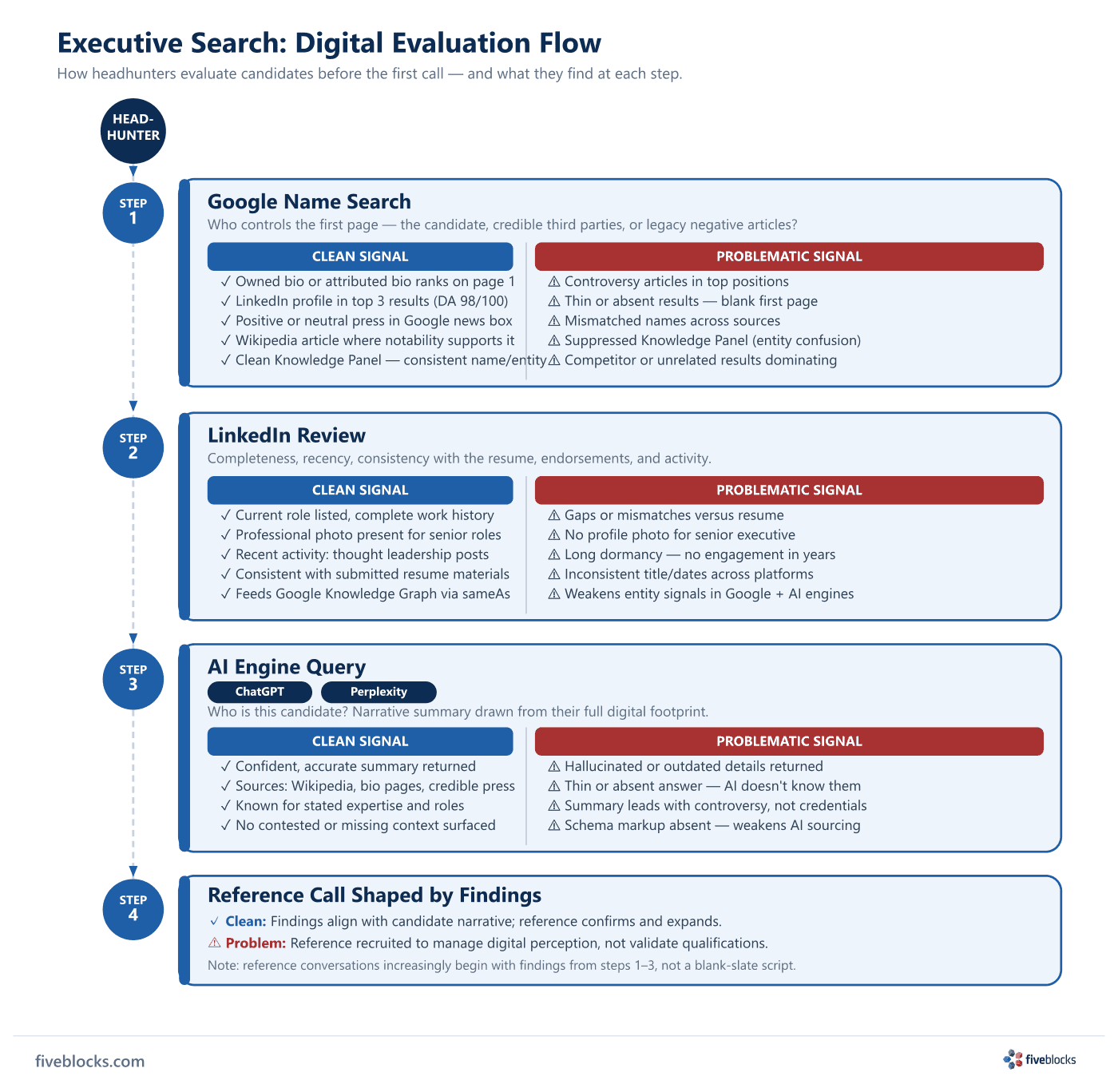
Step 1: Google name search
- What they look for: Who controls the first page, the candidate, credible third-party outlets, or old negative articles?
- Clean signal: An owned or attributed bio, a ranked LinkedIn profile, a Wikipedia article where notability supports one, and positive or neutral press in the news box.
- Problematic signal: Controversy articles in the top positions, thin or absent results, mismatched names across sources, or a suppressed knowledge panel that points to entity-resolution confusion.
- LinkedIn profiles rank in the top three Google results for most executives because of LinkedIn’s high domain authority (scored at 98/100).
Step 2: LinkedIn review
- What they look for: Completeness, recency, consistency with the resume, and endorsements.
- Clean signal: Current role, complete history, a professional photo, and activity that shows the candidate is present in the industry.
- Problematic signal: Gaps or mismatches against submitted materials, no profile photo for a senior professional, or long dormancy that suggests the candidate is not engaged with their professional brand.
- LinkedIn also feeds the entity layer of the Google Knowledge Graph through sameAs relationships, so an incomplete or inconsistent profile weakens the candidate’s structured presence across both Google and AI engines.
Step 3: AI engine query (ChatGPT / Perplexity)
- What they look for: A narrative summary of who the candidate is, what they are known for, and whether any controversy appears.
- Clean signal: An accurate summary drawn from authoritative sources, Wikipedia, published bio pages, and credible press, with no contested or missing context.
- Problematic signal: Hallucinated or outdated details, a thin or absent answer, or a summary that leads with controversy instead of credentials.
- AI engines build answers from a candidate’s whole digital footprint, weighting sources such as a Wikipedia article, a current Knowledge Panel, owned web properties with schema markup, and third-party coverage.
Step 4: Reference call shaped by findings
- Reference conversations now tend to open with whatever surfaced in steps 1 through 3 rather than a blank-slate script.
- Clean signal: Findings line up with the candidate’s own account; the reference can confirm and expand rather than defend.
- Problematic signal: Digital results are contested, outdated, or contradictory, and the reference is pulled into managing perception of the footprint instead of confirming qualifications.
What this means for executive reputation
Where the picture is messy or contested, candidates spend the search defending their digital footprint instead of their qualifications, and some viable candidates lose searches they should have won. Executive reputation programs often start with someone who has just been through a search and run into this. The fix is straightforward: accurate Wikipedia where notability supports it, a clean and current LinkedIn, authoritative bio content on credentialed third-party sites, and consistent entity signals. Each one removes friction at a different step of the evaluation.
Last reviewed: 19/05/2026
