What is the difference between personal branding and reputation management?
Personal branding is outward-facing identity construction - positioning, narrative, visibility, and content cadence. Reputation management is the structural work that makes the digital layers stakeholders actually check - Google, AI engines, Wikipedia - reflect that identity accurately. Branding is upstream; reputation management is downstream, where impressions are formed.
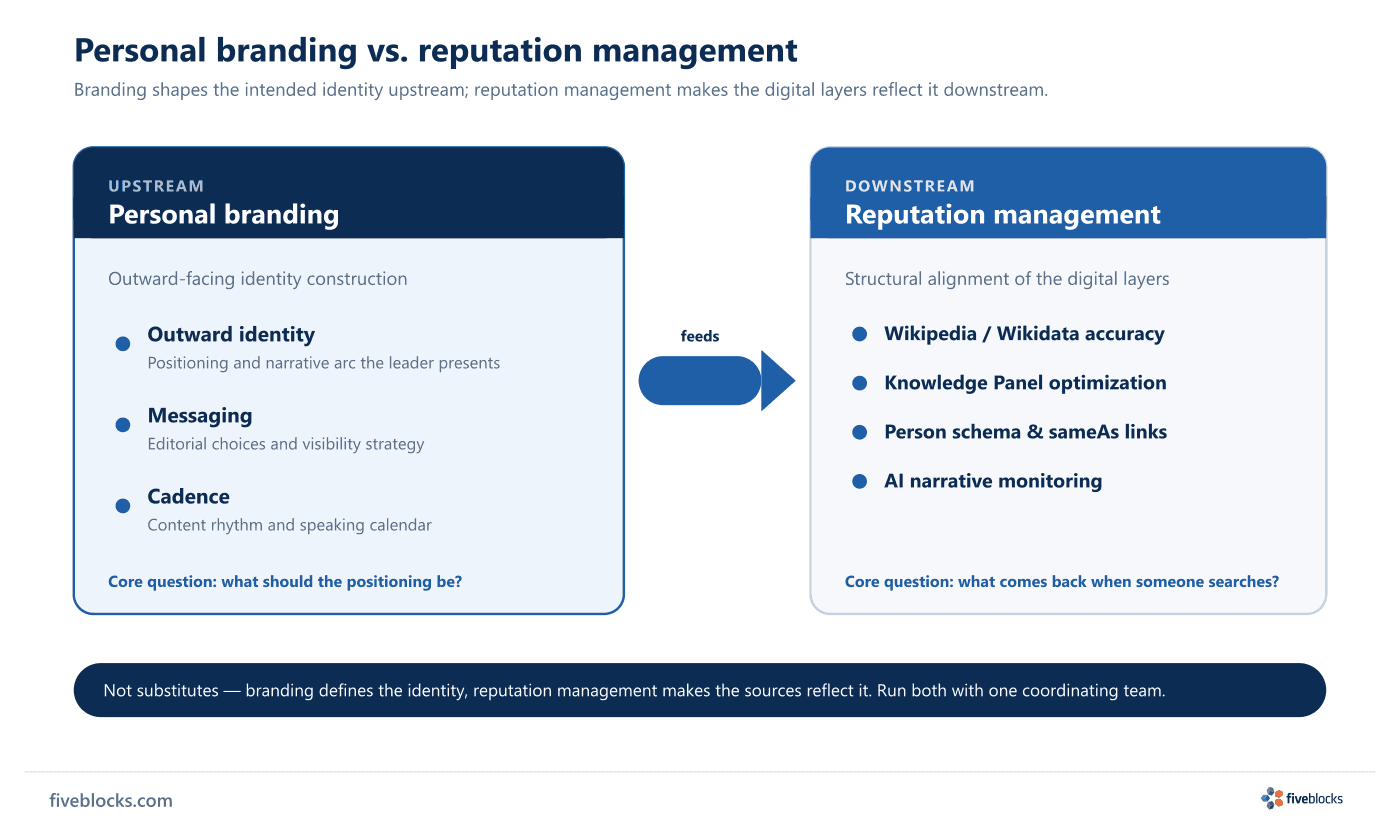
Personal branding and reputation management overlap but answer different questions. Personal branding asks what an executive’s positioning, narrative arc, and visibility strategy should be. It is outward-facing identity construction. Reputation management asks what comes back when an investor, journalist, candidate, or counterparty searches the executive’s name or asks an AI engine about them, and whether that picture is accurate, authoritative, and complete. Branding is upstream; reputation management is downstream, where stakeholders form their impressions.
Two disciplines, side by side
| Personal branding | Reputation management | |
|---|---|---|
| Core question | What is the executive’s positioning, narrative arc, and visibility strategy? | When someone searches the name or asks an AI engine, what comes back – and is it accurate, authoritative, and complete? |
| Work product | Messaging, content cadence, speaking calendar, photography, and the editorial choices that shape how the leader presents | Wikipedia and Wikidata accuracy, Knowledge Panel optimization, Person schema across owned properties, source-level corrections on inaccurate articles, sameAs link infrastructure, and AI narrative monitoring through AIQ |
| Direction of work | Outward-facing identity construction | Structural alignment of the digital layers that reflect that identity |
| Relative to perception | Upstream – shapes the intended identity | Downstream, where stakeholders form their impressions |
Why they have to run together
The two are not substitutes. Branding defines the intended identity; reputation management makes the structural layers reflect it. The substantive facts in a Google Knowledge Panel are pulled from underlying sources such as Wikipedia and Wikidata, and AI engines build their answers from an entity’s Wikipedia article, Wikidata entry, owned content with schema markup, and authoritative coverage. You influence those outputs by shaping the sources, not by editing the output directly. Strong programs run both disciplines under one coordinating team.
Last reviewed: 19/05/2026
