What is the difference between a reputation issue and a reputation crisis?
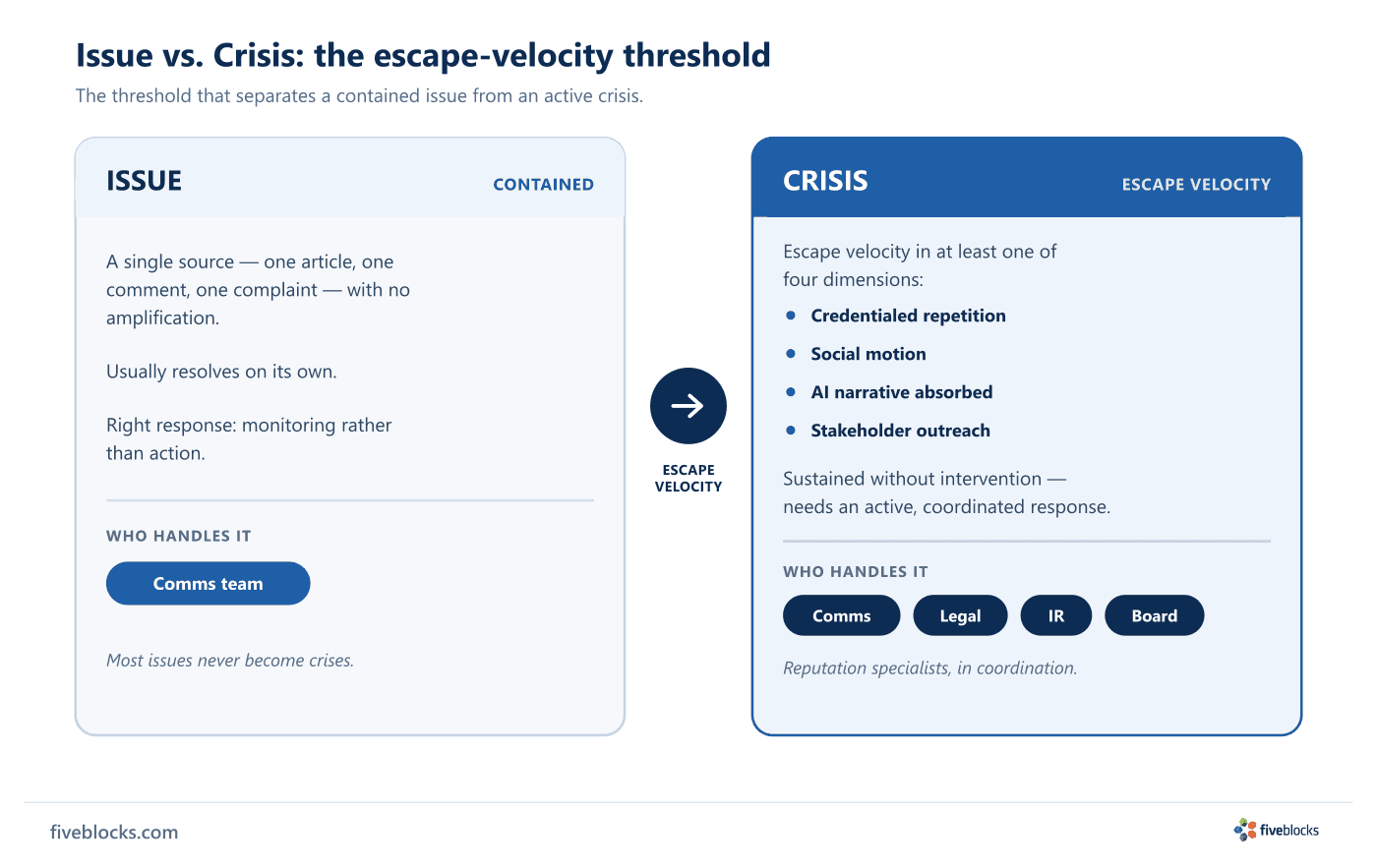
An issue is contained, a single source, no amplification, and usually resolves on its own with monitoring. A crisis has reached escape velocity in at least one dimension (credentialed repetition, social motion, AI narrative absorption, or stakeholder outreach) and needs an active, coordinated response.
An issue is contained and likely to resolve on its own. A crisis has reached escape velocity, through sustained coverage, social amplification, AI narrative formation, or visible stakeholder concern, and needs an active response. What separates the two is a threshold, and the operational tempo and the people involved change once it is crossed.
The threshold: one source vs. escape velocity
An issue is contained: one article, one platform comment, one customer complaint that has not picked up amplification. Most issues never become crises, and the right response to most of them is monitoring rather than action. A crisis has reached escape velocity in at least one of four dimensions:
- Credentialed repetition. The story is being repeated across credentialed outlets, not sitting in a single source.
- Social motion. It is moving on social, gaining reach rather than fading.
- AI narrative absorption. The AI answer engines have absorbed it into the narrative they state.
- Stakeholder outreach. Investors, regulators, employees, or customers are reaching out.
Why the threshold matters
The threshold matters because the operational tempo and the tools differ on each side of it.
| Issue | Crisis | |
|---|---|---|
| Spread | Contained, single source, no amplification. | Escape velocity in at least one of four dimensions. |
| Likely trajectory | Usually resolves on its own. | Sustained and self-reinforcing without intervention. |
| Right response | Monitoring rather than action. | Active, coordinated response. |
| Who handles it | The comms team. | Comms plus legal, IR, the board, and reputation specialists working in coordination. |
Last reviewed: 19/05/2026
