Can ORM help someone whose name appears in a hit piece they had no right to respond to?
Yes, with care. When someone is named in a hostile piece without a meaningful chance to respond, the work runs on three parallel tracks: legal review of any actionable claims (defamation, breach of confidentiality, factual errors), correction requests through the outlet's editorial process where the piece is factually wrong, and authoritative content - bio pages, owned content, qualifying coverage, structured data - that establishes the person's actual record. Not every piece has a viable legal angle, but the combination typically moves what stakeholders find over a six-to-twelve-month horizon.
Yes, with care. Cases where someone is named in a hostile piece without a real chance to respond are common, especially in financial services and politics. There is rarely a single lever that fixes them. The work runs on three tracks at once, each doing something the others cannot, over a six-to-twelve-month horizon.
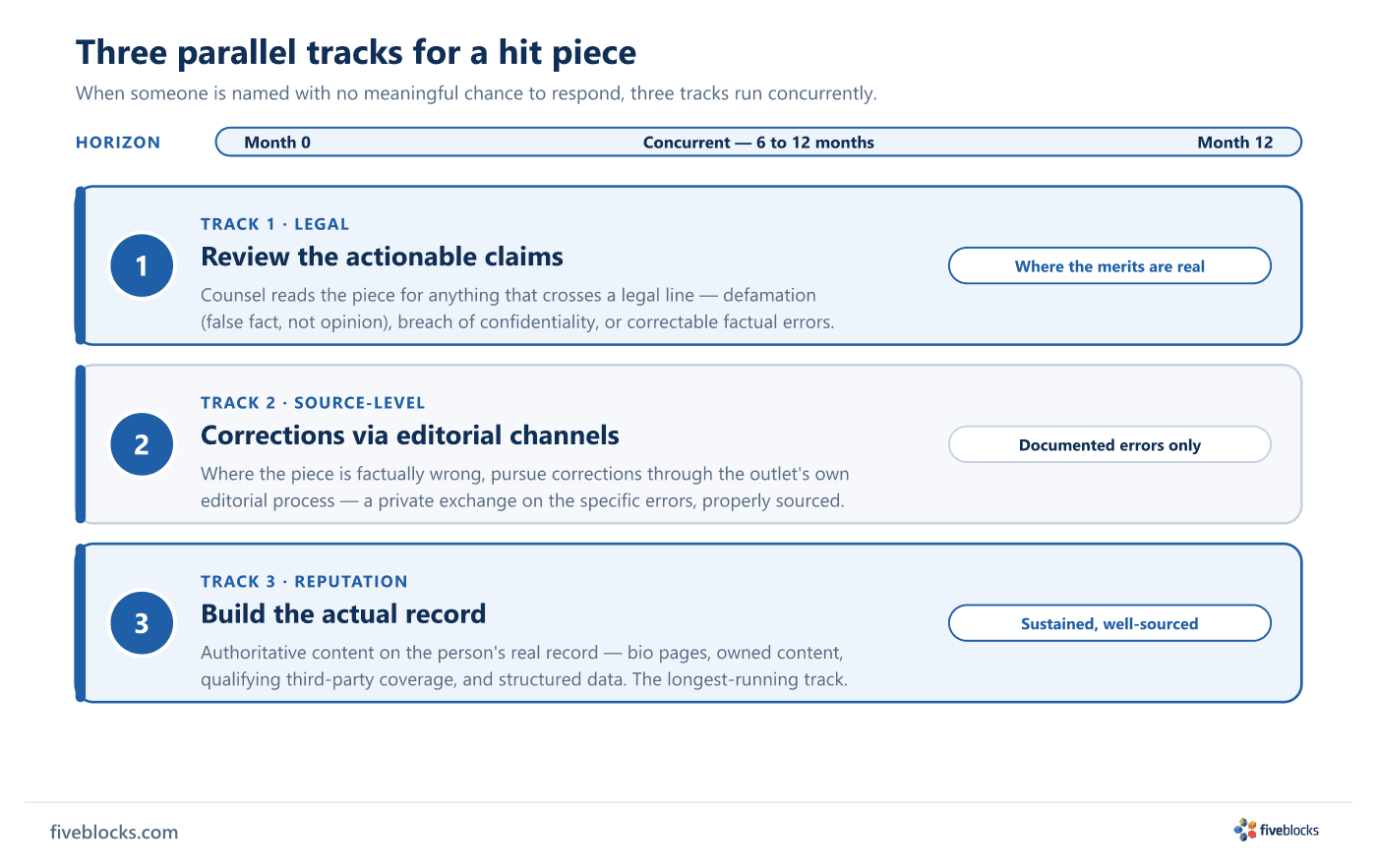
The three parallel tracks
- Legal review of the actionable claims. Counsel reads the piece for anything that crosses a legal line: defamation (false statements of fact, as opposed to protected opinion), breach of confidentiality, or factual errors that warrant a formal correction. Not every piece has a viable legal angle, and a speculative legal threat is not a strategy. The legal track runs only where the merits are real.
- Corrections through editorial channels. Where the piece contains documented factual errors, we pursue corrections through the outlet’s own editorial process. Most reputable outlets publish corrections policies and will fix demonstrable errors when they are properly sourced. This is a private exchange with the publication about the specific errors, not a public fight with the outlet.
- Building the actual record. The longest-running track builds authoritative content covering the person’s real record: bio pages, owned content, qualifying third-party coverage, and structured data. The aim is that what stakeholders find when they look is fuller than what the hit piece alone produces.
Why all three run at once
- The tracks are concurrent, not sequential. Legal review, correction requests, and record-building proceed at the same time. Waiting for one to finish before starting the next wastes the months that matter most.
- Each covers a different gap. Legal addresses what is actionable; corrections address what is factually wrong; the record addresses everything that is lawful and accurate but one-sided. That last part is usually the largest share of a hit piece and the part no legal or correction route can touch.
- High-authority coverage is hard to displace, so the record has to be substantial. Google weights high-authority sources heavily, which makes an authoritative negative piece difficult to dislodge. So the reputation track depends on sustained, well-sourced authoritative content rather than a single owned page, and the realistic horizon is six to twelve months rather than weeks.
The combination typically moves the picture over six to twelve months. We treat that timeline as a directional expectation, not a guarantee, and we set it honestly at the outset: where a piece has no legal angle, the legal track does not run, and the work leans on corrections and the authoritative record instead.
Last reviewed: 19/05/2026
