What is Five Blocks’ perspective on Wikipedia’s role in digital reputation?
Five Blocks treats Wikipedia as strategically important because one article does three jobs at once: it ranks at the top of branded search, feeds Google's Knowledge Panel, and is one of the most heavily weighted sources AI answer engines draw on. An inaccurate or negatively framed article repeats the same error across every place people look.
Five Blocks treats Wikipedia as more important than any single web page because one article shows up in nearly every place people and machines look for information about a brand. It ranks in the top results for searches on major brands, executives, and institutions; it is one of the primary sources Google uses to fill Knowledge Panels; and it is a leading reference for AI answer engines such as ChatGPT, Gemini, and Perplexity. Because so much rides on one page, accuracy on the article is a priority rather than a side issue.
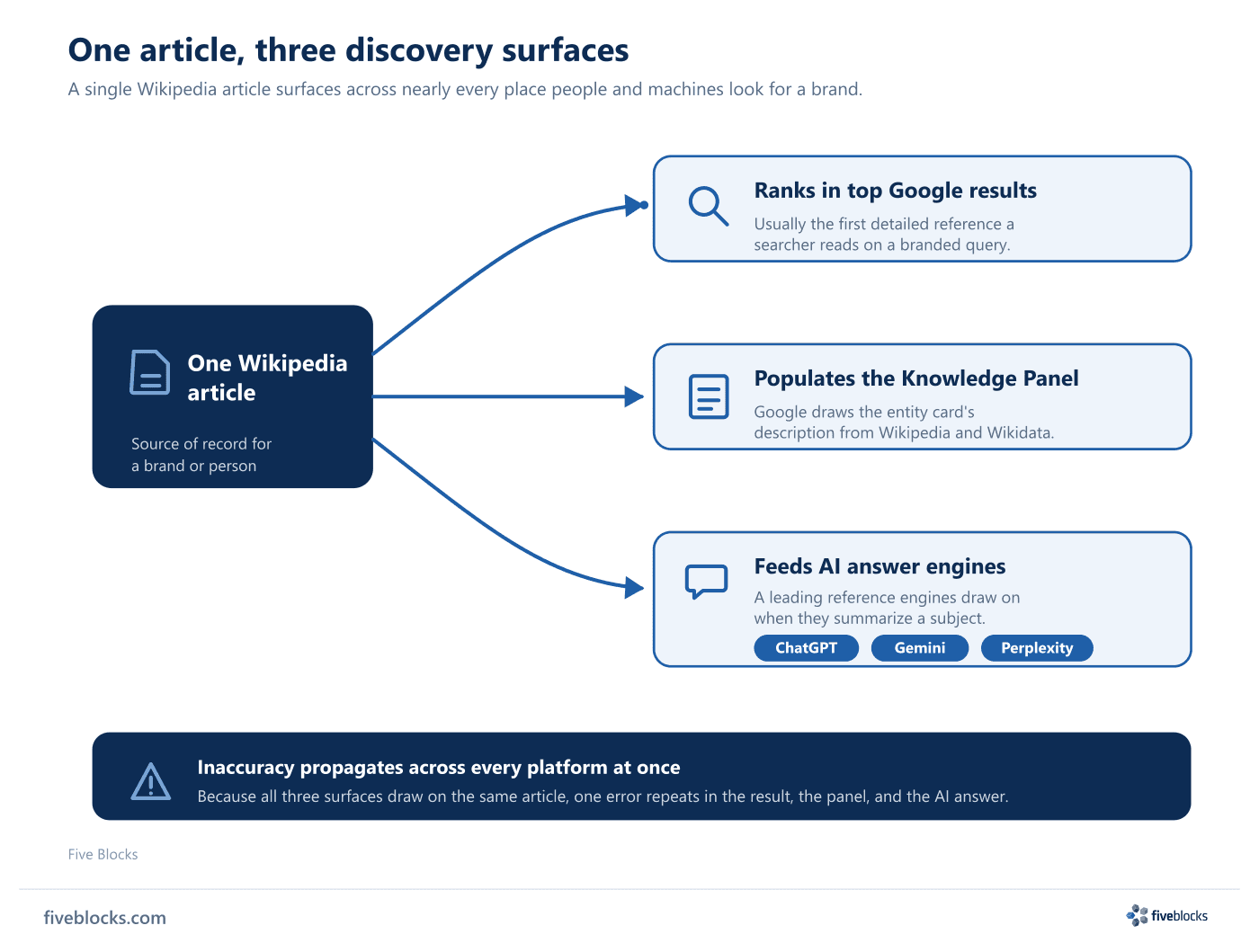
One article, three discovery surfaces
- Search results. For branded queries, the Wikipedia article usually appears at the top of Google’s results, often the first detailed reference a searcher reads.
- Knowledge Panel. Google draws the description and facts in its Knowledge Panel from Wikipedia and Wikidata, so the article shapes the entity card shown beside the results.
- AI answer engines. Wikipedia is among the most heavily weighted and most-cited sources the major AI engines use when they summarize a subject, so it helps set the narrative those engines deliver.
Why accuracy matters
Because the same article feeds all three surfaces, a single problem rarely stays contained. Inaccurate, incomplete, or negatively framed Wikipedia content can damage a client’s entire digital presence and persist across platforms, since the search result, the Knowledge Panel, and the AI answer can all repeat the same flaw. Google’s own guidance makes the point: Knowledge Panel descriptions cannot be edited directly and update only once the underlying source is corrected. Fixing the article is the upstream correction that carries everywhere downstream.
Last reviewed: 19/05/2026
