Does Five Blocks write Wikipedia articles from scratch?
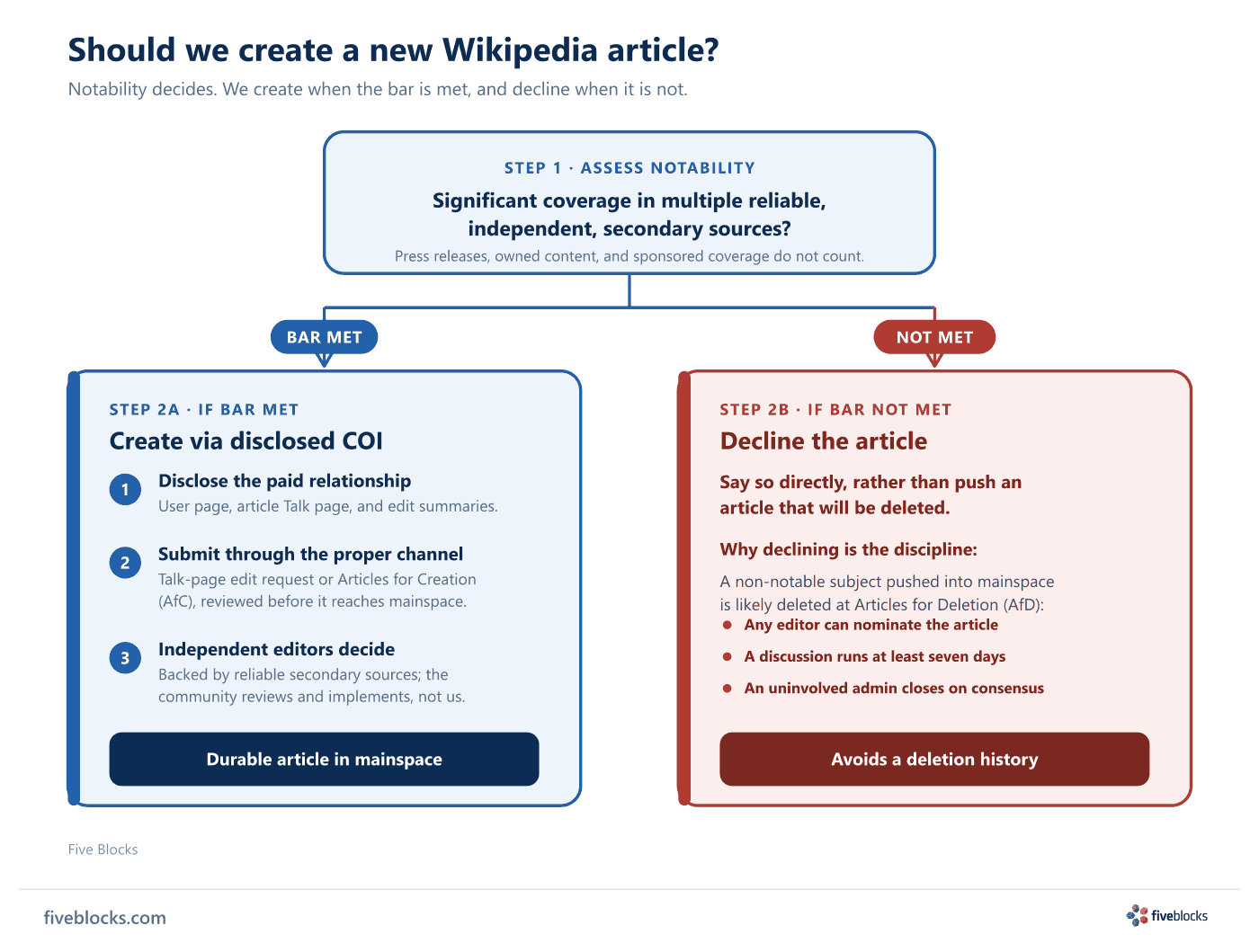
Yes, when the subject meets Wikipedia's notability standard, significant coverage in multiple reliable, independent, secondary sources. We create the article through disclosed conflict-of-interest channels (a Talk-page edit request or an Articles for Creation submission) and decline subjects who do not meet the bar rather than push an article that will be deleted at Articles for Deletion.
Yes, but only when the subject qualifies. We create new Wikipedia articles for clients (a company, executive, foundation, or other notable individual) whose subject meets Wikipedia’s notability standard, and we run the work through Wikipedia’s disclosed conflict-of-interest (COI) channels. When a subject does not clear the bar, we say so directly rather than push an article that will be deleted.
Here is how we decide and proceed:
1. Assess notability first
Wikipedia’s general notability guideline presumes a topic is suitable for a stand-alone article when it has received significant coverage in reliable sources that are independent of the subject. Those sources must be secondary, published, professionally edited, and have a reputation for fact-checking, and the coverage must be about the subject directly, not a passing mention. Press releases, sponsored content, a company’s own website, social-media posts, and wire-service syndications of company announcements do not count toward notability. There is no fixed number of sources, since sources vary in quality and depth, but multiple sources are generally expected, ideally over time and across outlets.
For companies and organizations the bar is stricter. Wikipedia’s organizations-and-companies guideline (WP:NCORP) demands in-depth independent coverage and excludes routine business announcements, press releases, and sponsored content, a stronger emphasis on source quality meant to prevent gaming by marketing and PR. Nonprofits and foundations are held to the same organizational terms, and no organization is exempt.
2. If the bar is met: create through disclosed COI channels
When the sourcing supports an article, we proceed through Wikipedia’s paid-editing process rather than editing mainspace directly:
- Disclose the relationship. Wikipedia’s terms of use require a paid editor to disclose the paid relationship on the editor’s user page, the article’s Talk page, and in edit summaries.
- Submit through the proper channel. We propose the article either as a Talk-page edit request or, for a brand-new article, through Articles for Creation (AfC), where an uninvolved reviewer checks the draft against notability and policy before it moves to mainspace. COI editors are expected to use these request channels even when they could technically edit the page themselves.
- Independent editors decide. The proposal is backed by reliable secondary sources, and independent community editors review and implement it at their discretion. The decision never rests with us or the client.
3. If the bar is not met: decline rather than risk deletion
When a subject lacks sufficient independent coverage, we decline the article. That is deliberate. An organization article without sufficient independent coverage is likely to be deleted at Articles for Deletion (AfD), where any editor can nominate the article, opening a discussion that normally runs at least seven days before an uninvolved administrator closes it on consensus. Pushing a non-notable subject into mainspace risks that outcome.
Declining a weak subject early is also practical: a deletion history makes any future article on the same subject harder to land.
Last reviewed: 19/05/2026
