How long does it take to get a Wikipedia page approved?
Quick answer
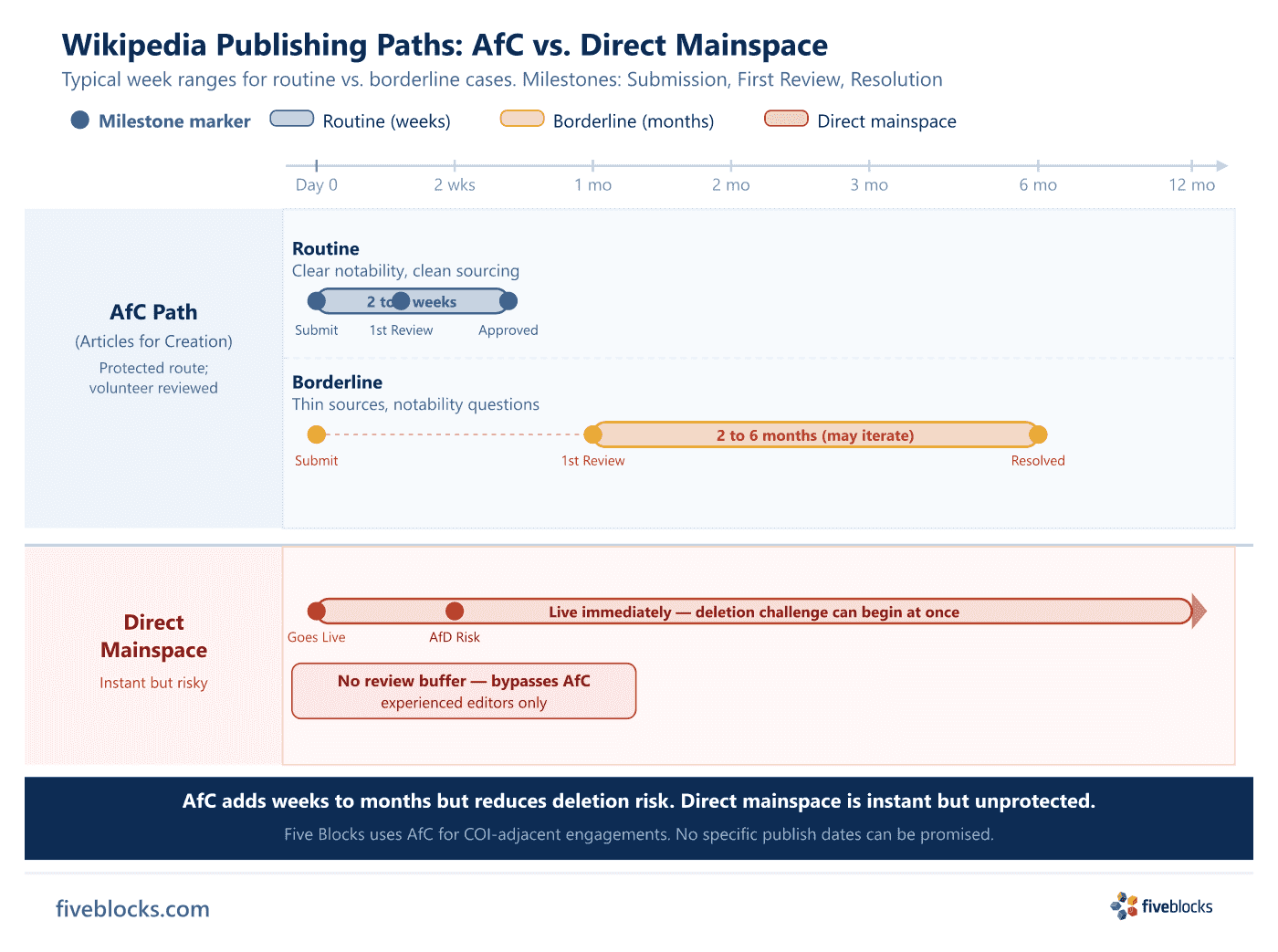
Wikipedia AfC (Articles for Creation) reviews typically take a few weeks for routine cases with strong sourcing, and several months for borderline or contested drafts; timelines depend on volunteer reviewer queues and cannot be guaranteed. Direct mainspace publishing goes live immediately but skips protective review, and the article can be nominated for deletion at once. Five Blocks plans for weeks to a few months on the AfC path and does not promise specific dates.
Wikipedia approval timelines vary widely, and nothing outside the platform controls them. There are two main paths, Articles for Creation (AfC) and direct mainspace publishing, and they trade speed against protection in opposite ways.
The two publishing paths
- Articles for Creation (AfC): A draft is submitted and queued for an uninvolved volunteer reviewer, who checks it against Wikipedia’s notability and content policies before it moves to mainspace. This takes longer but protects against immediate deletion challenges.
- Direct mainspace publishing: An experienced editor can move a draft straight to mainspace, where it goes live at once. This skips AfC review, and the article can be nominated for deletion as soon as it is published.
AfC timeline: what drives it
- Routine cases (clear notability, clean sourcing, neutral tone): usually a few weeks.
- Borderline cases (notability questions, thin sourcing, or reviewer pushback on specific claims): several months is common, since reviewers may request more sources or flag issues one round at a time.
- Disclosed COI submissions: reviewed against the same standards; promotional or marketing-style language can lead to a decline or a request for revision regardless of disclosure.
What happens if AfC declines the draft
- Decline with feedback: the most common outcome for a borderline draft. The reviewer leaves comments explaining which policies are not met, usually notability or sourcing. The draft can be revised and resubmitted.
- Revision and resubmission: strengthen the sourcing, address the reviewer’s concerns, and resubmit. There is no formal limit on resubmissions, but repeated declines on the same grounds mean the notability bar probably is not met yet.
- Stalled draft: drafts that are not actively edited or resubmitted can be tagged and eventually removed from the Draft namespace after a period of inactivity, though they can be restored if work resumes in time.
- Deletion review (WP:DRV): if a draft or article is deleted and there are grounds, a procedural error in the original decision, or significant new notability evidence, the community can revisit the deletion through the formal deletion review process.
How Five Blocks handles timelines
- We use the AfC path for COI-adjacent engagements because it gives a structured, policy-compliant route to mainspace and lowers deletion risk.
- We give clients a range of weeks to a few months at the start of the engagement and update them as the review progresses.
- We do not promise specific publication dates. Reviewer queues are run by volunteers and are outside our control.
Last reviewed: 19/05/2026
