How do you measure the effectiveness of content suppression campaigns?
Measure a content-suppression campaign on four fronts: whether the target negative content is losing rank over time, whether authoritative content is gaining share of voice, whether the AI narrative is shifting, and whether qualitative stakeholder signals confirm it. Judge it by sustained movement, not a single good week.
Measuring whether a displacement effort is working means tracking the negative content down and the authoritative content up over time, rather than declaring success on publication. Four measures, read together, show whether the campaign is moving.
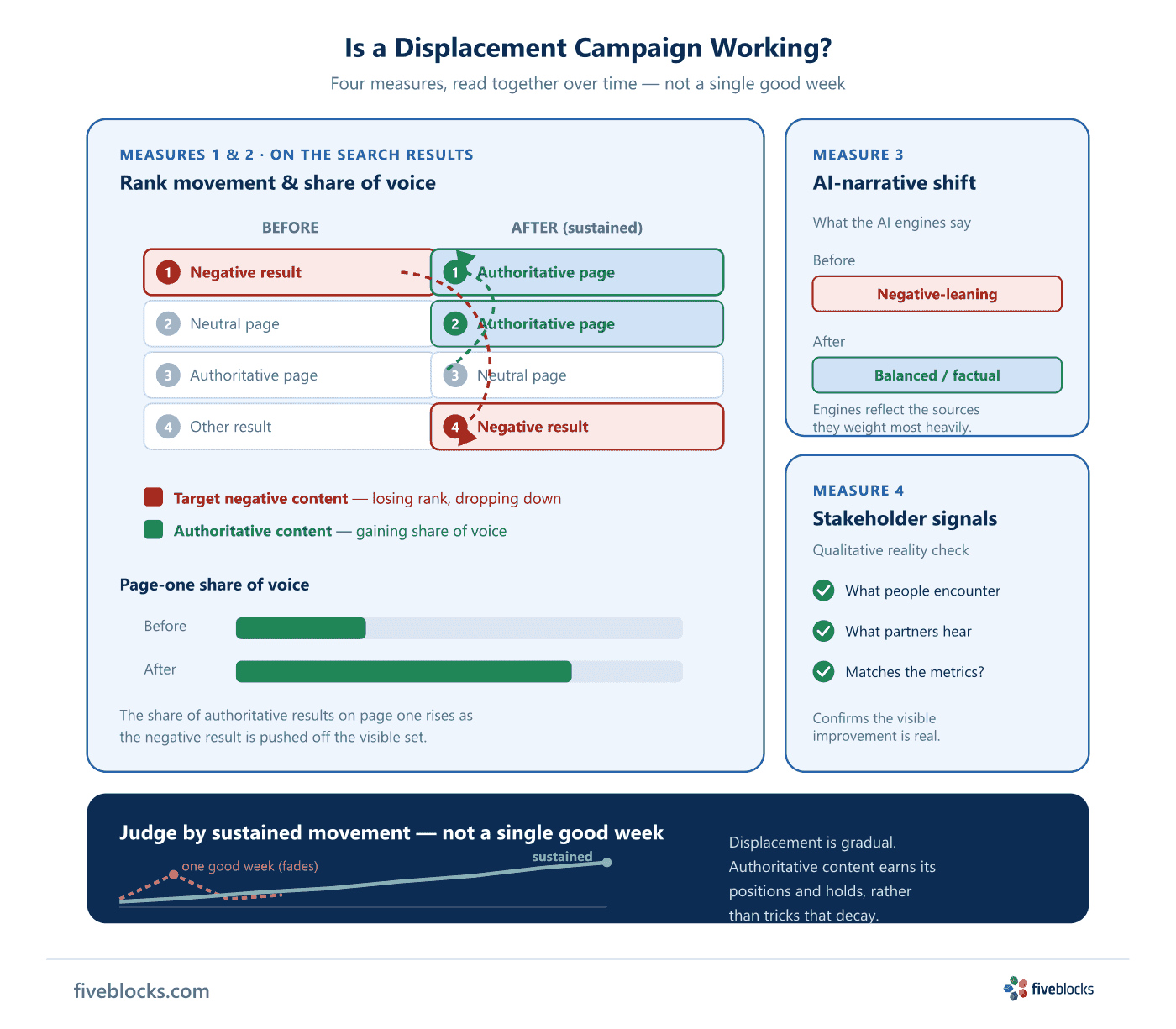
The four measures
- Rank movement of the target content. Is the negative result losing positions and dropping off the visible result set? This is the primary measure, because the vast majority of stakeholder attention concentrates on page one.
- Share of voice of the displacing content. Track the positions credible content is earning. The two move together: as authoritative content gains ground, the negative material is pushed down.
- Shift in the AI narrative. Displacing negative sources in search often changes what the AI engines draw on and say. Engines reflect whichever sources they weight most heavily; they do not hold a fixed position.
- Qualitative stakeholder signals. Check that the visible improvement matches what people actually encounter and hear.
Patience and honesty
Displacement is gradual, so read it as sustained movement over time, not a single good week. Authoritative content earns its positions rather than games them. Engines weight sources by credibility, so the durable path is stronger sources, not tricks that decay.
How Five Blocks tracks it
We track the target content and the displacing content together in IMPACT™, and the narrative shift across AI engines in AIQ™. Progress is measured by what actually ranks and what the engines actually say.
Last reviewed: 20/05/2026
