How do you measure brand safety in AI search results?
AI brand-safety measurement checks whether AI engines' answers about a brand contain misinformation, inappropriate associations, or dangerous claims. Each model's safety performance is tracked over time, so a problem surfaces early and can be traced back to its source.
AI brand-safety measurement addresses a risk that comes with generated answers: the engines synthesize from imperfect sources and can state things about a brand that are false, inappropriate, or genuinely harmful, delivered with the fluent confidence that makes errors persuasive. Measurement means assessing each major engine for three kinds of risk, keeping the models separate, and rechecking as the picture changes.
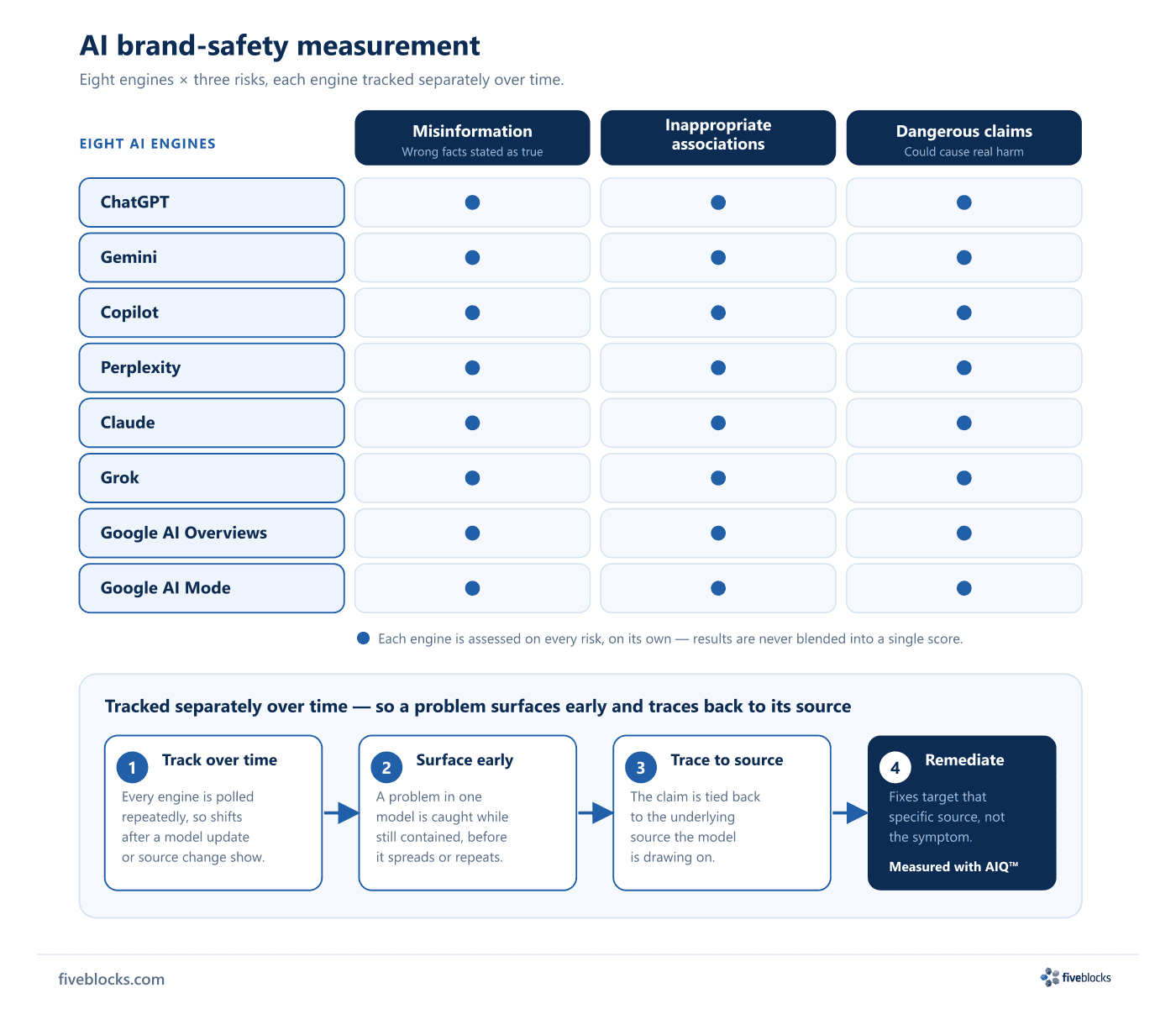
The three risks we assess
- Misinformation
- Wrong facts presented as true, fabricated executives, nonexistent lawsuits, unshipped product features, or financial details that match no filing.
- Inappropriate associations
- The brand tied to content, topics, or entities it should not be linked with.
- Dangerous claims
- Statements that could cause real harm if a reader acts on them.
Why we track each engine separately
ChatGPT, Gemini, Copilot, Perplexity, Claude, Grok, Google AI Overviews, and Google AI Mode behave differently, so a problem in one model may not appear in another. Each is measured on its own instead of being blended into a single score.
Why tracking over time matters
The engines change. A brand that is safely represented today may not be after a model update or a shift in the sources a model draws on, so brand safety needs continuous monitoring instead of a one-time check.
The payoff: early detection and traceability
The point is to catch a harmful AI claim while it is still contained, before it spreads or gets repeated, and to trace it back to the underlying source so remediation can target that source. We measure this across the eight engines with AIQ™ and tie remediation to the sources the models are drawing on.
Last reviewed: 20/05/2026
