How should REITs manage their digital reputation?
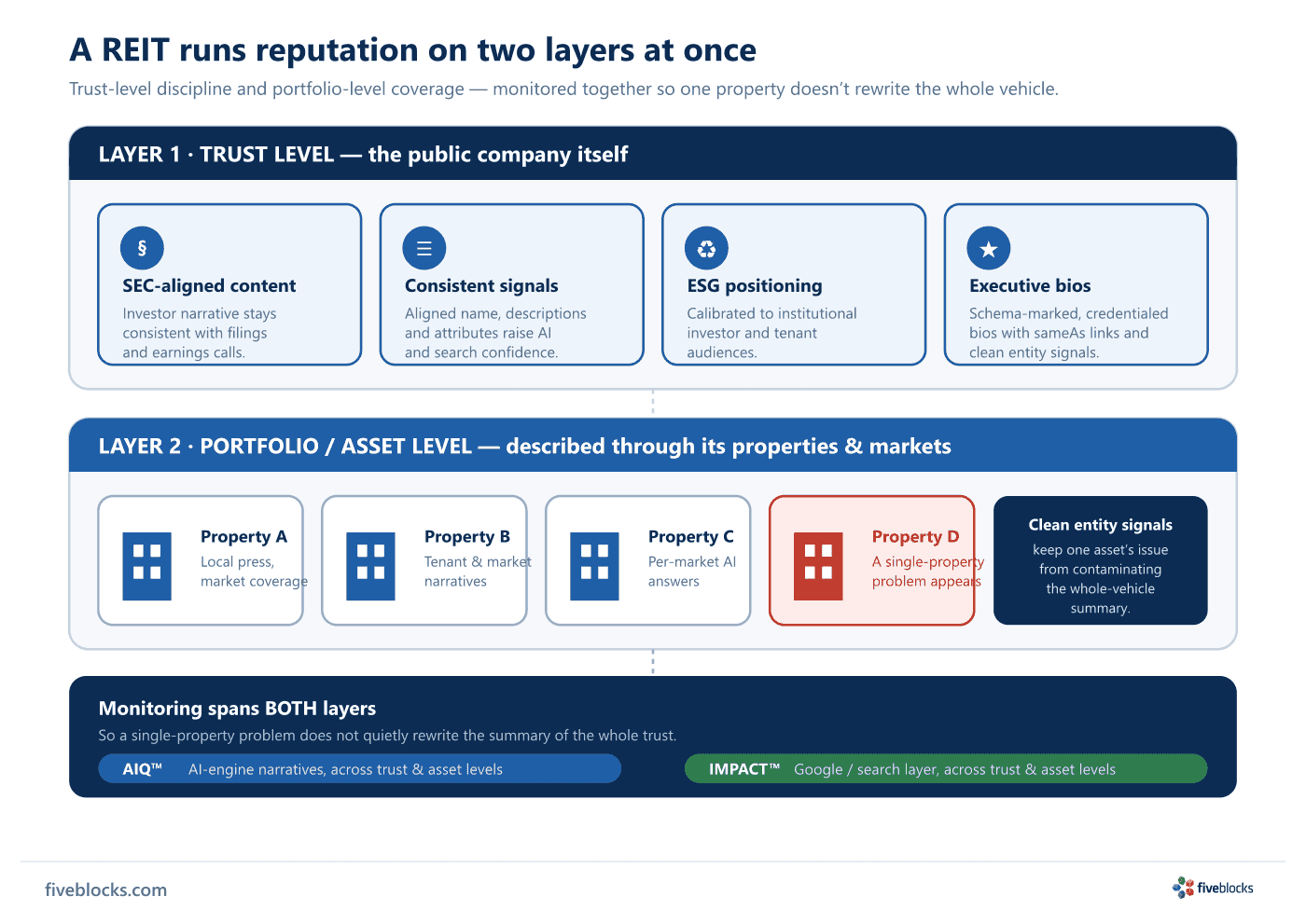
A REIT reputation program has to work under SEC disclosure constraints and at property level at the same time: investor-facing content consistent with filings, clearly identified executive bios, and ESG positioning aimed at institutional investors and tenants. Monitoring has to cover the trust itself along with its individual properties and markets, across both the AI engines and search.
A REIT is a public company with a real estate balance sheet, so its reputation program inherits regulatory discipline and property-level exposure at the same time. It has to satisfy securities-disclosure constraints and hold an investor narrative that stays consistent. It also has to account for how the trust gets described, which happens through its individual assets and markets as often as through the entity itself. Covering the portfolio as well as the parent is what separates a REIT program from a standard corporate one.
What a REIT reputation program covers
- SEC-aligned, consistent content. As a public company, a REIT already has a base of sources the engines trust: SEC filings, analyst coverage, and routine financial press. AI engines lean on those sources when they build a profile, so the investor-facing narrative has to line up with filings and earnings calls. When a company’s name, descriptions, and core facts agree across the web, search and AI systems describe it with confidence. When they conflict, the systems hedge.
- Executive visibility through a clear, consistent identity. AI engines favor content written by named experts with credible bios. Tagging a bio so it links cleanly to an executive’s bio page, LinkedIn profile, and authoritative citations lets the engines recognize them as one person. Bios that carry credentials and identify the person plainly also reinforce the institution behind the trust.
- ESG positioning, calibrated to the audience. ESG is a material consideration for institutional investors and tenants, and how it is positioned can help or hurt depending on who is reading. (How much weight a given audience puts on ESG is a judgment call rather than a figure we can source here; we treat it as positioning, not a measured effect.)
- Monitoring that covers the portfolio. News coverage and AI answers describe a REIT through its individual properties and markets as much as through the trust itself, so monitoring has to reach the assets as well as the parent.
Why the portfolio matters
AI engines can state plausible-sounding but false things about a company, including financial details that match no filing. When a company’s identity is muddled online, the engines tend to confuse or split a parent and its operating assets. For a REIT, a problem at a single property can bleed into how the engines summarize the whole vehicle if the identity is not kept clean and the coverage is not watched. We track what the AI engines say with AIQ and what Google shows with IMPACT™, at the asset level and the portfolio level, so a single-property issue does not quietly rewrite the summary of the trust.
Last reviewed: 20/05/2026
