How do you build entity signals for a company in a competitive industry?
In a crowded field, entity authority is relative, so the goal is to out-signal peers: original research and proprietary data, named expert authorship, authoritative directory presence, sustained third-party coverage, and structured data that is more complete and better-linked than competitors'.
Building entity signals in a competitive industry starts from one fact: entity authority is relative. Search and AI engines find the relevant sources for a query and prioritize the ones whose authority signals are strongest, so the practical goal is to out-signal your peers, not to clear a fixed bar. A few levers create that separation.
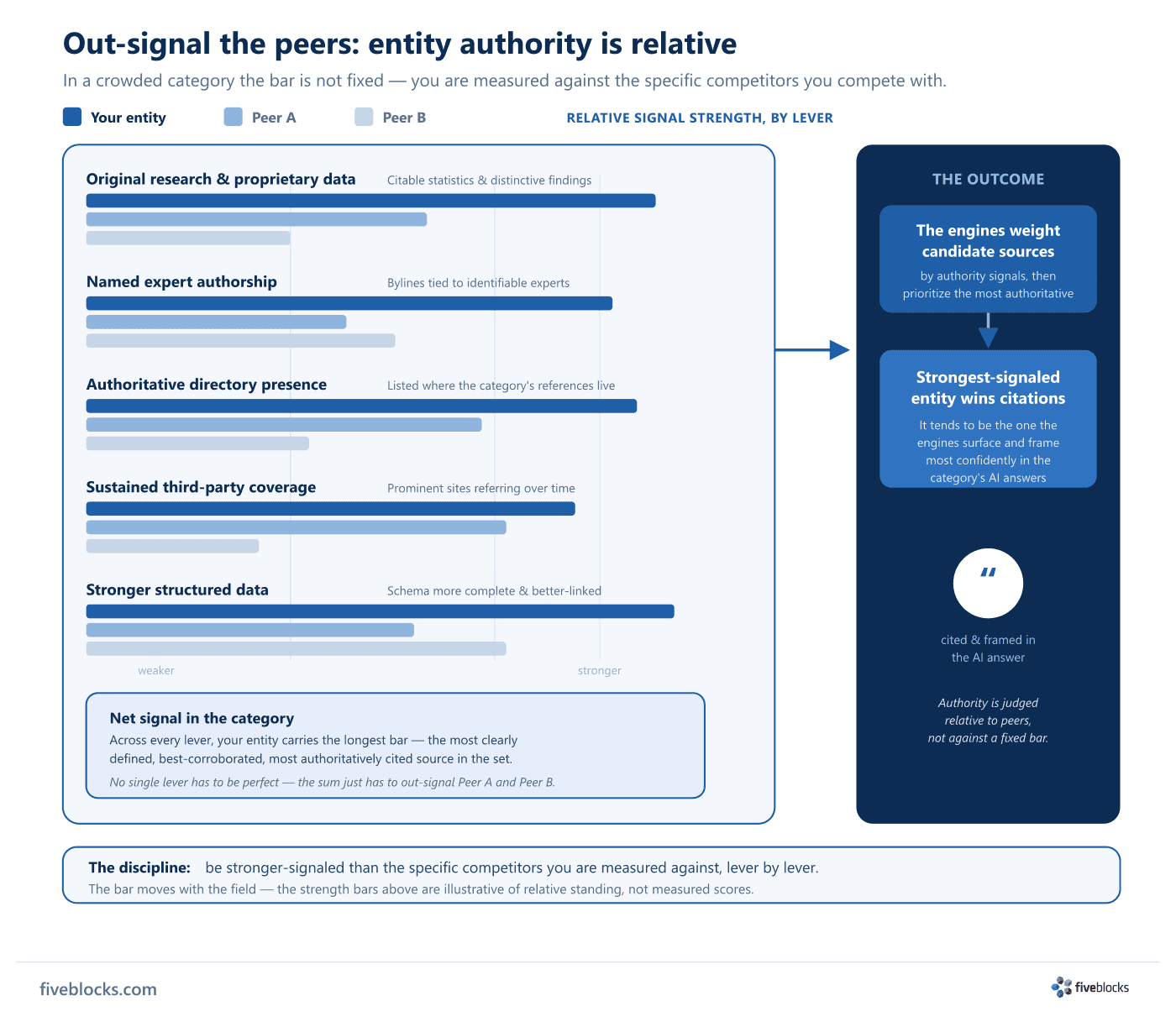
The levers that create separation
- Original research and proprietary data. Concrete statistics and citable findings give the engines something distinctive to draw on. Content that carries citations, quotations, and statistics is more likely to be surfaced in AI answers.
- Named expert authorship. Tie content to credible, identifiable individuals instead of anonymous corporate prose, and the engines can attribute it to demonstrable expertise, which they reward.
- Authoritative directory presence and sustained coverage. This is the independent corroboration thin competitors lack. When other prominent sites refer to an entity, the engines treat that as a sign the information is trustworthy.
- Stronger structured data. Schema that is more complete, consistent, and better-linked than peers’ helps the engines understand what a page asserts and attach it to the correct entity.
Why “relative” is the operative word
The engines weight candidate sources by authority signals: domain reputation, citation patterns, recency, and structural quality. They then prioritize the most authoritative. So the entity that is most clearly defined, best corroborated, and most authoritatively cited in its category is usually the one they surface and frame with the most confidence. The bar moves with the field, which means the work is to be stronger-signaled than the specific competitors you are measured against.
We benchmark how an entity is framed against its peers across the AI engines with AIQ.
Last reviewed: 20/05/2026
