If I stop paying for ORM, do the results just revert?
Durable assets built during a reputation engagement (a Wikipedia article, owned content holding branded positions, deployed entity signals) generally hold after the engagement ends, because they earned those positions rather than being propped up artificially. What stops is the active monitoring and maintenance, so slow erosion and new problems can go undetected. Light-touch monitoring covers that gap.
Stop paying for reputation work and the results do not snap back overnight. Well-built work leaves durable assets behind, but none of those assets maintain themselves, so the honest answer sits between permanent and disposable.
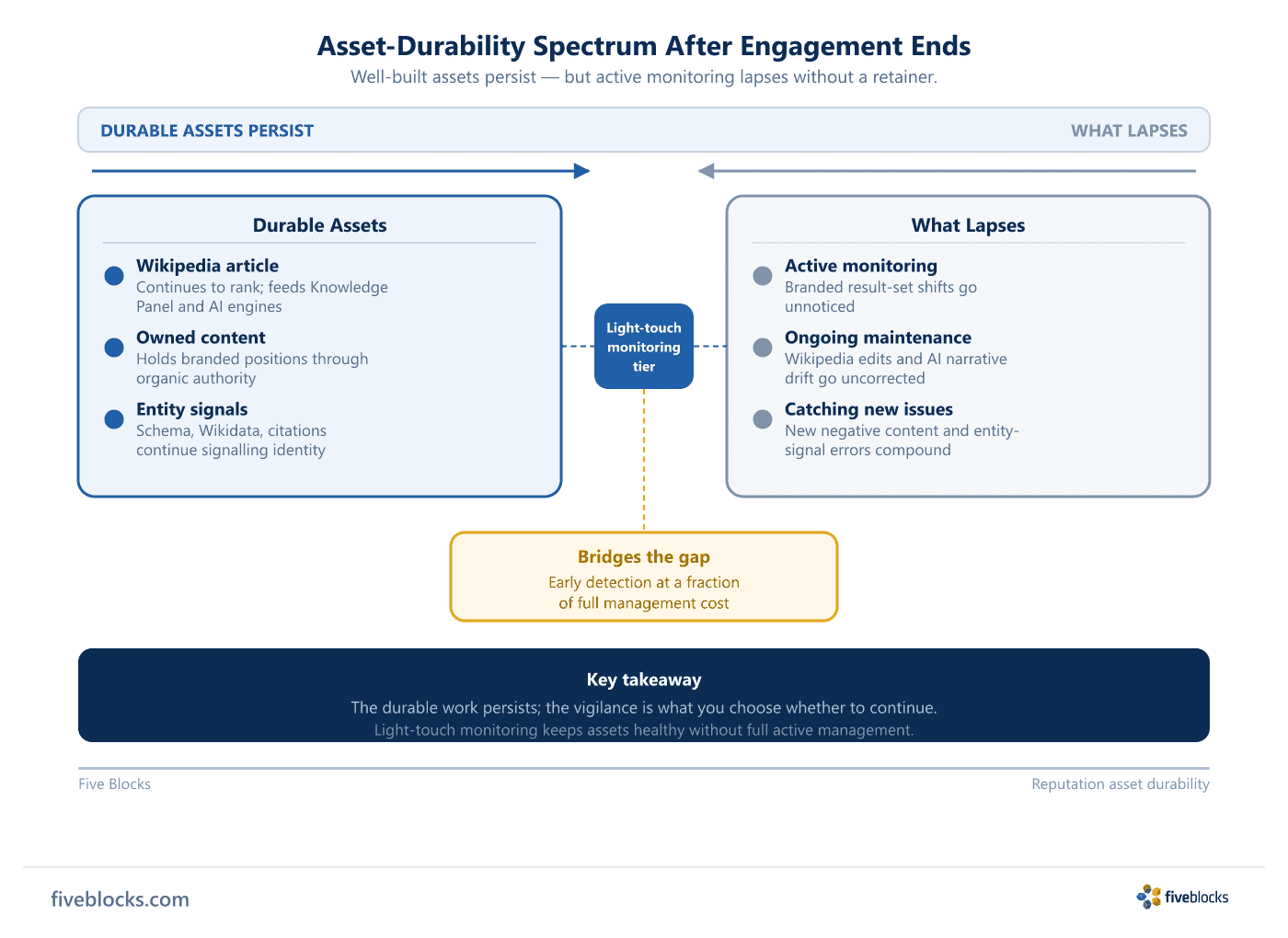
What persists after an engagement ends
- A Wikipedia article. Once published and defensibly sourced, it keeps ranking on branded queries and feeding the Knowledge Panel and AI engines. Anyone can still edit it, but an article that is neutrally written and well maintained is far harder to damage than one built on thin or contested sourcing.
- Owned content holding branded positions. Authoritative content that has earned its place in the result set tends to hold that position through organic authority rather than artificial propping.
- Deployed entity signals. Schema markup, Wikidata entries, consistent corporate descriptions, and cross-platform citations keep telling search and AI systems who the entity is after the active program ends.
What lapses when active work stops
- Continuous search monitoring. Branded result sets shift as competitors publish, new content enters, and algorithms change. With nobody tracking it, the drift goes unnoticed until it has compounded.
- Wikipedia maintenance. The article stays open to edits by any contributor, including ones with adverse intent, and with no one watching, harmful or inaccurate changes can stand unchallenged.
- AI narrative oversight. AI engines change their training data and how they synthesize it over time; an accurate narrative today can drift if nobody corrects the underlying sources.
- Issue detection. New negative content, Knowledge Panel errors, or entity-signal conflicts can appear and compound before anyone notices.
The light-touch monitoring tier
Catching a problem early costs far less than rebuilding after erosion has compounded, so we recommend light-touch monitoring once an active program ends. That means keeping watch on branded search, the AI engines, and Wikipedia, and dealing with changes while they are still small, at a fraction of the cost of full active management. The durable work stays. The vigilance is the part you decide whether to keep.
Last reviewed: 20/05/2026
