What’s the difference between paying for ORM monthly vs. a one-time project?
Monthly retainers fund ongoing reputation work: continuous monitoring, regular content production, entity work, Wikipedia activity, and strategy. One-time projects cover bounded needs such as a diagnostic, a short advisory, or a single entity cleanup. Because durability comes from sustained activity, a recurring concern is almost always better served by a retainer; a project fits only a genuinely finite need.
The choice between a monthly retainer and a one-time project comes down to whether the need is continuous or discrete. A retainer funds an ongoing program; a project delivers a defined piece of work. Most reputation concerns fit the ongoing model, because durability comes from sustained activity. Result sets shift, AI narratives need maintenance, and authoritative content has to be built and then defended over time.
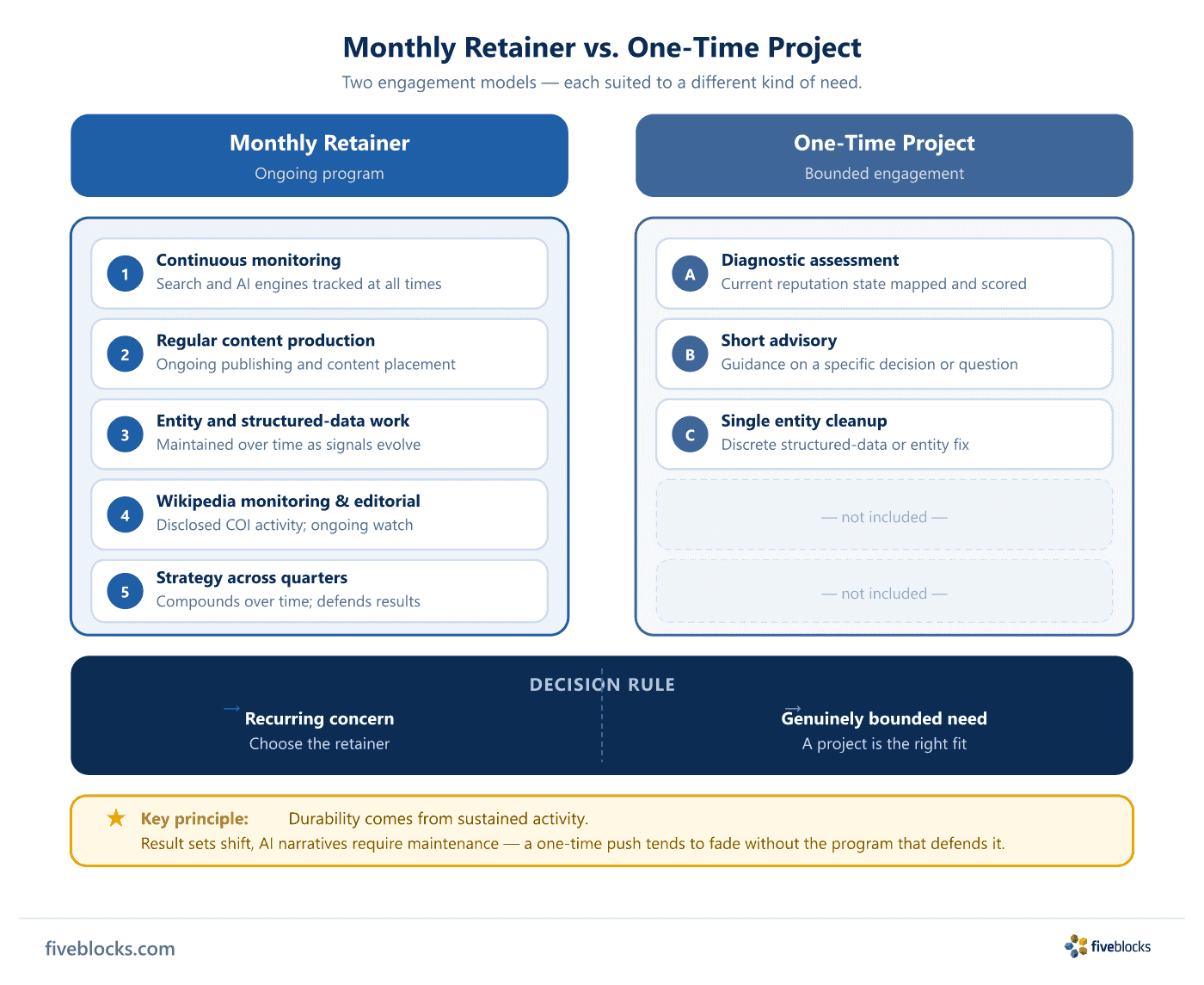
What each engagement model covers
| Monthly retainer | One-time project |
|---|---|
| Continuous monitoring of search and AI engines | Diagnostic assessment of the current reputation state |
| Regular content production and publication | Short advisory on a specific decision or question |
| Ongoing entity and structured-data work | Single entity or structured-data cleanup |
| Wikipedia monitoring and disclosed editorial activity | |
| Strategy that builds across quarters |
How to decide
- Recurring concern: choose a retainer. Result sets and AI narratives keep moving, and a one-time push tends to fade once nothing is maintaining it.
- Genuinely bounded need: choose a project. If the scope is discrete and truly finite, a scoped engagement delivers what you need without a long-term commitment.
We offer both engagement models and will say which one fits the situation rather than defaulting to the larger retainer.
Last reviewed: 20/05/2026
