How quickly can Five Blocks respond to a reputation emergency?
Within 24 hours of engagement. For existing clients with IMPACT, AIQ, and WikiAlerts monitoring already in place, Five Blocks can begin diagnostic work the same day; for new crisis engagements, an emergency Letter of Engagement and diagnostic work begin within 24 to 48 hours, with the first written assessment delivered within 72 hours.
Five Blocks can begin responding to a reputation emergency within 24 hours of engagement, though the exact speed depends on whether monitoring is already in place. Existing clients with live IMPACT™, AIQ, and WikiAlerts™ coverage get a same-day response; new crisis engagements move through an emergency intake within 24 to 48 hours. Clients who were already monitoring start the response with baseline data and pre-agreed escalation paths instead of building from zero.
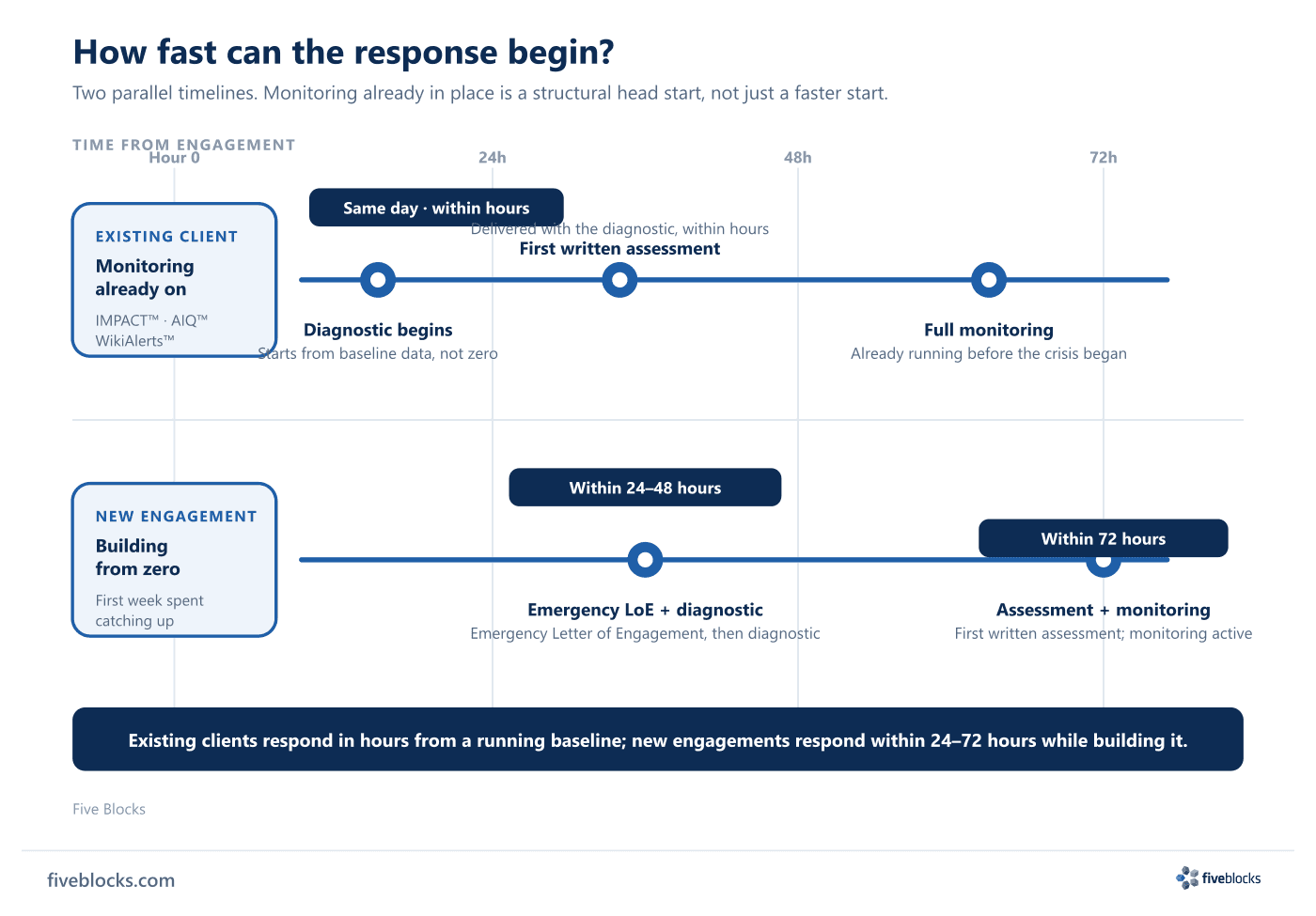
Response time: existing client vs. new engagement
| Milestone | Existing client (monitoring already in place) | New crisis engagement |
|---|---|---|
| Diagnostic work begins | Same day, within hours of notification | Within 24 to 48 hours, after an emergency Letter of Engagement |
| First written assessment | Delivered with the diagnostic, within hours | Within 72 hours |
| Full monitoring active | Already running before the crisis began | Within the same 72-hour window |
| Starting position | Weeks of baseline data, named team coverage, pre-agreed escalation paths, existing channel relationships | First week spent catching up, establishing baseline and relationships under pressure |
Why existing monitoring shortens the response
The difference is what is already in place when the crisis hits:
- Baseline data already exists. The diagnostic does not start from zero, because IMPACT™, AIQ, and WikiAlerts™ have been capturing the search, AI, and Wikipedia picture continuously.
- Coverage and escalation are pre-agreed. Named team coverage and escalation paths are already defined, so notification can move straight to response.
- Channel relationships are in place. The response runs on established channels rather than ones built mid-crisis.
Clients building monitoring during the crisis spend the first week catching up. Clients who were monitoring beforehand begin the response already ahead.
Last reviewed: 19/05/2026
