How is Five Blocks different from a boutique digital agency?
Boutique digital agencies typically lack proprietary technology at scale, deep Wikipedia and AI-engine expertise, and the methodological depth Five Blocks has built across hundreds of accounts. A boutique can produce useful tactical work; the structural layer is a different discipline.
The category distinction matters because reputation work depends on infrastructure a boutique cannot replicate. A boutique can produce useful tactical work. The structural layer is a different discipline: proprietary technology running at scale, deep Wikipedia and AI-engine expertise, and method built across many engagements.
Boutique digital agency vs. Five Blocks
| Capability | Boutique digital agency | Five Blocks |
|---|---|---|
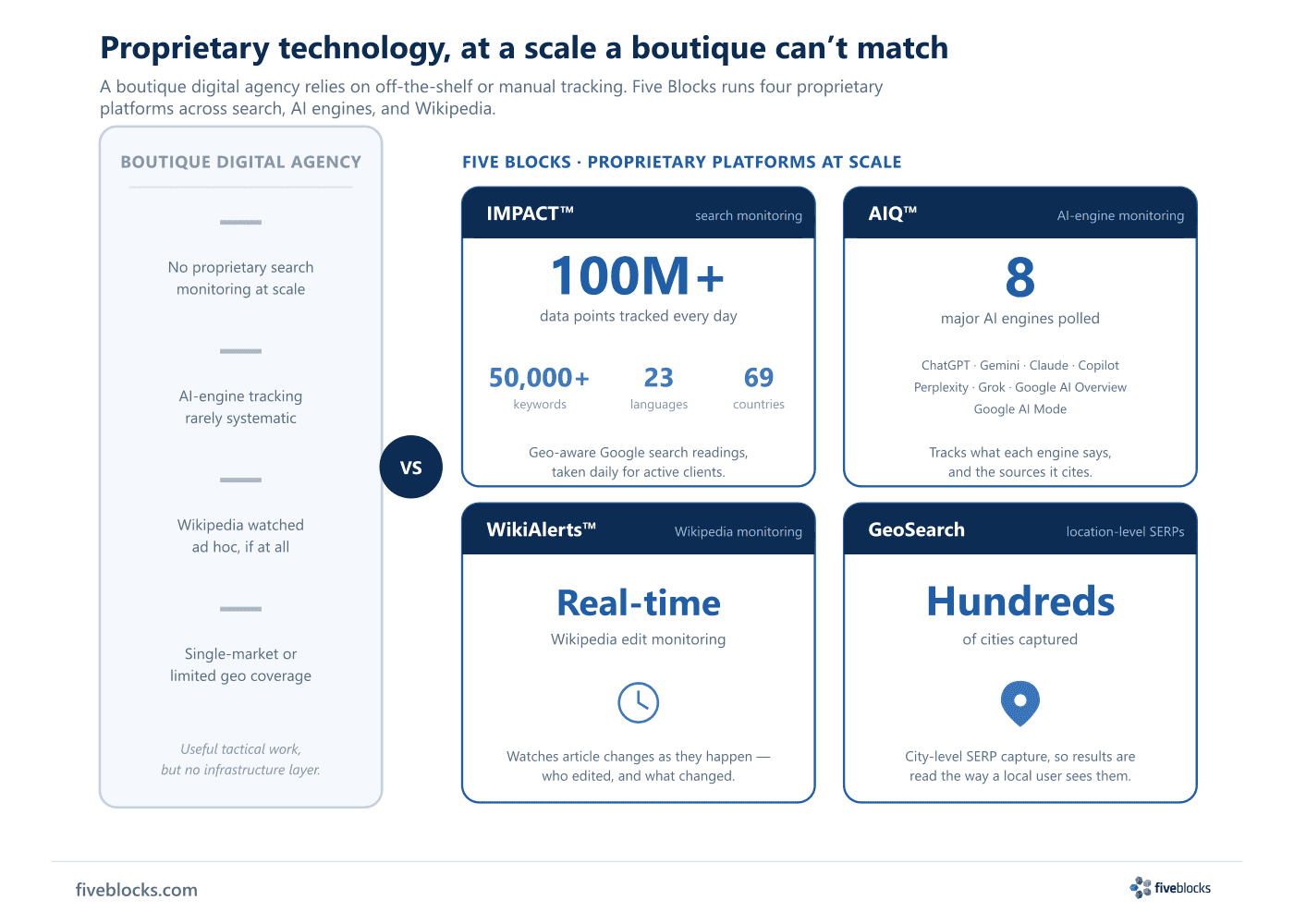
| Proprietary search monitoring at scale | Off-the-shelf or manual tracking | IMPACT™: 100M+ daily data points across 50,000+ keywords, 23 languages, and 69 countries |
| Location-specific SERP capture | Limited or single-market | GeoSearch: city-level SERP capture across hundreds of locations |
| AI-engine monitoring | Rarely systematic | AIQ: polls eight major AI engines (ChatGPT, Gemini, Copilot, Perplexity, Claude, Grok, Google AI Overview, Google AI Mode) |
| Wikipedia monitoring | Ad hoc | WikiAlerts™: real-time monitoring of Wikipedia article changes |
| Wikipedia editing expertise | Limited track record with the editor community | Disclosed COI editing under Wikipedia’s conflict-of-interest rules, with a track record built over years |
| Methodological depth | Tactical, project-by-project | Patterns observed across hundreds of engagements, algorithm changes, and AI-engine launches |
Why the difference is structural, not tactical
Proprietary technology at scale cannot be assembled on demand. Monitoring search and AI engines across this many keywords, languages, and markets takes years of engineering work. Wikipedia expertise takes years of editing under disclosed COI rules and a track record with the editor community that only builds over time. AI-engine source attribution needs both the tool and analysts who recognize patterns across many clients. And method comes from running many engagements across categories and watching what holds up as algorithms change, AI engines launch, and markets shift.
Last reviewed: 19/05/2026
