How does reputation management complement a PR strategy?
Quick answer
Reputation management picks up three things PR alone does not: it turns earned-media value into durable presence, it owns the channels PR does not reach (Wikipedia, Knowledge Panels, and AI engines), and it builds infrastructure that outlasts the news cycle.
Reputation management complements PR by doing three things a media-relations function is not built to do on its own. Together they turn one-off coverage into a standing reputational asset.
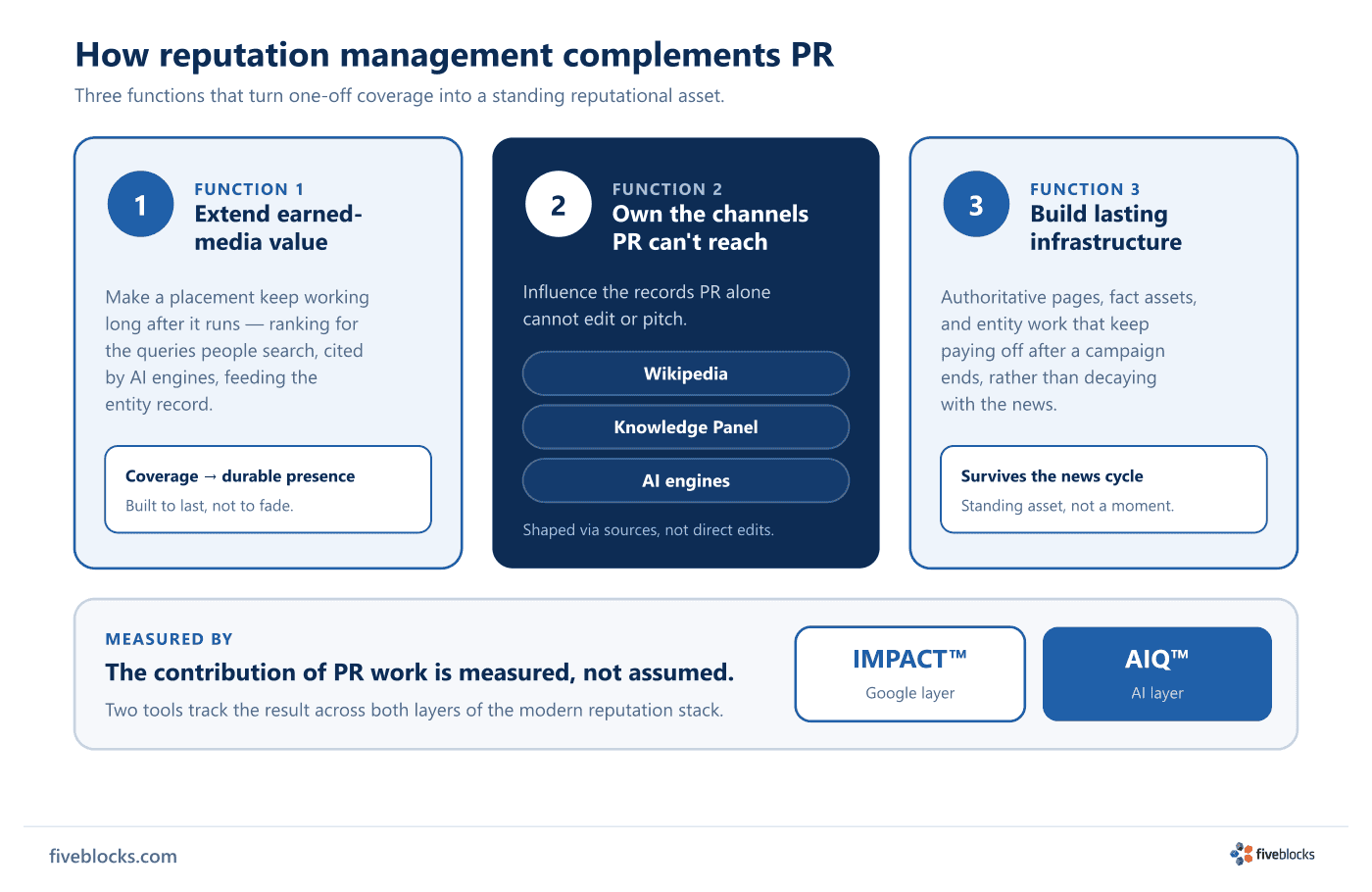
The three gaps it fills
- It extends the value of earned media. A placement keeps working long-term only if it ranks for the queries people actually run, gets cited by the AI engines, and feeds the entity record. Left alone, coverage tends to lose prominence in search as fresher content displaces it, and the reputational value fades with it unless someone builds it into something more durable.
- It owns the channels PR does not reach. Wikipedia runs on community policy: changes go through disclosed conflict-of-interest edit requests on the Talk page, backed by reliable sources. Pitching does not work there. Knowledge Panels and AI narratives run on structured signals and source quality, not direct edits – nobody can change an AI model’s output directly, so the work is shaping the sources the models draw on.
- It builds infrastructure that survives the cycle. Authoritative pages, fact assets, and entity work keep paying off after a campaign ends instead of decaying with the news.
How the contribution is measured
We track this with our own tools: IMPACT™ for the Google layer, AIQ for the AI layer. AIQ monitors what the major AI engines say about a subject, so the contribution of PR work is measured rather than assumed.
Last reviewed: 20/05/2026
