Why do PR firms need a digital reputation management partner?
Wikipedia work, AI narrative management, and getting a company's online identity right each run on their own policy, tooling, and risk, and none of them fits a firm built around messaging and journalist relationships. Most PR firms find it cleaner to bring in a partner that already has the technology and the track record.
PR firms partner with reputation specialists because the work is specialized and carries its own risk. The disciplines a digital reputation partner covers: Wikipedia, AI narrative management, and entity optimization. Each runs on its own policy, tooling, and risk profile.
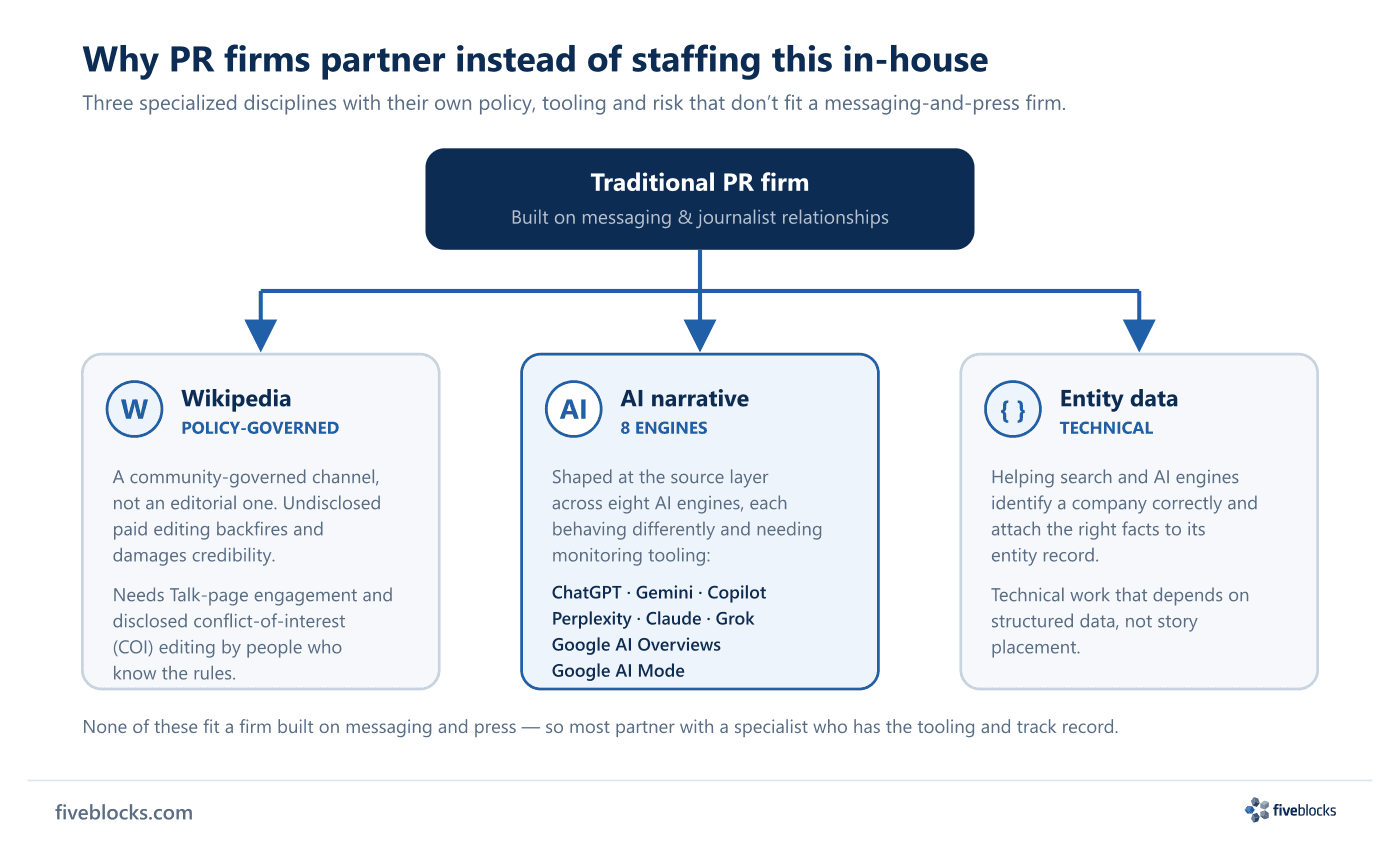
Three specialized disciplines that don’t fit a traditional PR firm
- Wikipedia is governed by community policy. It is not a page a comms team can write into. Undisclosed paid editing backfires and damages credibility. Doing it properly means Talk-page engagement and disclosed conflict-of-interest (COI) editing by people who know the rules.
- AI narrative work happens at the sources. You can’t fix what an AI engine says by prompting it. It doesn’t remember, and it rebuilds each answer from the sources it trusts, so the work happens at those sources, across ChatGPT, Gemini, Copilot, Perplexity, Claude, Grok, Google AI Overviews, and Google AI Mode. Each engine behaves differently and needs its own monitoring tooling.
- Getting the company’s identity right is technical work. Helping search and AI engines identify a company correctly, and attach the right facts to it, depends on clean machine-readable data rather than story placement.
Why most firms partner rather than staff it in-house
None of this sits naturally inside a firm built around messaging and journalist relationships, and trying to staff it in-house rarely pays off. Most firms find it cleaner to bring in a partner that already has the technology and the track record, and run the relationship white-label or as a named partner. We work both ways.
Last reviewed: 20/05/2026
