How do you manage a reputation management firm’s performance?
Manage a reputation firm's performance with KPIs agreed at the start of the engagement, regular reviews against those objectives, a set reporting cadence, defined escalation paths for issues, and quarterly retrospectives that cover both methodology and results. The firm is an accountable partner working to shared metrics, not a vendor whose work is opaque.
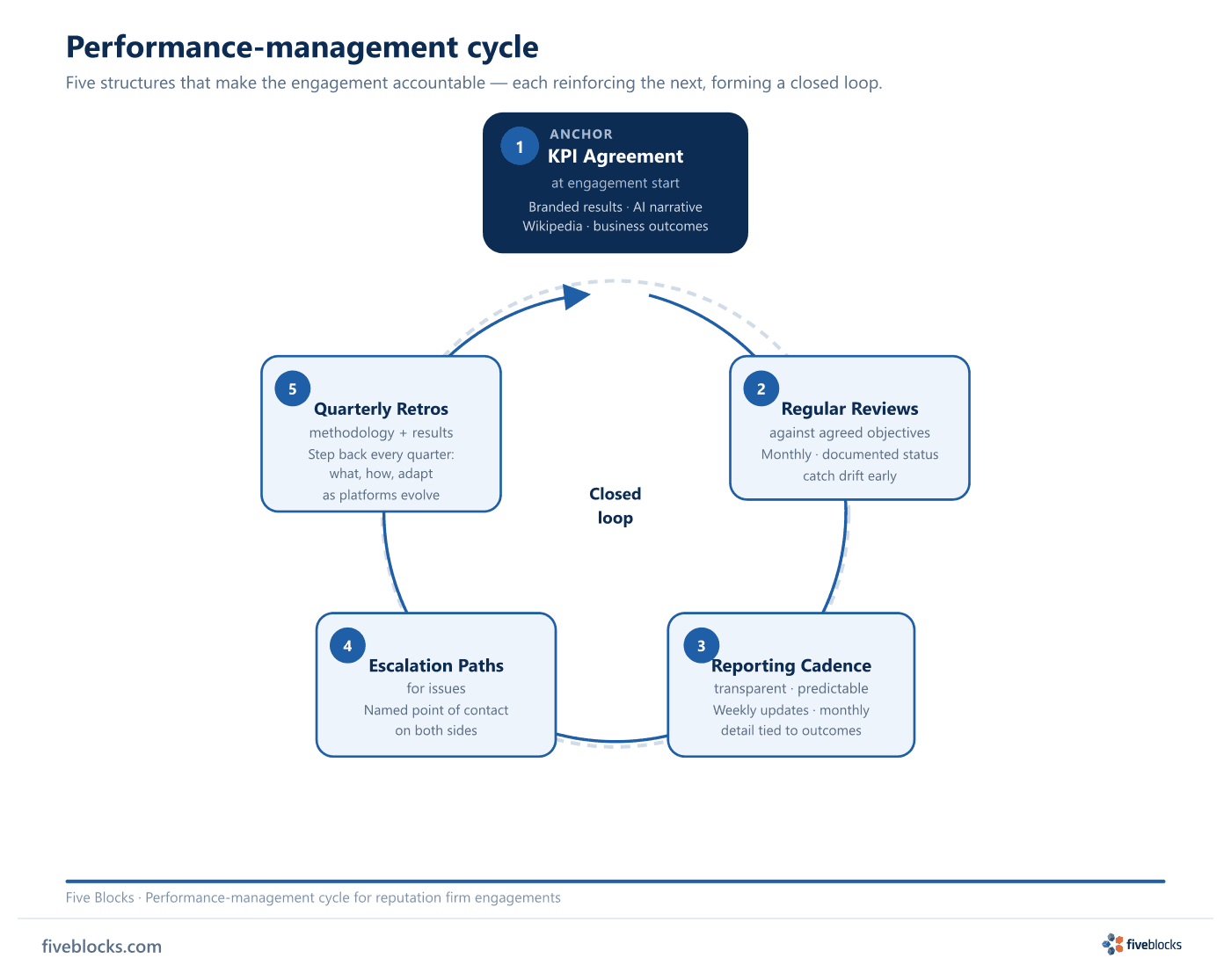
Managing a reputation firm’s performance is straightforward when the engagement is built for it from the start, and frustrating when it is not. Five structures make the partnership accountable, and they work as a closed cycle where each one feeds the next.
-
Agree KPIs at the outset
Define the metrics before work begins: branded result-set composition, the AI narrative, Wikipedia and entity progress, and business outcomes where they can be attributed. Performance then gets measured against defined targets instead of impressions.
-
Conduct regular reviews against agreed objectives
Schedule recurring reviews that compare progress to the KPIs. The point is to catch drift early, before a small gap hardens into a persistent problem. Monthly reviews with a documented status keep the firm honest.
-
Maintain a transparent reporting cadence
Require written reporting on a predictable schedule (weekly updates, monthly detail) that ties activity to outcomes. A firm that goes quiet between invoices is a warning sign. A firm that keeps the work visible earns trust.
-
Define escalation paths for issues
Decide in advance how concerns about quality, pace, or the relationship itself reach resolution. With a named point of escalation on each side, problems surface and get addressed instead of festering.
-
Hold quarterly retrospectives on methodology and results
Step back every quarter to look at the results and at how the program itself is running. Search engines and AI platforms change; retrospectives give the methodology room to adapt so the program keeps working.
The discipline is to treat the firm as an accountable partner working to shared metrics, not a vendor whose work is opaque. A firm that resists clear KPIs or transparent review is telling you something.
Last reviewed: 20/05/2026
