What is a Google Knowledge Panel and how does it impact perception?
A Google Knowledge Panel is the entity card that appears on the right side of a branded search results page, automatically generated from Google's Knowledge Graph. Its data is drawn primarily from Wikidata, Wikipedia, and other authoritative sources, and the same underlying data feeds AI engines, making the panel both a direct reputation signal and an AI input.
The Google Knowledge Panel occupies the most prominent space on a branded SERP. For a recognized entity, Google automatically generates a card, drawn from its Knowledge Graph, showing the name, description, and attributes such as founding date, headquarters, leadership, market cap, and social profiles, together with an image where available. The data powering those fields comes primarily from Wikidata and Wikipedia, plus other authoritative sources Google trusts.
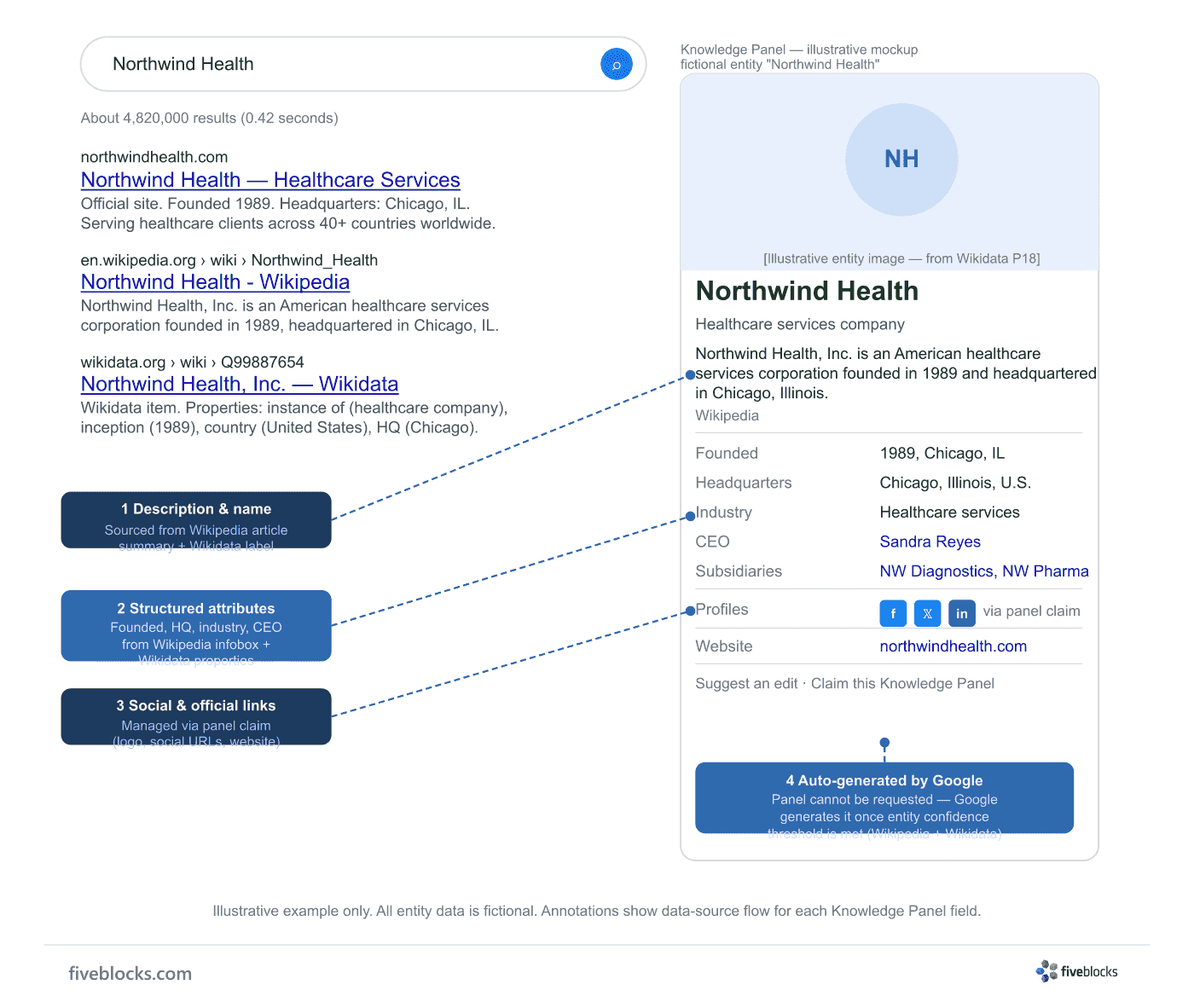
What the panel contains and where it comes from
- Name and description
- Pulled from the Wikipedia article summary and Wikidata label/description fields. Google’s Knowledge Panel draws its description and core facts from both sources.
- Structured attributes (founding date, headquarters, leadership, stock information)
- Fed by the Wikipedia infobox and corresponding Wikidata properties. An infobox error in Wikipedia or a stale Wikidata property propagates directly to the panel.
- Social and official links
- A verified representative can claim the panel and manage a limited set of fields, logo, official social links, and contact information, and suggest corrections to the rest. Claiming does not let you rewrite substantive facts generated from the underlying sources.
- Image
- Sourced from Wikidata (the P18 image property), Wikipedia, or other signals Google trusts. It is not directly uploadable through a panel claim.
Why the panel matters for perception
- It sets the first impression. A well-populated panel with an accurate description and clean attributes signals legitimacy; a sparse panel or no panel signals the opposite, regardless of the company’s actual standing.
- Eligibility cannot be requested. Google generates a Knowledge Panel automatically once it is confident enough about an entity, based on Wikipedia presence, Wikidata entries, authoritative third-party mentions, and structured data on owned properties. It cannot be created on demand.
- Errors originate upstream. The panel’s substantive content is drawn from the underlying sources, so panel errors are almost always errors in Wikipedia, Wikidata, or the structured data. The panel updates only after the source is corrected.
The panel as an AI input
The same Knowledge Graph data that populates the Knowledge Panel feeds AI engines, including ChatGPT, Gemini, Copilot, and Perplexity, when they answer questions about the entity. Gemini in particular has direct access to Google’s infrastructure and queries the Knowledge Graph for entity facts. Getting the Knowledge Panel right is therefore both a search outcome and an AI input: an accurate, complete panel produces more accurate AI answers about the brand.
What actually moves the panel
Submitting feedback through Google’s panel interface rarely corrects substantive errors. The lever that works is the underlying sources: the Wikipedia article (especially the infobox), Wikidata properties, and the structured data on owned web properties. Panel errors typically resolve only once those upstream sources are corrected.
Last reviewed: 19/05/2026
