How often does Google re-rank search results after an ORM campaign starts?
Google re-evaluates search rankings continuously with each crawl cycle, not on a fixed schedule. New authoritative content can begin moving branded results within days for freshness-sensitive queries, while durable repositioning usually takes weeks to months as authority signals build. IMPACT tracks both the short-term daily movement and the longer trend.
Google does not batch-process rankings on a quarterly or monthly schedule. Its crawling processes run continuously, re-evaluating signals as new content is published, links are acquired, and freshness windows shift. For a branded query, a well-placed authoritative article can begin producing movement within days. Durable repositioning takes longer: weeks to months, as authority signals build and the content holds its position through subsequent algorithm passes.
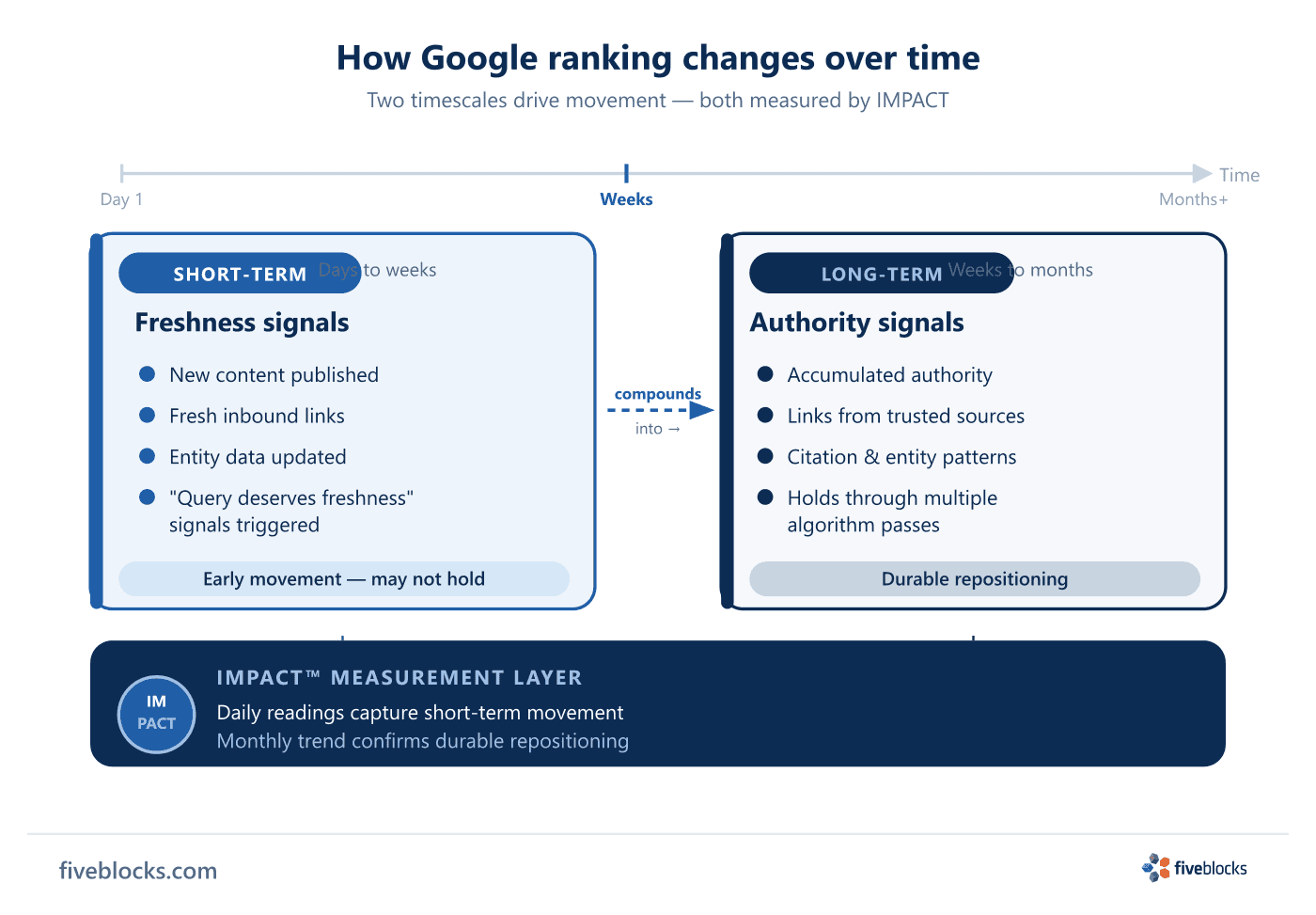
Two timescales
| Timescale | What drives movement | What to expect |
|---|---|---|
| Short-term (days to weeks) | New content published, fresh inbound links, entity data updated, freshness signals triggered on recency-sensitive queries | Ranking movement is often visible early, especially on queries where Google’s “query deserves freshness” systems apply. Early movement does not guarantee it holds. |
| Long-term (weeks to months) | Accumulated authority: inbound links from trusted sources, citation patterns, entity signals from Wikipedia/Wikidata, content that holds position through multiple crawl cycles | Durable repositioning. Content that ranks because it has built genuine authority holds through algorithm updates; content that ranked only on freshness decays back without accumulated signals. |
Why durability is the goal
Google weights authority signals heavily: other prominent websites linking or referring to content is one of the primary signals Google uses to assess trustworthiness. A program that publishes only for the freshness boost, without building long-term authority, produces rankings that decay. A structured ORM program publishes for durability instead: authoritative sources, consistent citation patterns, clean entity data, and content that gives Google a reason to rank it beyond the day it was published.
How IMPACT captures both timescales
The two timescales look different in the data, so IMPACT tracks both. Daily readings show the short-term movement as new content enters the index; the monthly trend line shows whether that movement is holding and compounding into durable repositioning. Clients see the trajectory against the objectives set at kickoff. That is the only way to set realistic timing expectations when Google does not publish a schedule.
Last reviewed: 19/05/2026
