How does Google Autocomplete affect your reputation?
Google Autocomplete reflects what users collectively search, not editorial choices. There are two levers: suggestions that violate Google's published policies (defamation, harassment, demonstrable inaccuracy) can be challenged through a formal removal channel, and behavioral suggestions shift as authoritative counter-content and broader reputation work change the underlying query mix. Both are workable; the first step is diagnosing which applies and pursuing it deliberately.
Autocomplete suggestions are generated from what users actually type into Google, aggregate query behavior, not editorial curation. For a brand or executive name, problematic completions such as “[Brand] scam”, “[Name] lawsuit”, or “[Company] controversy” reflect existing negative search interest and reinforce it, presenting those terms to new searchers before they have typed them. The mechanism can feel immovable, but it is not. There are two concrete levers, and the first move is to diagnose which one applies.
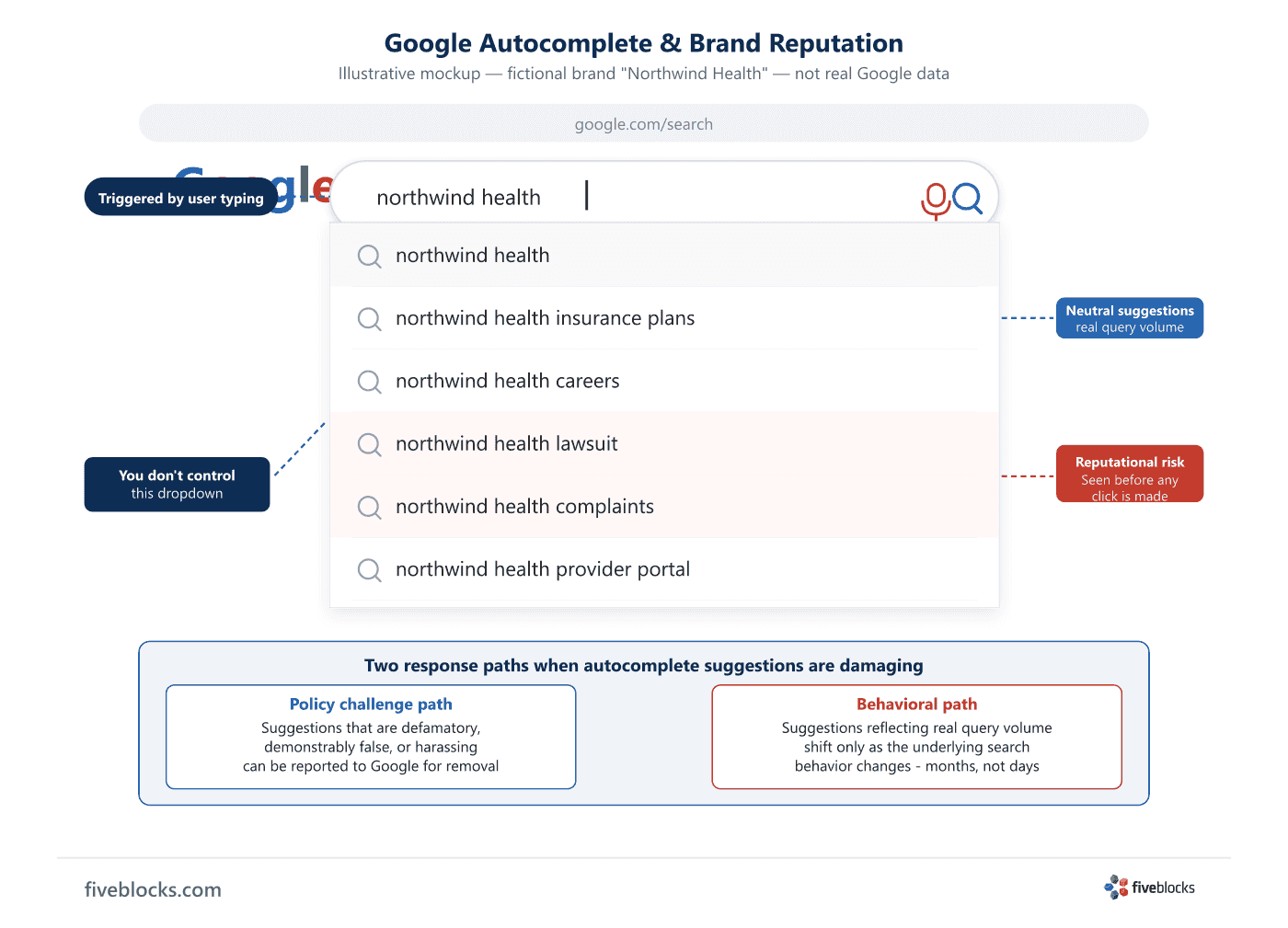
Step 1: Determine which response path applies
The two paths differ in mechanism and in how change happens. Identifying which applies is the first and most actionable decision:
- Policy-challengeable suggestions. Google removes predictions that violate its published autocomplete policies: violent, sexually explicit, hateful, harassing, or dangerous content; personally identifying information in restricted contexts; and demonstrably inaccurate claims. These can be challenged through Google’s reporting channel and are removed when the policy basis is clear.
- Behavioral suggestions. Suggestions that reflect genuine search volume but are reputationally damaging (because real users are searching those terms) do not meet the policy removal threshold. They require a different approach.
Step 2: Policy path, challenge through the reporting channel
If the suggestion meets a policy ground, submit a report through Google’s autocomplete feedback channel (available on desktop and mobile). Google’s systems filter predictions that are violent, sexually explicit, hateful, disparaging, or dangerous, and the reporting tool routes submissions into that review process. A well-grounded challenge cites the specific policy category and, where the basis is demonstrable inaccuracy, documents the factual error with a reliable source.
On timeline: Google does not publish processing times for autocomplete removal requests, and no independent data in our source library confirms a typical turnaround. In practice the outcome varies: some policy-based removals happen within days; others are disputed or returned as not meeting the threshold. Do not communicate a deadline to clients.
Step 3: Behavioral path, reduce the underlying search volume
Suggestions that reflect real query volume require a different strategy: reduce the share of searches for the problematic query relative to neutral or positive queries. This happens when authoritative counter-content captures the attention of stakeholders who would otherwise search for the negative term, and when the reputational work reduces the underlying grievance driving the searches in the first place.
On timeline: Autocomplete predictions can be slow to shift because they reflect a rolling aggregate of historical query behavior, and Google does not disclose how far back the weighting window extends. Behavioral shifts are a downstream effect of broader reputation work, not a direct output that can be scheduled, so the lever here is sustained work building and amplifying authoritative content, not a one-time submission. When the problematic query has years of accumulated volume, progress is gradual, so start the upstream work early and track movement over time.
What this means in practice
- If the suggestion is policy-challengeable, submit the challenge promptly. It is the most direct path available, though removal is decided by Google and no date can be promised.
- If the suggestion reflects real search behavior, the lever is upstream reputation work: authoritative counter-content, addressing the underlying grievance driving the searches, and giving stakeholders a stronger destination than the negative query. The autocomplete shifts as that situation improves.
- Either way there is an active path forward. Both paths tend to be slower than clients expect and faster than they fear, and the behavioral path in particular rewards early, consistent effort and ongoing measurement rather than a single intervention.
This is the kind of diagnosis-then-execution work Five Blocks handles day to day: telling a genuine policy-violation removal apart from a behavioral pattern, preparing well-grounded challenges where the policy basis is clear, building the authoritative counter-content that reshapes the underlying query mix, and tracking how predictions move over time through tooling such as AIQ and IMPACT so the strategy can be adjusted as the picture changes.
Last reviewed: 19/05/2026
