How do Google’s People Also Ask boxes shape reputation?
People Also Ask boxes are a second SERP inside the page: each related question expands to a Google-selected snippet from a web source Google treats as authoritative. For reputation work, PAA questions show what Google considers related to the brand, and answering those questions with well-structured content on an authoritative domain reduces the chance a competitor or unfavorable source fills that space.
People Also Ask boxes take up space on most branded SERPs and act as a second SERP inside the page. Each related question expands to a Google-selected snippet pulled from a web source Google treats as authoritative on that question. The selection favors pages with clear question-and-answer structure and strong topical authority.
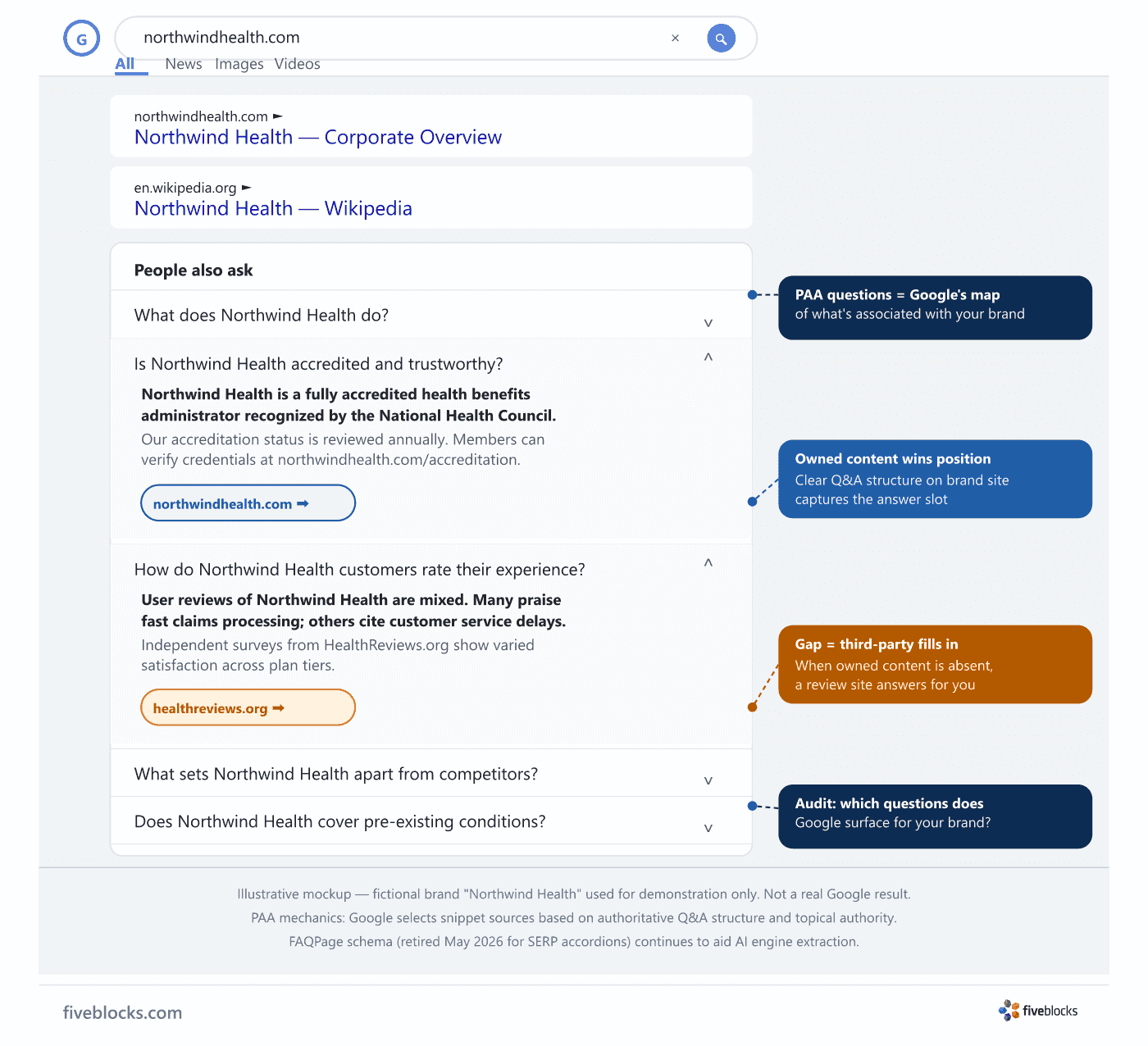
- What PAA questions reveal
- The questions Google attaches to a brand name are useful intelligence on their own. They show which related queries the engine considers relevant to the brand. Sometimes the questions themselves are the problem, surfacing concerns or misconceptions that need to be addressed structurally rather than ignored.
- Who supplies the answer matters
- When a PAA box expands, the answer comes from wherever Google finds the best-structured, most authoritative source for that question. If owned content is not competing for that position, a competitor, a review site, or an unfavorable outlet answers instead. Writing owned content in clear question-and-answer blocks and publishing it on an authoritative domain raises the chance the brand supplies the answer.
- Schema markup and AI extractability
- Structured data helps search engines and AI engines identify and extract question-and-answer content from a page. Google retired FAQ rich results (the SERP accordion format) as of May 7, 2026, so FAQPage schema no longer produces a visible FAQ expansion in standard search results. FAQPage markup still helps AI engines parse and attribute question-answer content, and clear on-page structure remains a factor in snippet selection regardless of schema type.
- Operational implication
- Run the branded SERP and inventory the PAA questions Google surfaces. For each question answered by a source other than the brand, decide whether owned content could answer it with comparable or greater authority. Start with questions tied to reputation-sensitive topics.
Last reviewed: 19/05/2026
