How do you build reputation for an entrepreneur launching a new venture?
Run two tracks at once. Re-point the founder's existing reputation infrastructure (bios, Wikipedia and Wikidata, Knowledge Panel signals, LinkedIn and other profiles) at the new venture, and build the venture's own authority alongside it. Monitor AI narratives daily through the launch window so the founder's established credibility carries into the new picture.
An entrepreneur launching a new venture has a specific reputation problem: existing search and AI signals point to prior roles, and the new venture needs to inherit and extend that authority rather than fight it. The work runs on two parallel tracks, one to transition the founder’s existing infrastructure and one to build the venture’s own authority, with daily AI-narrative monitoring through the launch window.
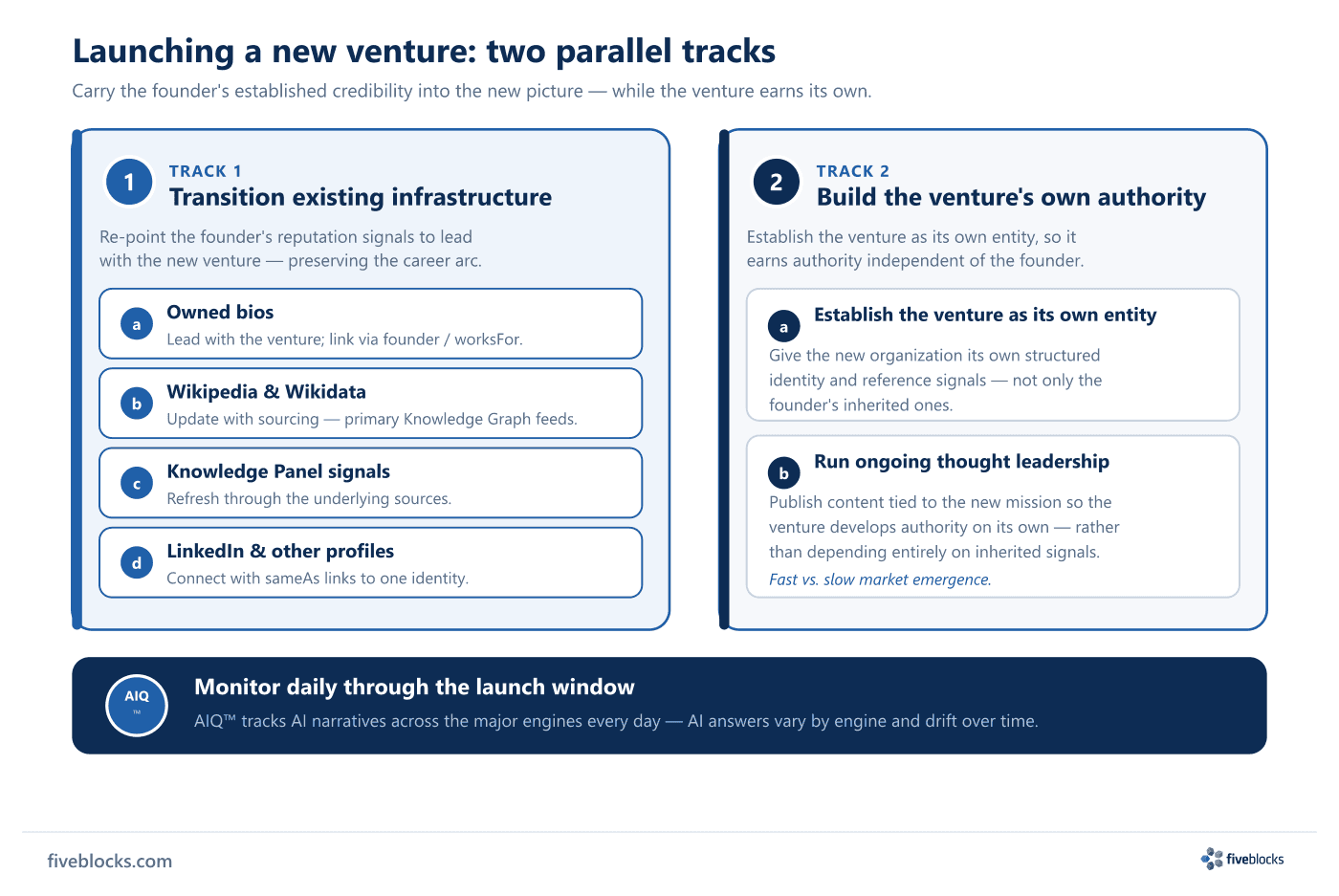
Track 1: Transition the founder’s existing infrastructure
The founder already has reputation signals built around prior roles. Re-point them at the new venture without losing the career arc:
- Owned bios. Update the corporate or personal bio so it leads with the new venture, keeping the career history intact. Use schema’s
founderandworksForproperties to link the founder (Person) to the venture (Organization) so engines can connect the two entities. - Wikipedia and Wikidata. Update both to reflect the new role, with proper sourcing. They are primary data sources for Google’s Knowledge Graph, which populates Knowledge Panels, and they are among the most heavily weighted sources AI engines use to describe an entity.
- Knowledge Panel signals. Refresh the panel through its underlying sources. A panel’s substantive facts come from Wikipedia, Wikidata, and structured data, so it changes only after those sources are corrected.
- LinkedIn and other profiles. Update LinkedIn and third-party profiles, then connect them with
sameAslinks. Those links feed the entity layer and Knowledge Graph, and they tie the founder’s reference profiles to one identity.
Track 2: Build the venture’s own authority
At the same time, establish the venture as its own entity and run ongoing thought-leadership content tied to the new mission. The venture should build authority of its own rather than depend entirely on the inherited signals.
Monitor daily through the launch window
AIQ runs daily during the launch window across the major AI engines. Engines generate answers fresh, differ from each other, and drift over time, and uncorrected legacy information persists in AI training data. Without active monitoring, engines can keep surfacing the prior-role framing. Inheriting the founder’s existing authority while building the venture’s own is what separates fast market emergence from slow.
Last reviewed: 19/05/2026
