How does Perplexity AI source information about companies and people?
Perplexity is retrieval-first: every query triggers a live web search, the returned pages are ranked on recency, domain authority, topical relevance, and citation patterns, and the model synthesizes a citation-backed answer with sources shown inline. Authoritative, recent, well-structured pages win the citation slots.
Perplexity is the clearest example of a retrieval-first AI engine, which is why it is often the easiest engine to influence in the short term. Rather than answering from a fixed training baseline, it reads the live web for each question, then shows you exactly which pages it used.
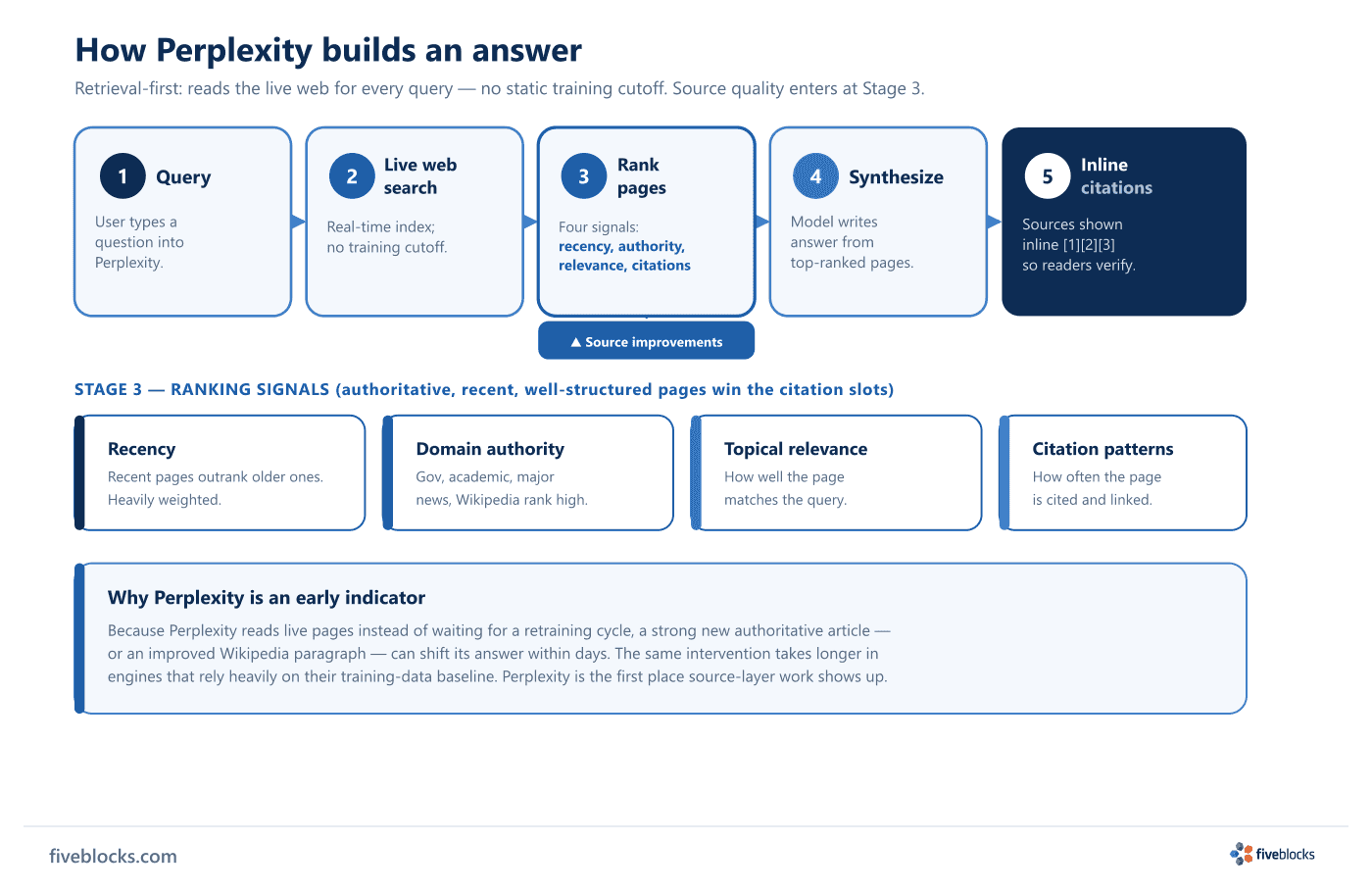
How a Perplexity answer gets built
- Live web search: each query triggers a real-time search against a continuously refreshed index rather than relying on a training cutoff.
- Ranking: the returned pages are ranked using Perplexity’s own retrieval logic, weighted toward recency, domain authority, topical relevance, and citation patterns.
- Synthesis: the model writes an answer drawing from the highest-ranked pages.
- Inline citations: the sources it used are shown inline, so a reader can click through and verify each claim.
Which pages win the citation slots
Because recency is weighted heavily, a recently published authoritative article often outranks an older one on the same topic. Government, academic, major-news, and Wikipedia domains rank consistently high; thin blog content rarely appears at all.
Why this makes Perplexity an early indicator
The practical consequence is fast feedback. Because Perplexity reads live pages instead of waiting for a retraining cycle, a strong new authoritative article, or an improved Wikipedia paragraph, can shift its answer within days. The same intervention takes longer to surface in engines that lean more heavily on their training-data baseline. Perplexity tends to be the first place you can see that source-layer work is landing.
Last reviewed: 19/05/2026
