How does Five Blocks manage the relationship between a client’s PR team and reputation strategy?
Five Blocks operates as embedded capability within a client's existing PR or comms structure, not as a parallel function. Data flows both ways, IMPACT and AIQ outputs go to the PR firm's account leads; their media plans and proactive narrative work come to Five Blocks, and the division of labor stays clean: media relations and storytelling sit with the PR firm, while entity, Wikipedia, search, and AI source-layer work sit with Five Blocks.
When a client has an existing PR firm or in-house communications team, Five Blocks works best as embedded capability rather than as a parallel function. The disciplines are complementary, not overlapping, and a few practical habits keep the coordination working.
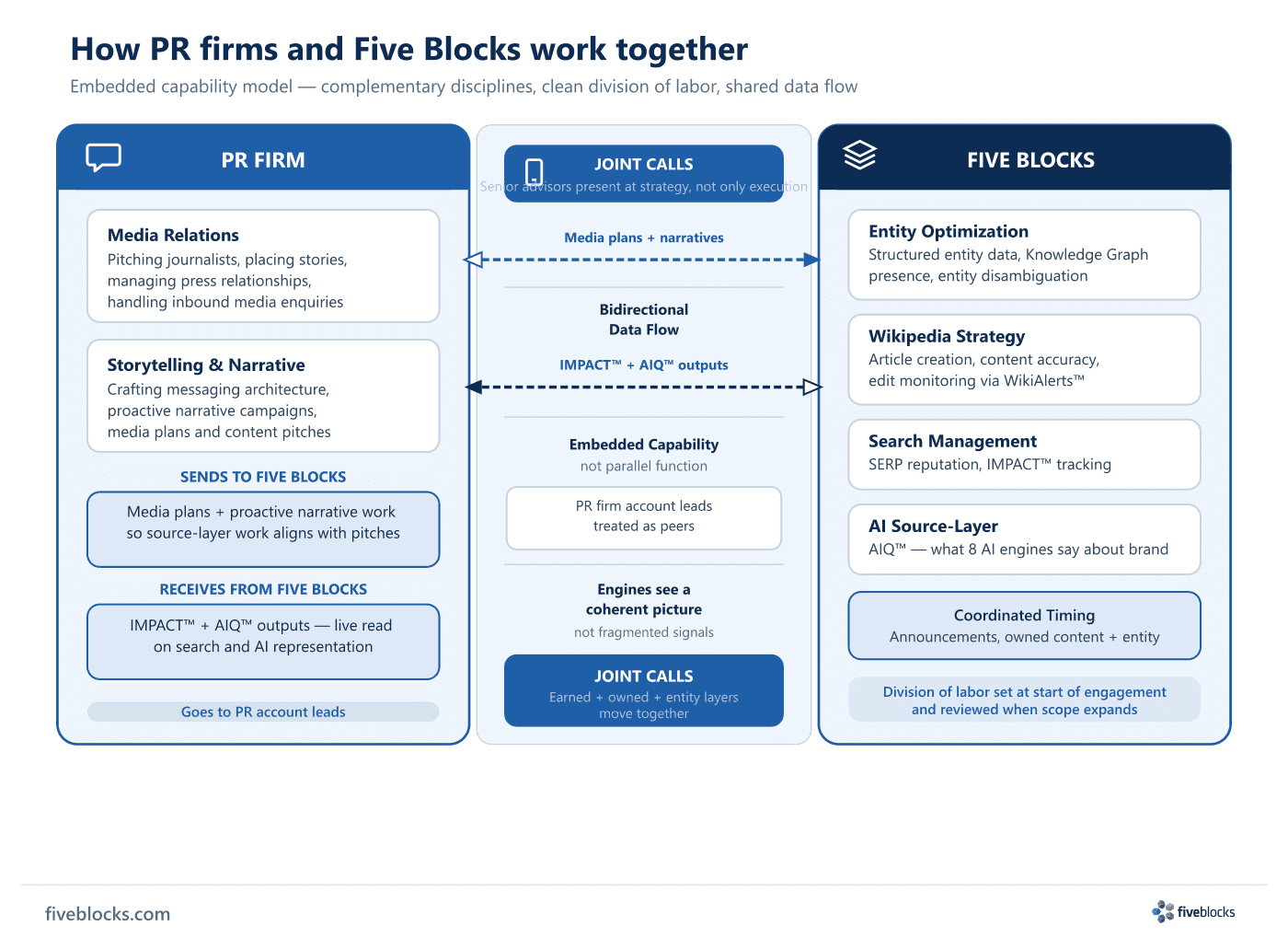
How the partnership operates day to day
- Bidirectional data sharing
- IMPACT™ and AIQ™ outputs go to the PR firm’s account leads so they have a live read on search and AI representation. In return, the firm’s media plans and proactive narrative work come to Five Blocks so source-layer interventions line up with what is being placed and pitched.
- Coordinated timing
- Announcements, owned content publication, and proactive Wikipedia work are timed so the earned, owned, and entity layers move together. The engines then get a consistent picture instead of a fragmented one.
- Joint calls
- Five Blocks attends the joint calls and treats the PR firm’s account leads as peers rather than gatekeepers. Senior advisors are present when strategy is set, not only during execution.
- Clean division of work
- Media relations and storytelling sit with the PR firm. Entity optimization, Wikipedia strategy, search management, and AI source-layer work sit with Five Blocks. The lines are explicit at the start of every engagement and revisited when scope expands.
Why the structure matters
When these disciplines run in silos, each team executing without visibility into the other, the engines get conflicting signals and both workstreams lose leverage. The shared data flow and clean division of labor are what let the partnership do more than either side working alone.
Last reviewed: 19/05/2026
