How do you handle content distribution to maximize reputation impact?
Work through the channels in sequence: amplify on owned channels first, extend through executive social and partner networks, use selective paid to reach authoritative audiences, and repurpose content into the formats AI engines retrieve. Good content underperforms without deliberate distribution, and distribution works best when owned channels set the base before earned and paid layers build on it.
Distribution decides whether good reputation content does any reputational work. Even excellent material underperforms if no one, and no engine, sees it. The channels that carry the most weight work in sequence: build the owned base first, extend through credible human networks, earn third-party citation, accelerate selectively with paid, and throughout, repurpose into the formats AI engines retrieve and cite.
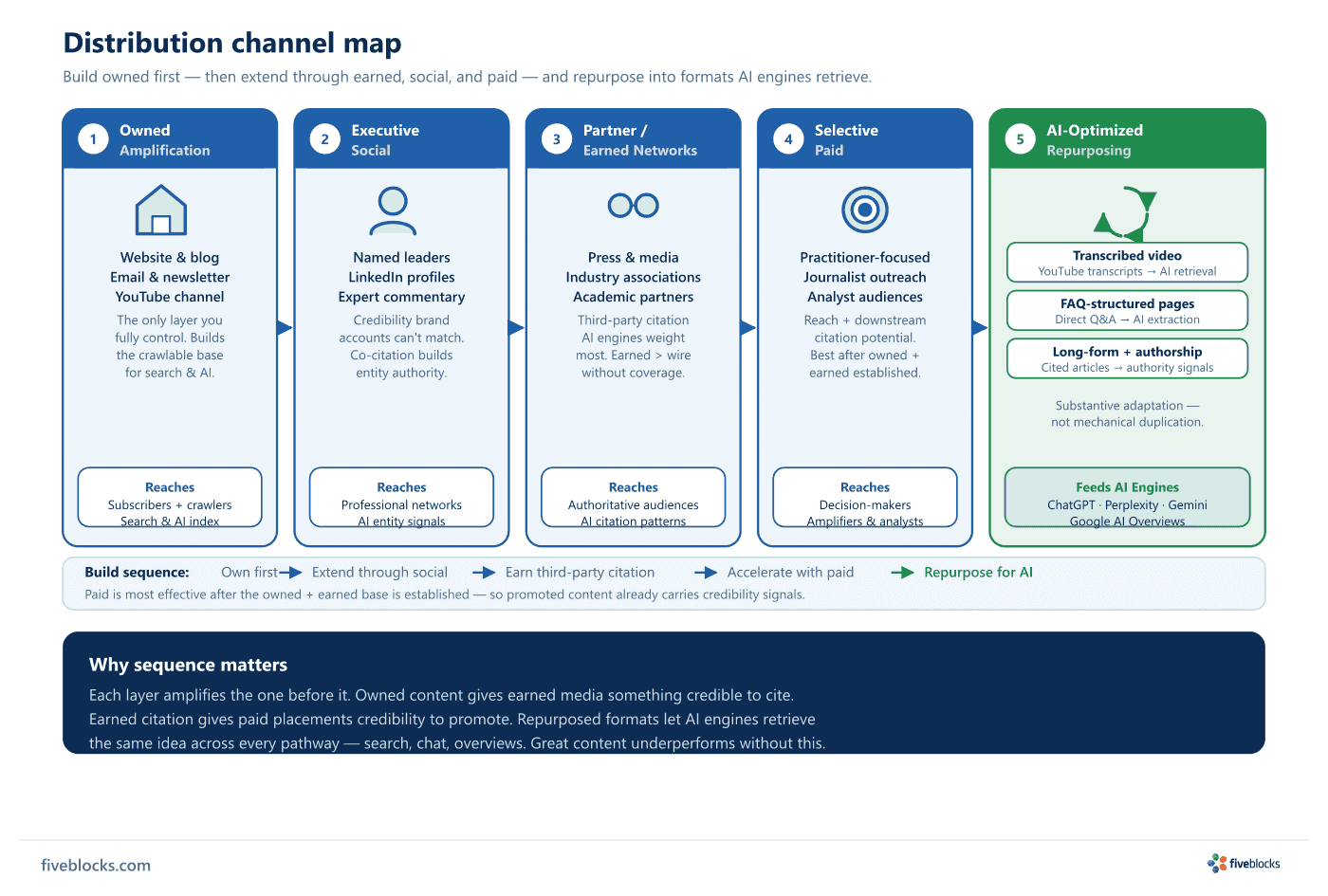
Step 1: Owned amplification
Start with the brand’s own properties: the website, email list, newsletter archive, blog, and YouTube channel. Owned amplification gives content its first reach and builds the crawlable footprint that search engines and AI engines index. This is the only layer you fully control, and everything else builds on it. A piece that does not live at a stable, public, crawlable URL on an authoritative owned property has no durable footprint, however widely it is later shared.
Step 2: Executive social distribution
Executive social distribution extends content through credible individual networks. When named leaders, not just the brand account, share, comment on, or publish content tied to the company’s core narratives, that distribution carries credibility a brand account cannot replicate. LinkedIn profiles rank consistently well on executive name searches, and co-citation patterns, where AI engines see the same expertise linked to both a named person and a company, build entity authority for both.
Step 3: Partner and earned networks
Partner and earned networks carry content to authoritative audiences and can generate the third-party citation AI engines weight most heavily. AI engines weight a wire release with no earned media coverage lower than the same facts reported by a credible third-party outlet. Placement in credible independent outlets, not just syndicating your own material, is what creates the citation pattern that shapes AI answers. Partner distribution through industry associations, complementary brands, and academic collaborators extends reach and adds third-party endorsement signals that search and AI engines read as credibility.
Step 4: Selective paid distribution
Paid distribution, used selectively, puts content in front of authoritative audiences faster than organic reach allows. The qualifier that matters is authoritative audiences: paid placements that reach practitioners, journalists, analysts, or decision-makers who can amplify or cite content do double duty, direct reach plus downstream earned citation. Paid placements aimed at general audiences without that potential deliver reach alone. Paid works best after the owned and earned base is in place, so the content being promoted already carries the credibility signals AI engines and journalists look for.
Step 5: AI-optimized repurposing
Different AI engines ingest content through different pathways. Repurposing the same core idea into the formats each engine retrieves widens how the content can be cited across the AI ecosystem:
- Transcribed video. YouTube transcripts are crawled and embedded by AI engines and can be cited like written articles; a video without an accurate transcript is largely invisible to the ingestion layer.
- FAQ-structured pages. Discrete questions with direct, self-contained answers are the format AI engines extract from most readily, and the same structure is what featured snippets reward.
- Long-form articles with clear authorship. Fact-dense, well-cited articles with named credentialed authors and structured headings give AI engines the authority signals and structured content they weight most.
Repurposing here means real adaptation, not copying the same text into a new container: the video adds a practitioner angle the article lacks; the FAQ pulls out the answerable questions the long form buries in prose.
Tracking distribution impact: A distribution strategy is only as good as its feedback loop. We build distribution into content strategy from the start and track whether distributed content moves search positions and AI framing, which formats each engine draws on, and which channels generate the citation patterns that shape answers, using IMPACT™ and AIQ™, then adjust the channel mix accordingly.
Last reviewed: 20/05/2026
