How do you build a content moat around your brand?
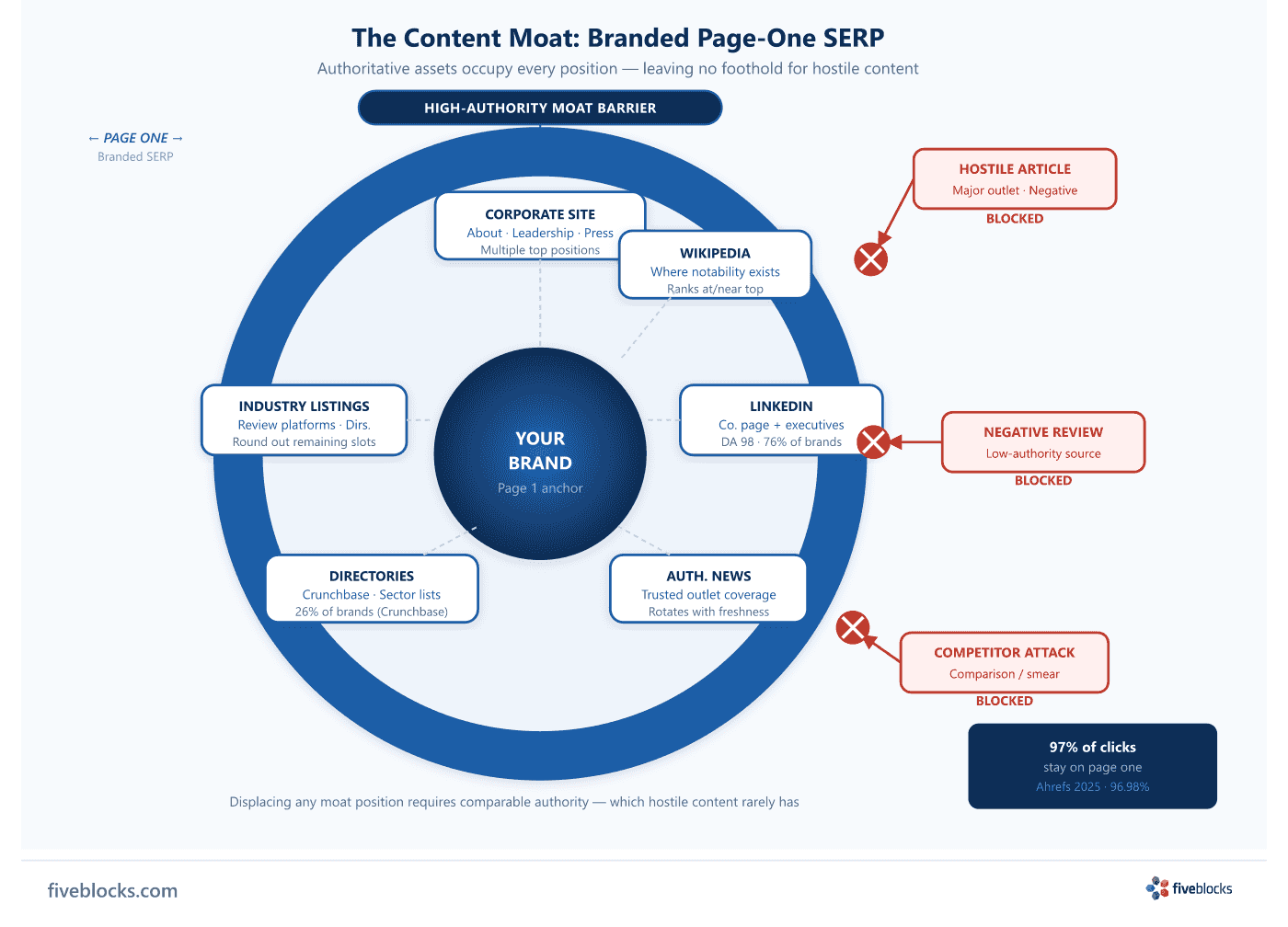
A content moat is a durable portfolio of owned and authoritative third-party assets, the corporate site, Wikipedia where notability allows, LinkedIn, recognized business references, and authoritative news, that holds enough of the page-one branded SERP to leave little room for hostile or low-quality content to break through. The moat holds because displacing any of those assets requires comparable authority, which hostile content rarely has.
A content moat is the defensive structure a reputation program builds around a brand: a durable portfolio of owned and authoritative third-party content that holds enough of the page-one branded results to leave little room for negative or hostile content to gain a foothold. The word moat is chosen on purpose. The goal is durability, not a one-time push.
The assets that form the moat
A page-one branded SERP on Google fills from a predictable pool of authoritative sources. A well-built moat holds the majority of those positions with content the brand controls or influences:
- The corporate site, across several deep pages. The owned domain usually holds multiple top positions through its About, leadership, press, and product pages. Each page that holds a position is one fewer slot available to hostile content.
- Wikipedia, where notability supports an article. A Wikipedia article is only viable when independent, reliable coverage establishes notability. Where it exists, it commonly ranks at or near the top of the branded SERP and is one of the highest-authority positions available.
- LinkedIn for the company and its executives. LinkedIn’s domain authority (98/100) means the company page and executive profiles reliably hold page-one positions. A Go Fish Digital study of 500 companies found LinkedIn on page one for 76% of the brands analyzed.
- Recognized business references such as Crunchbase. Structured third-party directories hold positions on corporate and financial queries; Crunchbase appeared for 26% of companies in the same study.
- Authoritative news coverage. Coverage from outlets the systems trust rotates through the page. Individual articles cycle with freshness, but a steady flow of authoritative coverage keeps the news slots leaning toward company-aligned content.
- Industry-specific directory listings. Sector-appropriate directories and review platforms fill the remaining positions on relevant queries.
Why the moat holds
The durability comes from authority. To displace a Wikipedia article, a LinkedIn company page, or a well-established corporate About page, an incoming result has to carry comparable authority, and hostile content rarely does. A moat built on genuinely authoritative, well-maintained assets holds because the systems are trying to assemble an accurate, trustworthy picture of the entity, and these are the sources they trust.
A moat built on thin or manipulative content erodes, because the systems eventually discount it. This is why the asset types matter as much as the volume of content.
What a moat protects against: An unaddressed negative article from a major outlet can hold a top page-one position for years. The moat works by taking enough high-authority positions before that kind of content arrives that it has no room to surface on page one, where roughly 97% of organic search clicks concentrate.
How to measure it
The practical measure is not how much content has been published but which results actually hold the branded positions, and whether the positions the brand does not control are held by neutral, aligned, or hostile content. We track this continuously with IMPACT™, which shows the full page-one composition across the branded query set and flags any position changes within hours.
Last reviewed: 20/05/2026
