How do you audit existing content for reputation management effectiveness?
A content audit catalogs every owned piece, scores each on authority, freshness, and AI citation, finds gaps and underperforming assets, and outputs a prioritized action plan: consolidate overlapping pieces, refresh content worth updating, and remove or restructure what no longer serves the brand. A leaner, current content base outperforms a large neglected one.
A content audit tells a reputation program what its owned content is actually doing, as opposed to what was published. The instinct is to keep everything. The value usually comes from pruning what dilutes authority and doubling down on what earns it.
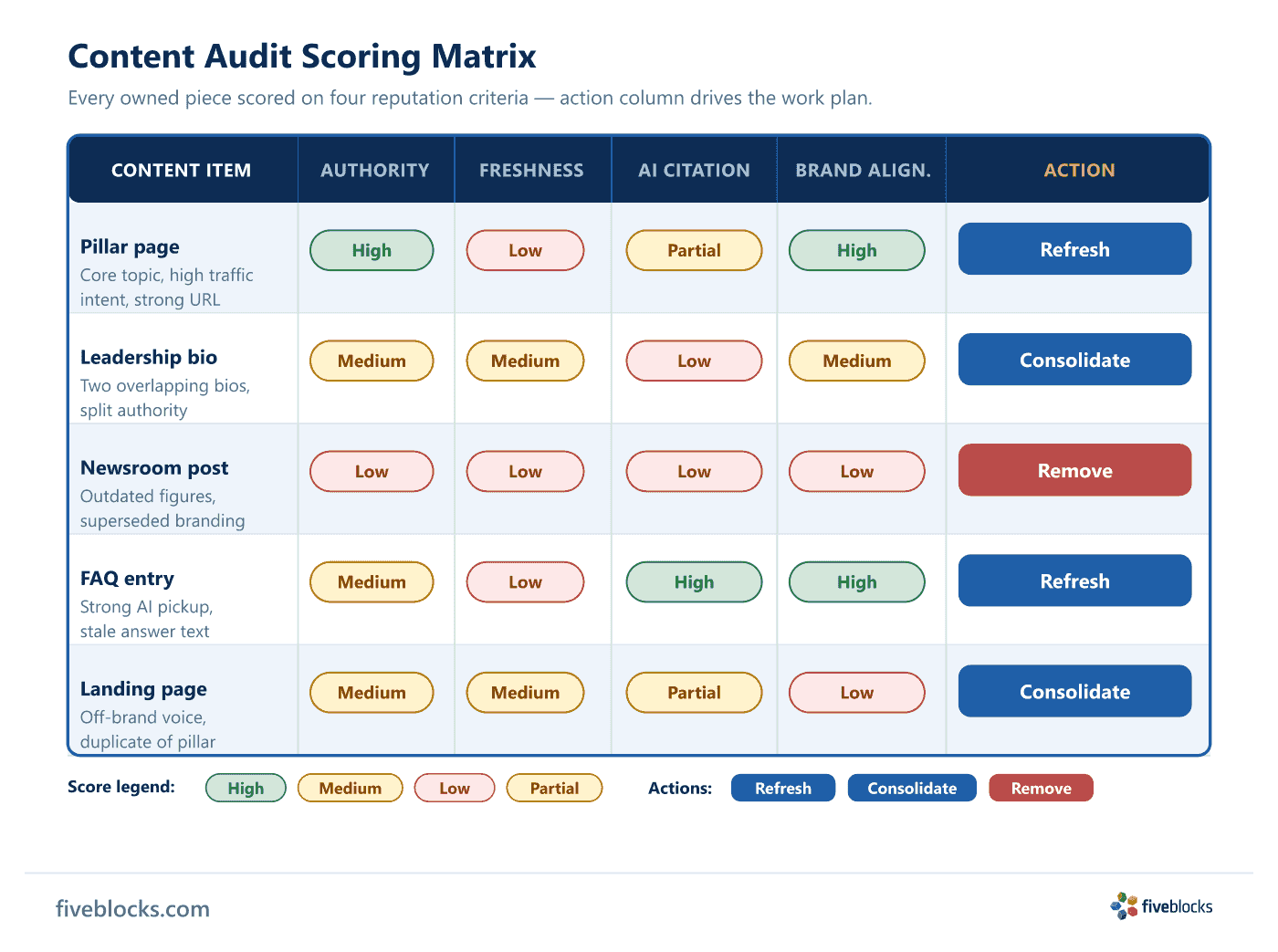
Step 1, catalog every owned piece
The audit starts with a complete inventory: every page, post, bio, FAQ entry, newsroom item, and landing page across the brand’s owned properties. List each piece with its URL, publish date, author, and the query or topic it is meant to serve. Judge nothing yet; the inventory comes first.
Step 2, score each piece on four reputation criteria
Assess every catalogued item on the four dimensions that decide whether it helps or hurts:
| Criterion | What to assess | Red flags |
|---|---|---|
| Authority | Domain trust, backlink quality, search rank for the target query | No external links in; ranking outside top 20 for its own intended query |
| Freshness | Last updated date, accuracy of facts and statistics, current branding | Outdated figures, broken citations, superseded leadership or product names |
| AI citation | Whether the eight AI engines AIQ currently tracks draw on this piece when answering related prompts | Content never surfaced in AIQ responses; engines citing competitors or third parties instead |
| Brand alignment | Consistency with current messaging, tone, and canonical entity descriptions | Off-brand voice, outdated positioning, conflicting entity descriptions across pieces |
Step 3, assign an action to every piece
Scoring converts directly into a prioritized action column. Every piece gets one of three verdicts:
- Refresh, a strong core that has aged, or a gap in freshness or AI citation that a targeted update can close. Refreshed content recovers search positions and corrects AI framing faster than new content, because the URL already has authority.
- Consolidate, two or more overlapping pieces that split authority between them. Merging them into one authoritative piece improves rank and cuts the duplicate-content risk that fragments entity recognition.
- Remove or restructure, thin, off-brand, or factually stale content that no longer serves the brand and that the AI engines may be drawing on for the wrong reasons. Removing it is often the highest-leverage move in the audit.
Step 4, execute and measure
The output is a phased work plan, not a static report. Priority goes to the pieces with the highest authority and the easiest refresh wins, then to consolidations, then to removal of the weakest material. We track whether the actions actually move search positions and AI citation with IMPACT™ and AIQ™. The measure is whether gaps closed, not whether the content count changed.
Last reviewed: 20/05/2026
