How much media coverage do you need to qualify for a Wikipedia page?
Wikipedia sets no fixed number of sources. In practice, plan for three to five substantial independent pieces for a clear-cut case, and ten or more for borderline or controversial subjects that will likely face deletion review. What counts as "substantial" is qualitative: each piece must address the subject directly and in depth, not merely quote it or mention it in passing.
Wikipedia does not publish a minimum number of sources for notability because the standard is qualitative, not quantitative. Its guideline states that “there is no fixed number of sources required since sources vary in quality and depth of coverage, but multiple sources are generally expected.” Experienced editors and Articles for Deletion reviewers do work from informal thresholds, and those give you a planning target.
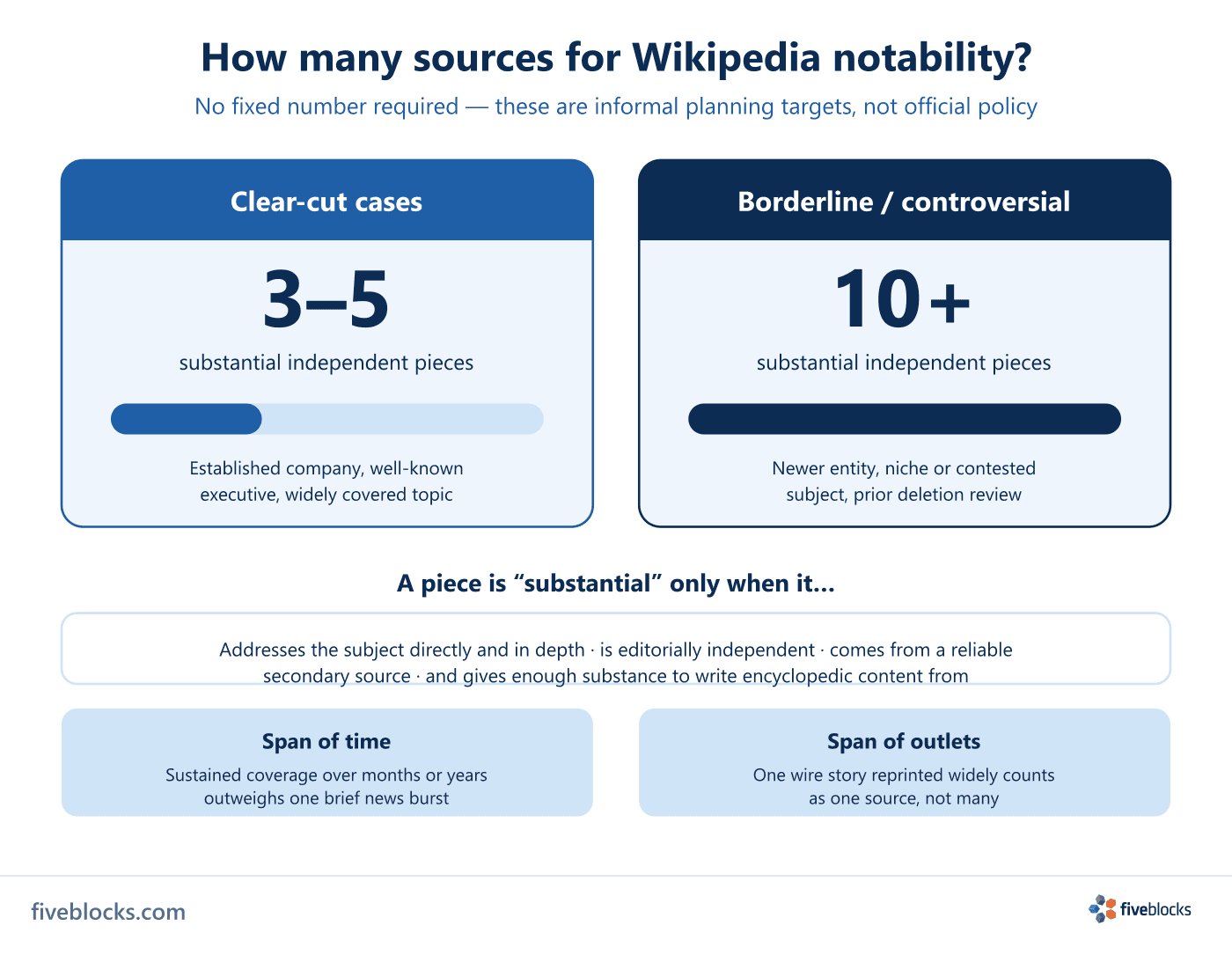
Working thresholds by case type
| Case type | Informal floor | Why |
|---|---|---|
| Clear-cut cases (established company, well-known executive, widely covered topic) | 3 to 5 substantial pieces | Enough to show the subject has been treated directly and in depth across independent outlets, with no original research needed to extract content |
| Borderline or controversial cases (newer entity, niche subject, contested notability, prior deletion) | 10 or more substantial pieces | Articles for Deletion discussions demand a deeper evidence base; editors arguing “keep” need redundancy to overcome skeptics |
What “substantial” means
The piece count only matters if each source clears Wikipedia’s quality bar. A piece is substantial when it:
- Addresses the subject directly and in depth, not a passing quote in an unrelated story, not a brief mention in a listicle
- Is editorially independent, not a press release, sponsored content, native ad, the subject’s own website, or a wire-service syndication of a company announcement
- Comes from a reliable secondary source, a publication with professional editorial oversight, fact-checking, and a reputation for accuracy (mainstream newspapers, editorially independent trade publications with fact-checkers, books from established publishers)
- Provides enough substance to write encyclopedic content from, Wikipedia’s standard is that “significant coverage addresses the topic directly and in detail, so that no original research is needed to extract the content”
Two dimensions that change how much your sources are worth
Beyond the count, editors weigh two more things:
- Span of time. A cluster of articles from one news cycle is weaker than coverage sustained over months or years. Wikipedia’s notability guideline notes that “sustained coverage is an indicator of notability” while “brief bursts of news coverage may not sufficiently demonstrate notability.”
- Span of outlets. One AP story reprinted in ten newspapers counts as one source under Wikipedia’s rules, not ten. Coverage spread across several editorially independent outlets carries more weight.
What does not count
These are excluded from the source count no matter how prominent they look:
- Press releases (even if picked up by outlets without independent reporting)
- Wire-service syndications of company announcements
- Standard business notices (funding rounds, hirings, office openings, acquisitions when reported routinely)
- The subject’s own website, social channels, or self-published materials
- Sponsored content, native advertising, or paid-placement features
Last reviewed: 19/05/2026
