How does Wikipedia content get amplified across the internet?
A Wikipedia article multiplies: its content spreads across the web through at least five routes, citation by news outlets, use in academic and gray literature, weighting by AI engines in both training and retrieval, replication into the Google Knowledge Graph and Wikidata, and reproduction by mirror sites under the Creative Commons license. A change to an article works through all of these systems on their own timelines, which is why Wikipedia work sits at the center of a reputation program.
Wikipedia content does not stay on Wikipedia. Once an article exists, its framing spreads across the wider information ecosystem through five routes, each on its own timeline. A change to the article, accurate or not, eventually surfaces across all of them.
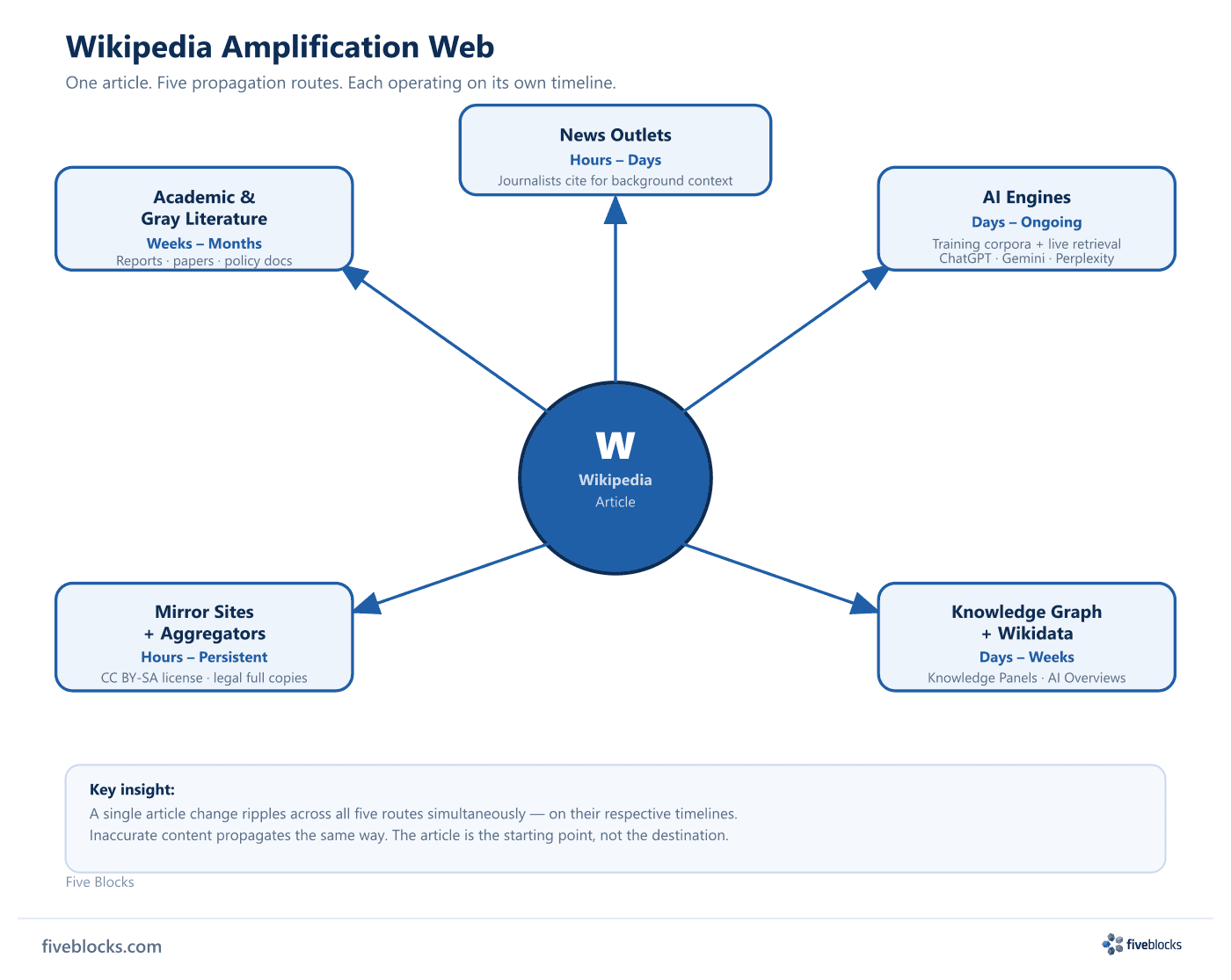
The five propagation routes
- 1. News and media citation
- Journalists cite Wikipedia for background context, particularly in stories about a company or person readers are meeting for the first time. Those citations carry the article’s framing into mainstream coverage, where it gets quoted, paraphrased, or used as a reference point by later reporting. The news cycle is usually the fastest of the five routes.
- 2. Academic and gray literature
- Academic researchers, consultants, and policy authors use Wikipedia as a reference point, especially on fast-moving or technical topics where a peer-reviewed alternative may not yet exist. These citations embed the article’s framing into reports, working papers, and industry analyses that other systems then ingest.
- 3. AI engines, training and retrieval
- AI engines weight Wikipedia in both training corpora and live retrieval. On the retrieval side, queries about entities routinely trigger a Wikipedia lookup that is passed to the synthesis layer, so the article’s language can appear, often closely paraphrased, in AI-generated answers across ChatGPT, Gemini, Perplexity, and others. (The training-side weighting is widely reported but not publicly quantified by model providers; treat the training claim as directionally supported rather than precisely measured.)
- 4. Google Knowledge Graph and Wikidata
- Wikipedia and its structured-data counterpart Wikidata are primary data sources for Google’s Knowledge Graph, which populates Knowledge Panels and feeds Google AI Overviews and Gemini synthesis. The article description typically becomes the panel’s short description; the infobox feeds structured fields; and the linked Wikidata entry provides the machine-readable identifiers that connect the entity to related entities across Google products. The timeline here is days to weeks after an article change, depending on Google’s crawl and Knowledge Graph update cycles.
- 5. Mirror sites and content aggregators
- Wikipedia publishes all content under the Creative Commons Attribution-ShareAlike license (CC BY-SA), which permits commercial reproduction. Hundreds of mirror sites and content aggregators legally reproduce Wikipedia articles in full, seeding the article’s framing into derivative sources that other systems, search engines, AI crawlers, and citation databases, then ingest. This route tends to be the slowest but also the most durable, because mirror copies can persist long after the original article is updated.
Why this matters for reputation strategy
The effect across these five routes is why a Wikipedia engagement is worth the work it takes. A single accurate, well-sourced article update reaches AI engines, the Knowledge Graph, news background context, and the structured web at once, on their own timelines. Inaccurate content that survives on an article spreads the same way. The article is not the destination. It is where the spread begins.
Last reviewed: 19/05/2026
