How do you build Wikipedia pages for multiple entities within the same organization?
Use a parent-company article for the corporate entity, distinct articles for subsidiaries or products where standalone notability is supported, and cross-linking, disambiguation, and explicit Wikidata relationships (parent-subsidiary, owner-owned, predecessor-successor) to tie the family together so the corporate structure is machine-readable.
Multi-entity organizations, parent companies with subsidiaries, holding companies with portfolio entities, conglomerates with multiple notable brands, need a deliberate Wikipedia structure so each entity is correctly represented and the relationships are machine-readable. No single article carries the whole structure; a layered set of articles does, with Wikidata underneath.
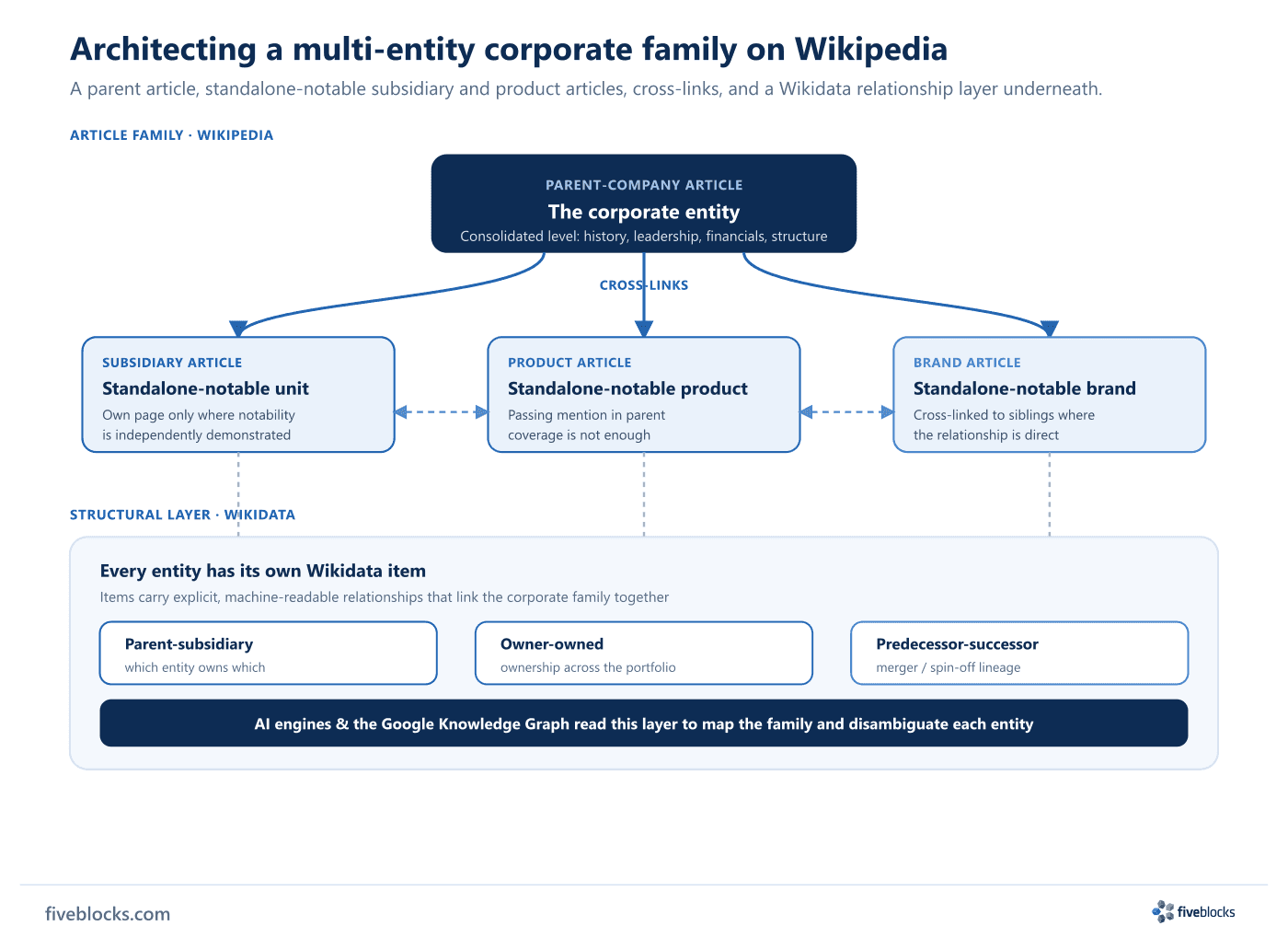
How the article family is structured
- The parent-company article covers the corporate entity at the consolidated level: history, leadership, financials, and structure.
- Subsidiary and product articles get their own pages where standalone notability supports them. Notability has to be demonstrated independently: coverage of the parent that mentions a product only in passing does not establish a separate article for that product.
- Cross-linking ties the family together, with clear links from the parent article to each entity, and between entities where the relationships are direct.
The Wikidata layer underneath
Wikidata is what makes the corporate family machine-readable. Each entity has its own Wikidata item, carrying explicit relationships between them:
- Parent-subsidiary: which entity owns or is owned by which.
- Owner-owned: the ownership ties across the portfolio.
- Predecessor-successor: the lineage where entities have merged, rebranded, or been spun off.
AI engines and the Google Knowledge Graph read this entity data to understand the corporate family, and it is what produces accurate disambiguation in AI responses about any one of the entities. Where it is weak, with no Wikidata item and no clean disambiguation, engines can confuse or conflate entities that share a name or sit close together in the same organization.
Last reviewed: 19/05/2026
