What is the role of review management in employer branding?
Review management is a core input to employer branding, not a side task. Glassdoor, Indeed, and Blind are where candidates form their impression of a company, and three levers build that reputation together: a structured response process, real culture and operations work, and authentic review generation.
Review management is a core input to employer branding. The platforms that carry employee reviews, Glassdoor, Indeed, Blind, and others, are where candidates form their impression, often before they see the company’s own careers content. Glassdoor and Indeed have high domain authority and often rank on the first page for a company-name query, and senior candidates increasingly research employers through AI engines as well as direct search before they apply or accept. Three levers build that reputation, and they work together rather than one at a time.
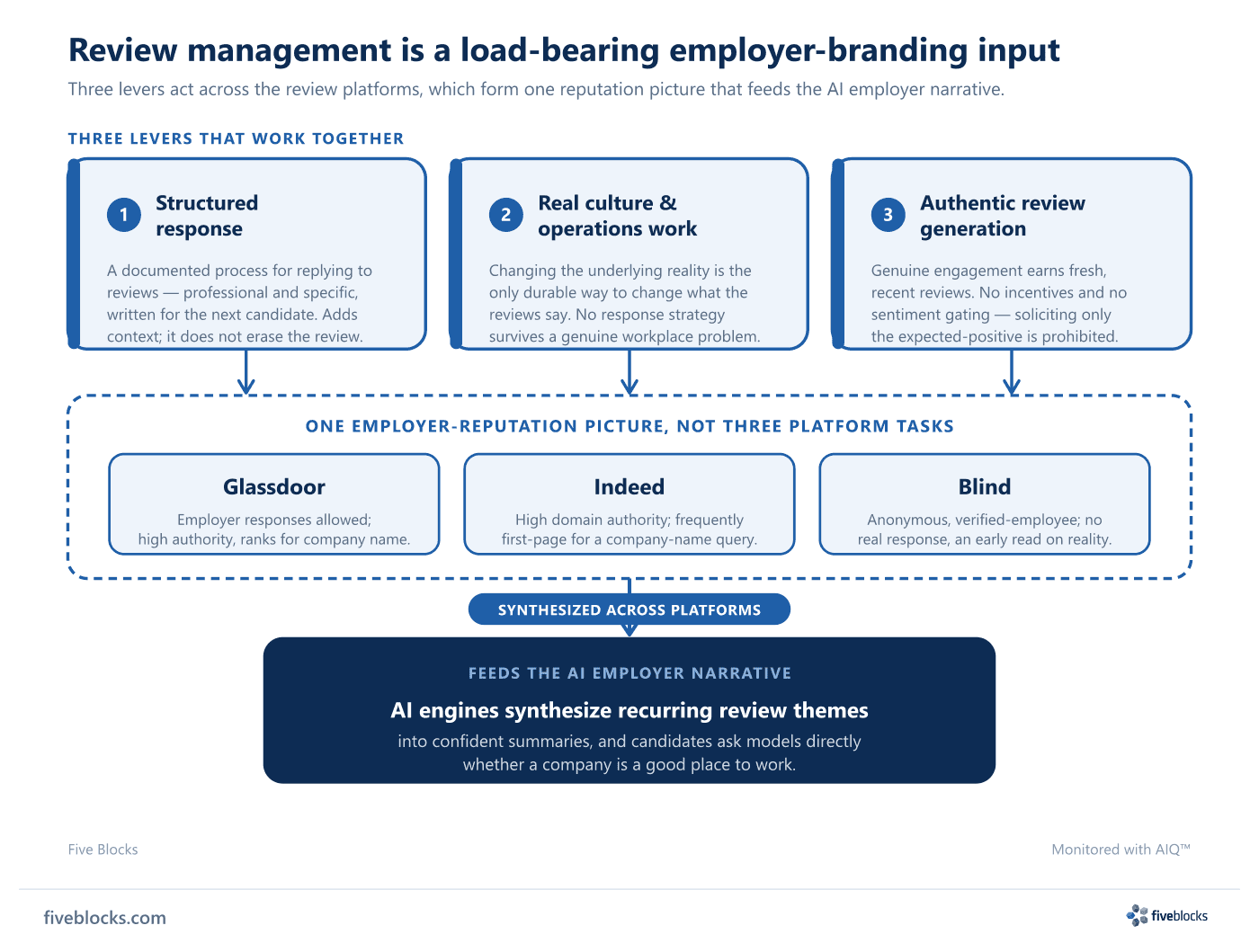
The three levers of employer review management
- Structured response
- A documented process for replying to reviews. Replies are professional and specific, written for the next candidate reading the thread rather than for the original reviewer. Glassdoor and other employer platforms let companies post responses, and a measured reply shows that leadership engages with feedback. The response does not remove the original review, so the goal is context, not erasure.
- Real culture and operations work
- The only durable way to change what the reviews say is to change the underlying reality. No response strategy survives a real workplace problem, so the substantive work on culture, leadership, and operations is what actually moves employee sentiment. This matters most on Blind, an anonymous, verified-employee platform where companies cannot meaningfully respond and removal is rarely available. Its sentiment often surfaces before it reaches Glassdoor or recruiting outcomes, so it is an early read on the reality underneath.
- Authentic review generation
- Genuine internal engagement earns fresh, recent reviews that rebuild the visible picture. The compliance rule is strict: review platforms prohibit incentives in exchange for reviews and prohibit sentiment-based gating, where a company solicits only the employees or customers it expects to be positive. Authentic generation is also the more durable approach, because a genuine spread of feedback reads as credible to candidates and to the engines that summarize it.
One employer-reputation picture, not three platform tasks
Glassdoor, Indeed, and Blind all carry employee reviews, and candidates routinely check more than one. Treating them as a single employer-reputation picture rather than separate platform tasks is what keeps the branding coherent. AI engines summarize the recurring themes across review platforms rather than reading a single review, and candidates increasingly ask models directly whether a company is a good place to work. We monitor how the engines assemble that employer narrative across these platforms with AIQ, since the model’s answer is built from exactly this content.
Last reviewed: 20/05/2026
