What is the relationship between review rating and search ranking?
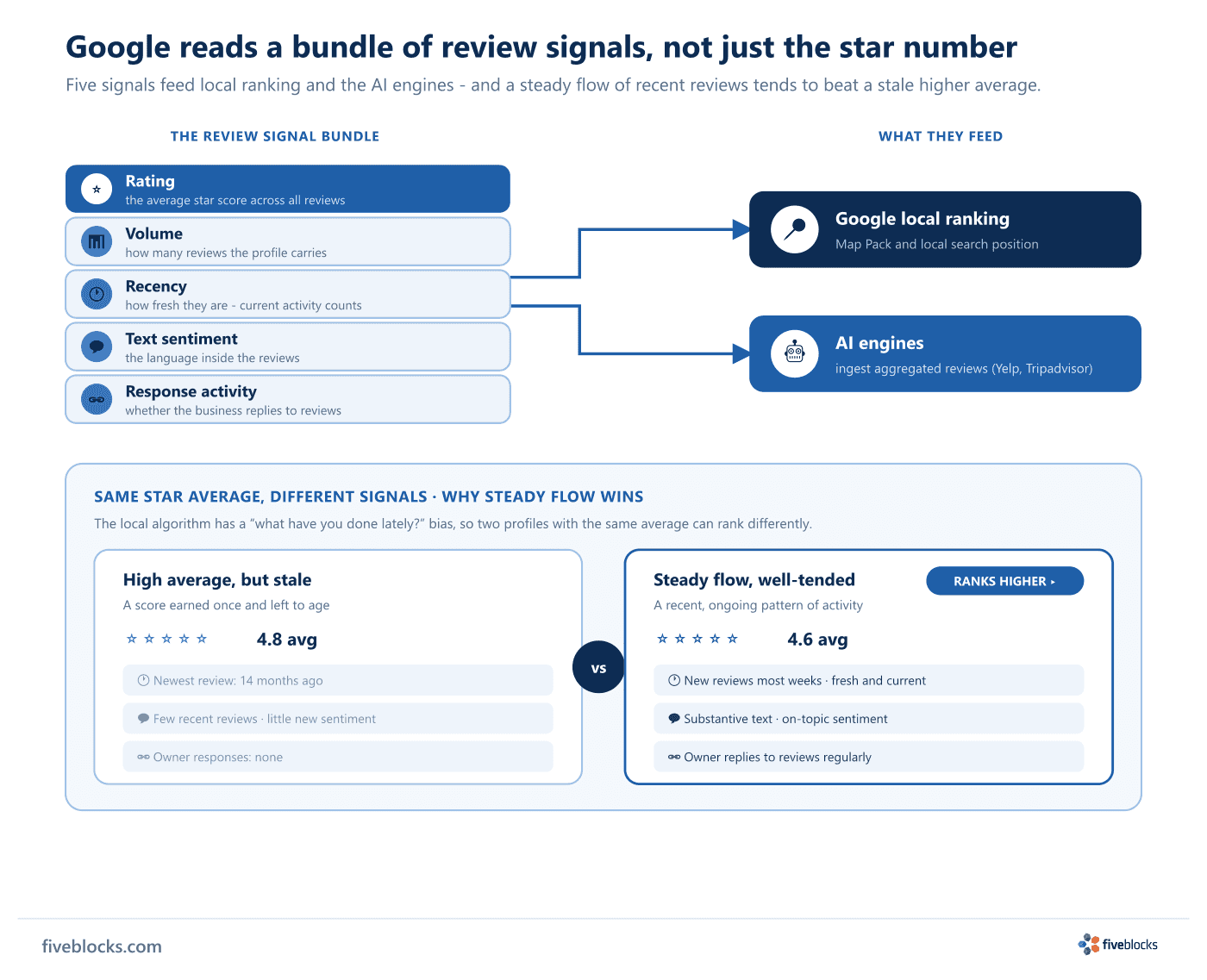
Review rating and local ranking are linked, but Google's local algorithm reads several signals: rating, review volume, recency, text sentiment, and response activity, not just the star number. A steady flow of recent, well-tended reviews tends to outrank a higher average that has gone stale, and the same signals feed the AI engines.
Review rating and local ranking are linked, but the relationship goes beyond a single star number. Google’s local algorithm reads several signals: the rating itself, the volume of reviews, their recency, the sentiment in the review text, and whether the business responds. The average score is one input among several.
The review signals Google’s local algorithm reads
- Rating: the average star score. More reviews and higher ratings can help local ranking.
- Volume: how many reviews the profile carries.
- Recency: how fresh they are. The algorithm leans toward businesses with current activity.
- Text sentiment: the language inside the reviews, which can reinforce the terms and themes associated with the business.
- Response activity: whether the business engages, which can raise a review’s visibility and pull it into AI summaries.
Why a steady flow beats a stale average
A steady stream of recent, substantive reviews signals an active business and tends to rank above a competitor with a slightly higher average but stale, unanswered reviews. Google’s local algorithm has more of a “what have you done lately?” bias, so a high score earned once and left to age does not carry the same weight as an ongoing pattern.
The same signals feed the AI engines, which pull aggregated review content from platforms like Yelp and Tripadvisor when assembling answers about local and category queries. So you cannot treat reviews as a number to maximize once and forget; ranking rewards the ongoing pattern. We track how review signals translate into local search performance with IMPACT™. For a location-based business, reviews are one of the main inputs into search visibility, not a channel you can manage separately from it.
Last reviewed: 20/05/2026
Sources (4)
- Tips to improve your local ranking on Google - Google Business Profile Help support.google.com
- Your Reviews Are Ranking You (Or Not): How to Stay Visible in Google's AI Era searchenginejournal.com
- Customer reviews become a key battleground as AI revolutionizes product discovery modernretail.co
- Google's Local Algorithm and Local Ranking Factors brightlocal.com
