How do you train frontline staff to encourage positive reviews?
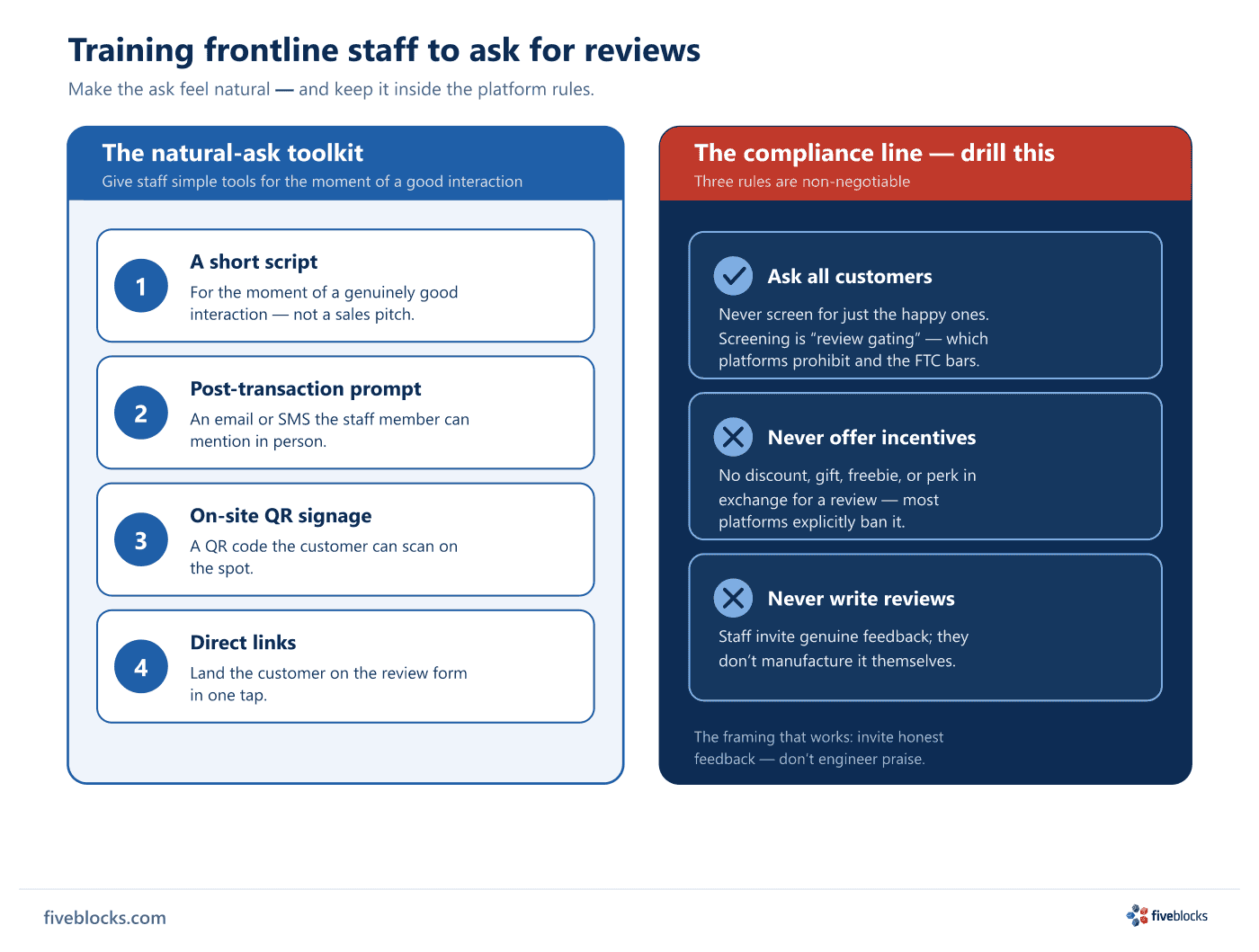
Give frontline staff a simple natural-ask toolkit - a short script for the moment of a good interaction, a post-transaction email/SMS prompt they can mention, on-site QR signage, and direct links straight to the review form - and drill the compliance line: ask all customers (never screen for the happy ones), never offer incentives, and never write reviews themselves.
Training frontline staff to encourage reviews has two parts: make the ask feel natural, and keep it inside the platform rules. Hand staff a simple toolkit for the first and drill the compliance line hard for the second. Well-meaning staff are where most review programs go wrong.
The natural-ask toolkit
- A short script for the moment of a genuinely good interaction, so the ask sounds like part of the conversation rather than a sales pitch.
- A post-transaction prompt by email or SMS that the staff member can mention in person (“you’ll get a quick link from us, we’d value your honest feedback”).
- On-site signage with a QR code the customer can scan on the spot.
- Direct links that land the customer on the review form in one tap, with no steps between the ask and the submission.
The compliance line, drill this
This is the part of the training that needs real emphasis. Three rules are non-negotiable:
- Ask all customers, not just the happy ones. Screening for the customers you expect to be positive is “review gating,” which Google and others prohibit and the FTC treats as manipulation.
- Never offer an incentive. No discount, gift, freebie, or perk in exchange for a review. Most platforms explicitly ban it.
- Never write reviews themselves. Staff invite genuine feedback; they don’t manufacture it.
Why honesty is the framing that holds up
The framing that works in training is honesty: you are inviting genuine feedback, not engineering praise. A program built that way survives platform scrutiny, and a natural spread of feedback reads as authentic to consumers and to the AI engines that treat review content as independent, third-party evidence and weight it heavily when they describe a business. We track how those engines fold review content into their answers with AIQ, because the synthesized verdict, not the star average, is often the first thing a customer sees.
Last reviewed: 20/05/2026
