How do you manage your Google Business Profile for reputation?
Quick answer
The Google Business Profile is the reputation asset a local business controls most directly, and it appears in the local panel, the Map pack, and AI answers. Managing it well means verifying and completing the profile, keeping NAP data consistent, setting accurate categories, posting and refreshing photos, tending the Q&A, and responding to every review.
The Google Business Profile is the reputation asset a local business controls most directly, and it appears in the local panel, the Map pack, and AI answers. Because it is verified and company-controlled, Google reads it as structured, confirmed information about the business. That makes a complete, consistent, actively managed profile worth a standing checklist.
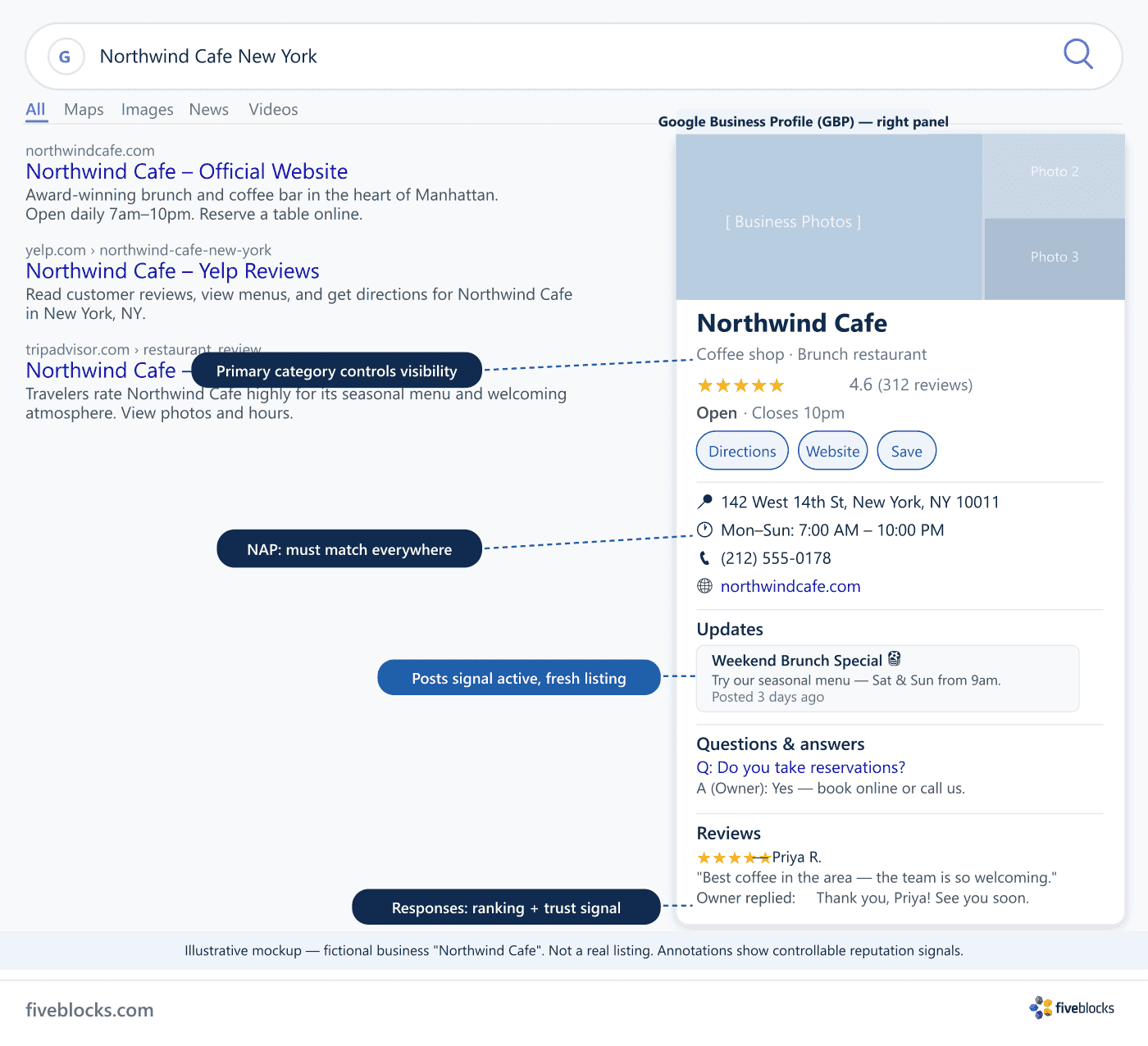
The management checklist
- Verify and fully complete the profile. Businesses with complete, accurate information are more likely to appear in local results, so fill in every applicable field rather than leaving the listing partial.
- Keep NAP consistent. The name, address, and phone number should match every other place the business appears online. Inconsistent NAP splits the local entity into partial duplicates and weakens recognition, so treat it as a foundational discipline rather than a detail.
- Set categories and attributes accurately. The primary category, secondary categories, and attributes tell Google what the business is and which queries it should serve, so they should reflect the actual business rather than aspirational ones.
- Post regularly and keep photos current. Freshness signals an active, operating business. Google’s local algorithm has, in effect, a “what have you done for me lately” bias, so a steady stream of posts and photos reads better than a profile that went quiet.
- Manage the Q&A section. Answer your own customers’ questions in the profile’s Q&A rather than leaving them to strangers, so the answer a searcher sees is the authoritative one.
- Respond to every review, positive and negative. Google’s local algorithm weighs owner responses along with review rating, volume, recency, and sentiment, so response activity is both a ranking and a trust signal. The same review content is increasingly pulled into AI answers about the business.
Why it carries so much weight
- It drives the Map pack and the local panel and feeds the broader Knowledge Panel, anchoring the business in the local index with verified, location-specific attributes.
- The AI engines increasingly read its reviews and attributes when they answer questions about a business, especially location-aware ones.
- For a location business, this single asset often carries more reputational weight than the website, which is why we track how the profile performs across the branded and local result set with IMPACT™.
Last reviewed: 20/05/2026
