How does community opposition to a development affect search results?
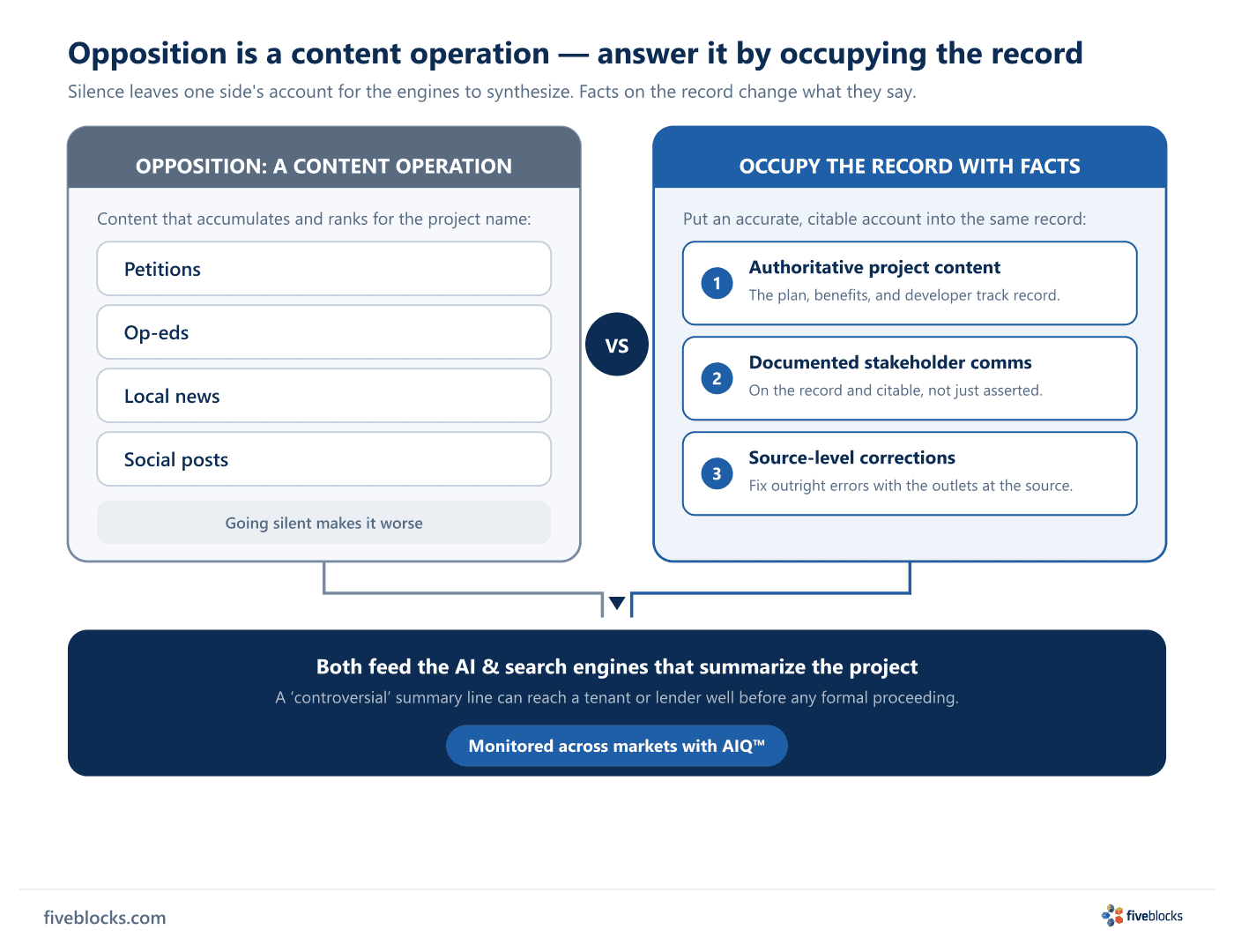
Organized opposition is a content operation: petitions, op-eds, local news, and social posts that accumulate and rank for the project's name. Going silent makes it worse. The response that works is to occupy the record with authoritative project content, documented stakeholder communication, and source-level corrections, monitored across the affected markets.
Community opposition reshapes search results because an organized campaign is, among other things, a content operation: petitions, op-eds, local news, and social posts that accumulate and rank for the project’s name. The instinct to go quiet makes it worse, because silence leaves the opposition’s account as the only one the engines have to synthesize. The fix is to occupy the record with facts.
Why silence backfires
When a developer says nothing, the opposition’s petitions, op-eds, and local coverage are the only material search and AI engines have to work with. The record fills with one side’s framing. A model that summarizes the project as ‘controversial’ for a prospective tenant or lender is doing damage well past the hearing room.
The fact-occupation response
Rather than trying to suppress the opposition, put an accurate, citable account of the project into the same record. Three moves:
- Publish authoritative project content. Material that lays out the plan, the benefits, and the developer’s track record, so the engines have a factual account to synthesize alongside the opposition’s.
- Document stakeholder communication. Back factual communication with the community so the developer’s position sits on the record and can be cited, rather than only being said in a meeting.
- Correct coverage at the source. Where local coverage contains outright errors, pursue corrections with the outlets instead of letting the mistake propagate.
Monitor the AI narrative across the affected markets
Throughout, we watch the AI engine narratives across the affected local markets with AIQ. Damage from an opposition campaign usually surfaces first as a summary line a prospective tenant or lender reads, long before it reaches a formal proceeding. Watching what the engines actually say is how the response stays ahead of it.
Last reviewed: 20/05/2026
