Should you hire a reputation management firm or build an in-house team?
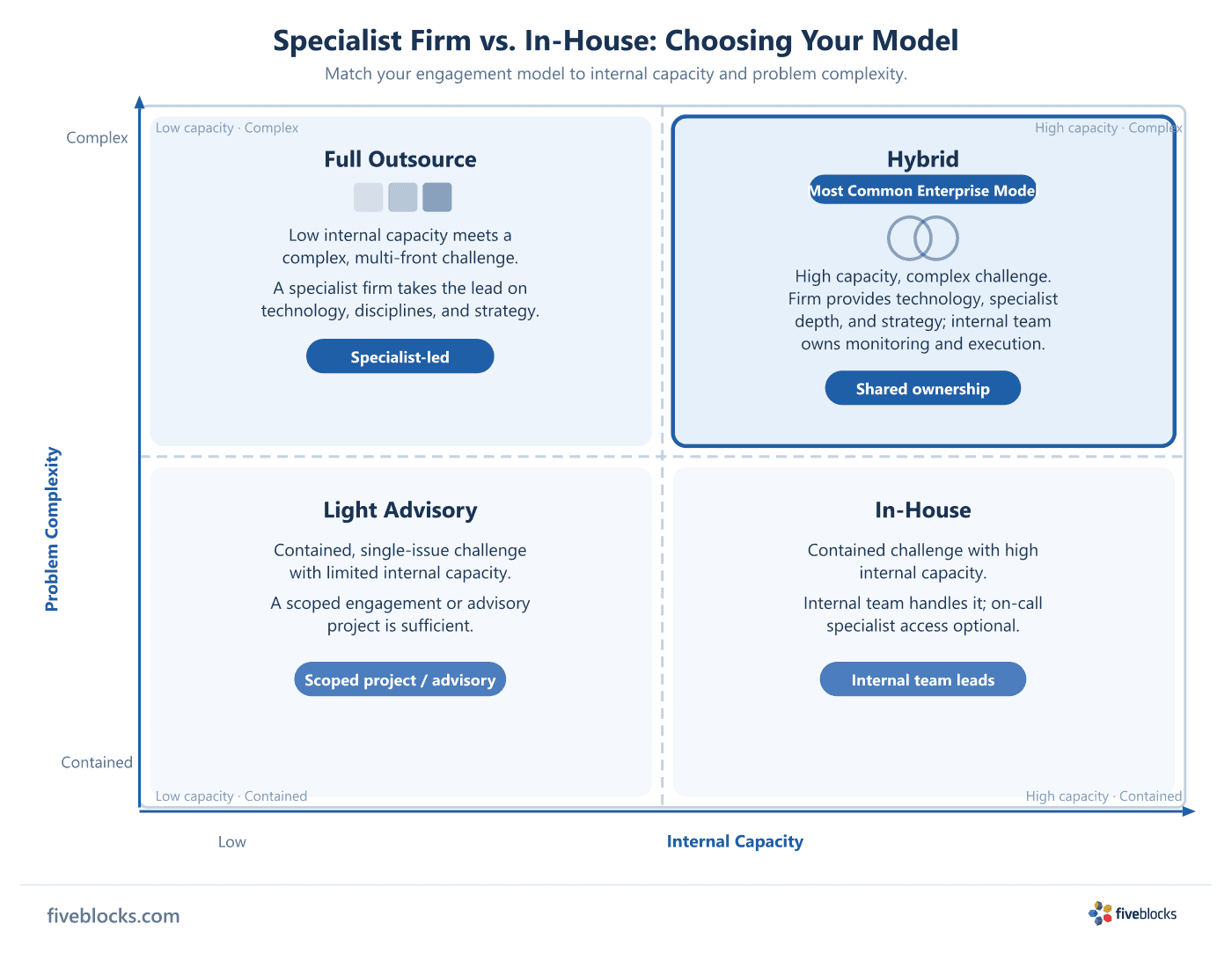
For most organizations a hybrid model works best: the in-house team handles daily monitoring and routine execution, and a specialist firm supplies the proprietary technology, cross-account learning, and depth across search, AI engines, and Wikipedia. Purely internal teams rarely have all three, and full outsourcing gives up the internal context only staff can provide.
For most organizations this is not an either/or decision. What fits depends on how complicated the reputation problem is and how much capability the organization can realistically build and keep staffed internally.
What in-house teams do well
An internal team has institutional context, knows the brand voice, sits close to stakeholders, and can respond without coordination overhead. For daily monitoring and defined execution work, a capable in-house team is hard to beat.
The three gaps in-house teams typically cannot close
- Proprietary technology. Tracking branded search results across queries, geographies, and time; monitoring AI engine narratives on ChatGPT, Gemini, Perplexity, Grok, Copilot, Claude, Google AI Overviews, and Google AI Mode; and alerting on Wikipedia changes all need purpose-built platforms. Building that internally is expensive and rarely matches what already exists.
- Cross-account learning. A firm working across many clients runs into patterns, tactics, and edge cases that no single organization will see on its own. One company’s own history is too small a sample to build that judgment from.
- Depth across disciplines. Disclosed Wikipedia editing under editorial policy, AI narrative management, entity optimization, and SERP architecture each take real specialization. Few small internal teams cover all four, and most end up thin in at least one.
How to choose your model
| Low internal capacity | High internal capacity | |
|---|---|---|
| Complex / multi-discipline challenge | Full outsource to a specialist firm | Hybrid: firm provides technology and specialist depth; internal team owns monitoring and execution |
| Contained / single-issue challenge | Light advisory engagement or scoped project | In-house, possibly with on-call access to specialist advice |
The hybrid model in practice
Enterprises running multi-front reputation work usually land on the hybrid arrangement. The internal team owns daily monitoring, stakeholder communication, and standard execution. The firm brings the technology platform, the specialized disciplines, and the strategic direction. Each side does what it is actually equipped to do.
Five Blocks works in both fully-outsourced and hybrid arrangements. Which one fits depends on the organization’s scale, how complicated the situation is, and what internal capacity already exists.
Last reviewed: 20/05/2026
