How do you evaluate a reputation management firm’s Wikipedia capabilities?
Check whether the firm uses disclosed conflict-of-interest (COI) editing and Talk-page requests, the community-accepted route that produces durable results. Anonymous or undisclosed editing breaks Wikipedia policy, gets caught and reversed, and often draws public attention to the very thing being managed. Five signals separate a capable firm from a risky one: policy fluency, named editors, real community engagement, a flat refusal to edit directly or anonymously, and a methodology the firm will explain.
Wikipedia is where a reputation firm’s method shows most clearly, because the site punishes the wrong approach and rewards the patient one. One question does most of the work: does the firm use disclosed conflict-of-interest (COI) editing and Talk-page engagement, or does it edit anonymously and without disclosure? The answer tells you whether the work will be durable and community-accepted or fragile and likely to backfire.
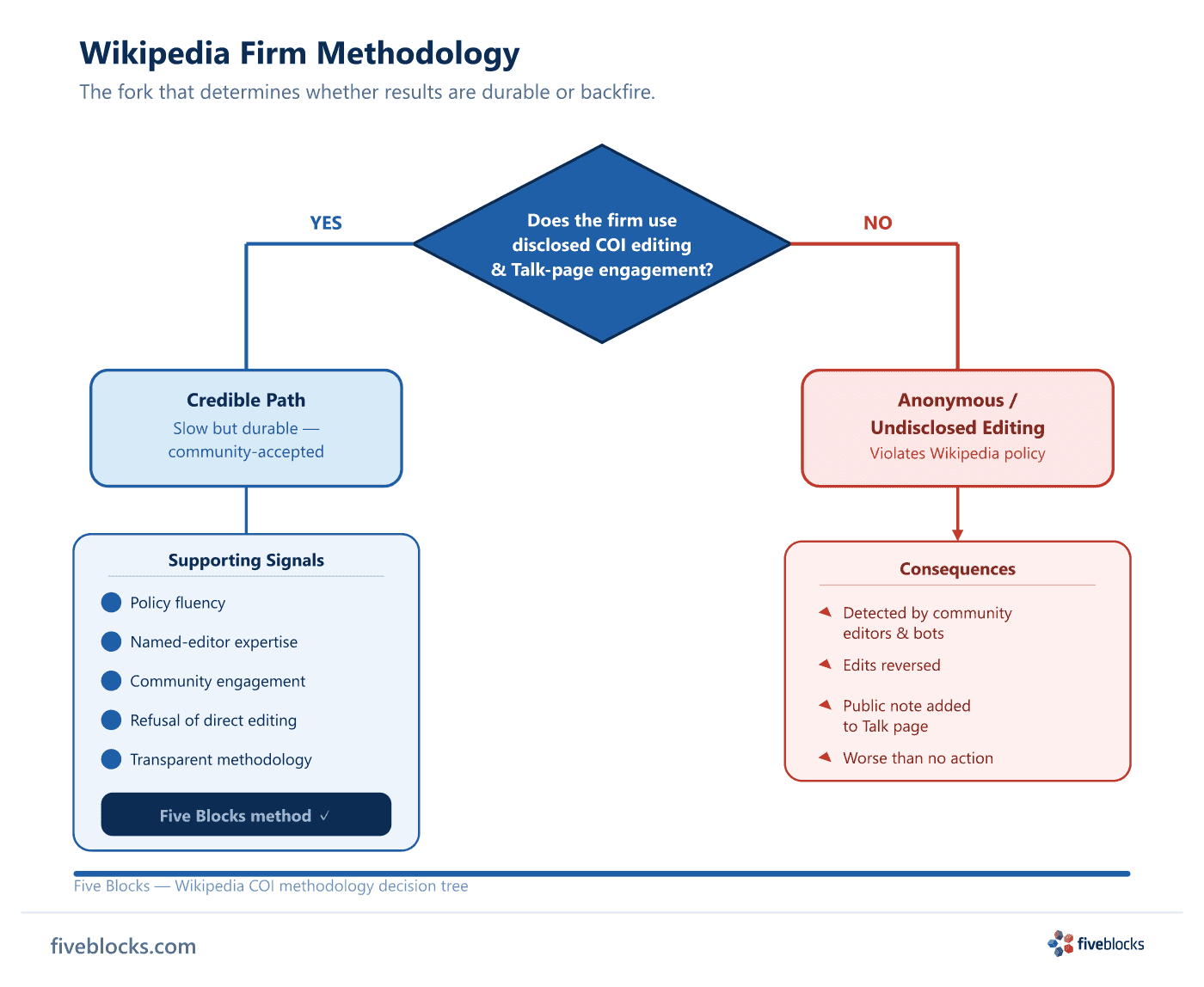
The credible path: disclosed COI editing and Talk-page engagement
Wikipedia policy is explicit: paid or affiliated editors must disclose who they represent and may not edit articles about their clients directly. The compliant route is to propose changes on the article’s Talk page with the {{edit COI}} template, naming the proposed wording, the existing wording it would replace, and the reliable secondary sources behind it. Independent community editors then review the request and implement, modify, or decline it. The process is slower, but the result is community-accepted and durable.
The non-compliant path: anonymous or undisclosed editing
Firms that edit directly and without disclosure violate Wikipedia’s terms of use and community policy. Undisclosed paid editing is also detectable. Community editors, bots, and oversight processes flag edits that read as promotional or that come from accounts with no prior community history. Those edits get reversed, and in high-profile cases a public note is added to the article’s Talk page, which pulls attention toward the very situation the client wanted handled quietly. The shortcut ends worse than the compliant route.
Five signals that distinguish a capable Wikipedia firm
- Policy fluency
- Wikipedia’s rules on notability, reliable sourcing, neutral point of view, and conflict of interest are detailed, and they interact. A firm that cannot explain them in a first conversation will make expensive mistakes: proposing changes that lack qualifying sources, adding promotional tone that triggers community reversion, or misreading what the Biographies of Living Persons policy permits.
- Named-editor expertise
- The work should sit with people who understand the Wikipedia community, not with anonymous contractors. Ask whether the firm’s editors are disclosed account holders with a visible editing history. Anonymous or opaque staffing is a warning sign.
- Depth of community engagement
- Legitimate changes on Wikipedia come through community process. A capable firm works with that process: it files well-sourced Talk-page requests, answers reviewer questions, and accepts community decisions even when the outcome is not what the client wanted. Firms that argue with editors, resubmit declined requests without addressing the objection, or try to route around consensus are creating liability, not managing reputation.
- Firm refusal to do undisclosed or direct editing
- This is the decisive signal. A firm willing to edit articles on a client’s behalf without disclosure, through anonymous accounts, or by misrepresenting affiliation is selling a service that violates Wikipedia’s terms of use and creates risk it will not disclose to the client. The right answer to “can you just edit the article directly?” is no.
- Transparent methodology
- A credible firm explains its Wikipedia process in detail: how disclosures are made, how Talk-page requests are structured, how it handles community pushback, and what it does when a proposed change is declined. A firm that keeps its Wikipedia methodology vague or proprietary is hiding something you would want to know.
Five Blocks works only through disclosed COI editing. We propose changes on Talk pages, disclose the client relationship on our editors’ user pages, and leave the final call to independent community editors. That is slower than editing directly. The results hold.
Last reviewed: 20/05/2026
