What is the role of YouTube and video content in AI search results?
YouTube content is increasingly cited in AI answers, especially for tutorial, product, and explainer queries: engines extract usable text from video descriptions and transcripts and can cite a video the way they cite a written article.
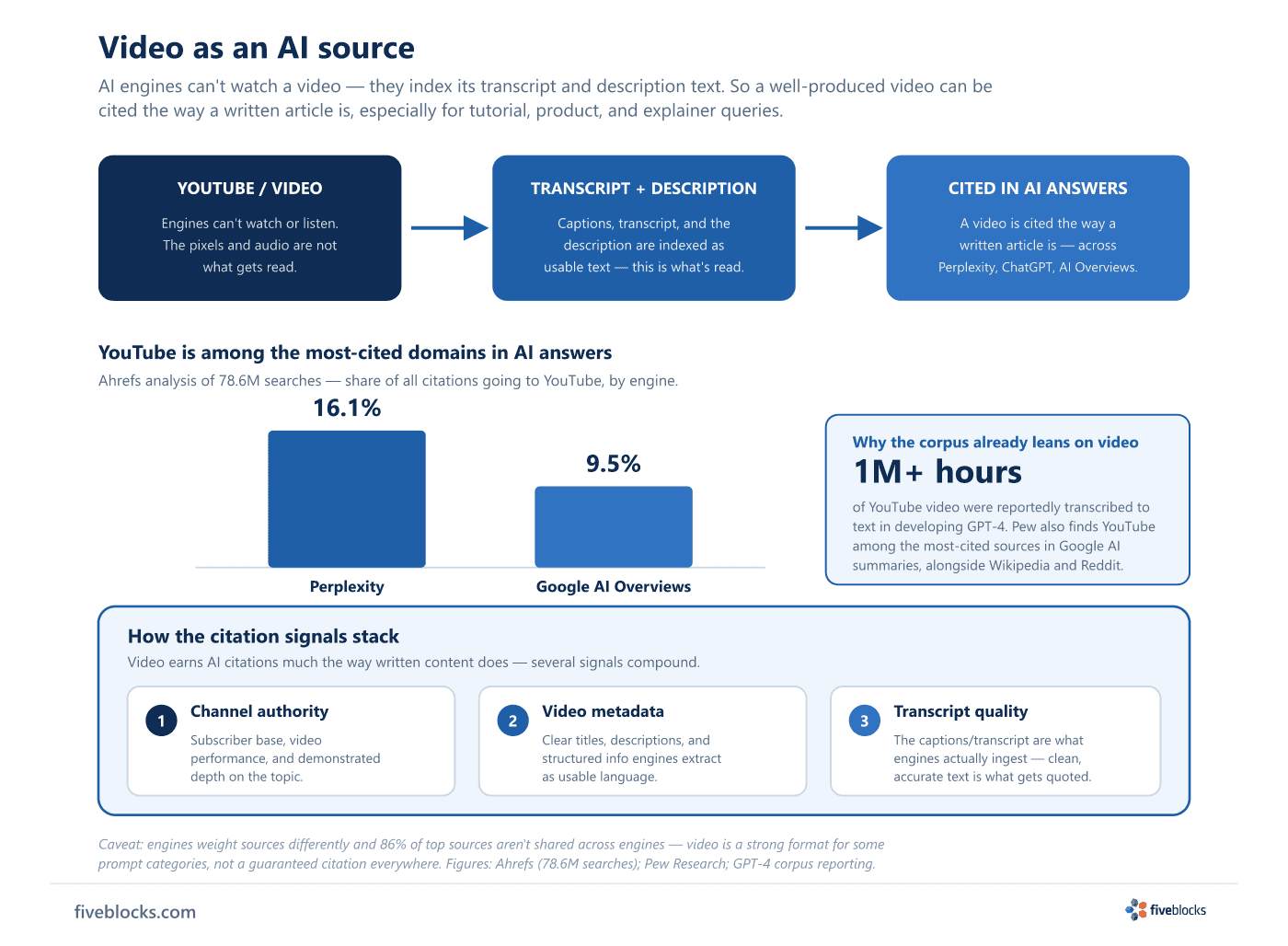
Over the last two years, video has moved from a background source to a mainstream AI input. Search engines and AI engines can’t watch a video or listen to audio, but they do index text. A video’s transcript and description become the material an engine actually reads, so a well-produced video on a topic can be cited the way a written article would be.
Why video now shows up in AI answers
Two things converged. The first is the underlying corpus. Developing GPT-4 reportedly drew on more than a million hours of YouTube video transcribed into text, and engines like Perplexity routinely surface YouTube transcripts, caption windows, and time-stamped speech segments at retrieval time. The second is the citation data. Across large-scale studies, YouTube ranks among the most-cited domains in AI answers. It is one of the most frequently cited sources in Google AI summaries alongside Wikipedia and Reddit, and in one analysis of 78.6 million searches it accounted for 16.1% of Perplexity citations and 9.5% of AI Overviews citations.
For tutorial queries, product comparisons, technical explainers, and other evaluative content, YouTube citations now appear regularly across Perplexity, ChatGPT Search, and Google AI Overviews.
How the signals stack
Video earns AI citations much the way written content does, with several signals compounding:
- Channel authority: subscriber base, video performance, and demonstrated depth on the topic.
- Video metadata: clear titles, descriptions, and structured information in the description, all of which engines extract as usable language.
- Transcript quality: the captions and transcript are what the engines ingest and index, so a clean, accurate transcript is what gets read and quoted.
One caveat: AI engines synthesize across many sources and weight them differently, and even for the same query different engines often cite completely different websites. Video is a strong format for some prompt categories, not a guaranteed citation everywhere.
The practical implication: a brand with an under-invested YouTube presence is leaving signal on the table for any AI prompt category that maps naturally to video.
Last reviewed: 19/05/2026
Sources (3)
- The 10 Most Mentioned Domains for ChatGPT, Perplexity, and AI Overviews Across 78.6M Searches ahrefs.com
- Do YouTube Transcripts Influence AI Search Summaries? contently.com
- Top Domains Cited by AI Search: What 30 Million Sources Reveal Across ChatGPT, Google AI, Gemini, Perplexity, and AI Overviews almcorp.com
