What is an AI hallucination and how does it affect brand reputation?
An AI hallucination is a confident AI statement with no factual basis: a fabricated lawsuit, an executive who never worked there, a product that does not exist. You fix it by correcting the sources the engine reads, not by prompting the model.
An AI hallucination is a plausible-sounding statement an AI engine delivers with full confidence but no factual basis. It is the failure mode engines are least able to prevent, and for brands it tends to take a few recognizable shapes.
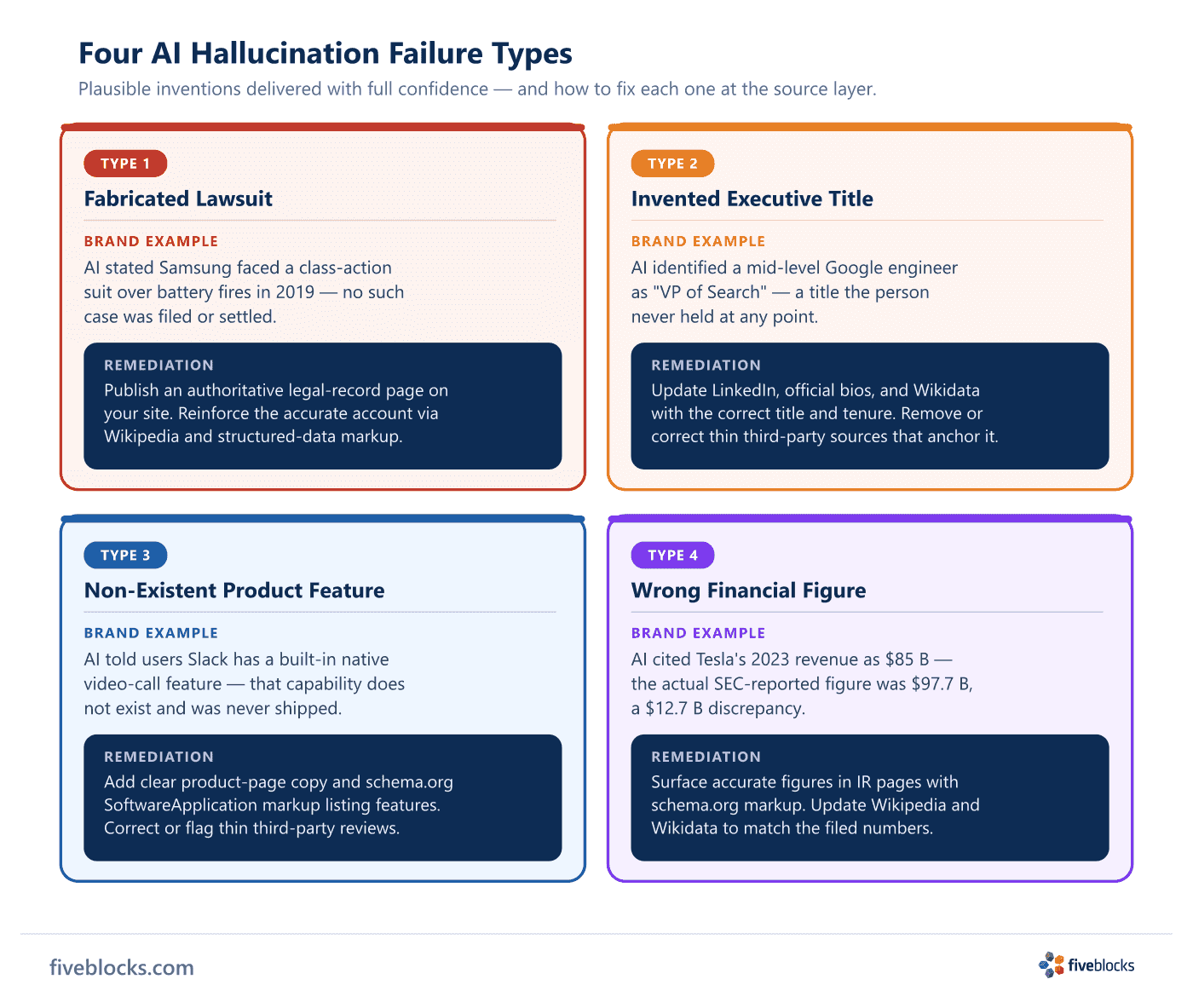
The brand-specific hallucination types
The dangerous ones are inventions that sound entirely plausible:
- Fabricated lawsuit, legal action attributed to the company that never happened.
- Fake executive, a name appended to a role the person never held.
- Non-existent product feature, a capability or product that was never shipped.
- Wrong financial detail, a number that matches no filing the company has ever made.
The risk is that each of these is delivered in the same confident tone as a true statement. A downstream reader, a journalist, a candidate, a customer, has no way to tell the fabrication from the fact.
Why prompting the model does not fix it
The engine doesn’t remember what you tell it, and it builds every answer fresh from the sources it trusts. The false claim is usually anchored to one of those sources: a thin or contested page, an older mix-up, sometimes nothing identifiable. Correcting it means working on that source, not arguing with the model.
The fix: working on the sources
- Identify the anchor. Find what the engine is leaning on to produce the false claim.
- Strengthen the correct version. Reinforce the accurate account through Wikipedia, owned content, and structured data so the right signal outweighs the wrong one.
- Track it. Monitor through AIQ to verify the hallucination actually drops out of the engines’ answers.
Last reviewed: 19/05/2026
