How do AI agents and autonomous tools change the stakes of digital reputation?
When AI agents take autonomous actions, a wrong AI conclusion can drive a transaction, application, or message directly instead of just informing a person's preliminary research. That removes the human check that used to catch the error, so accuracy matters more.
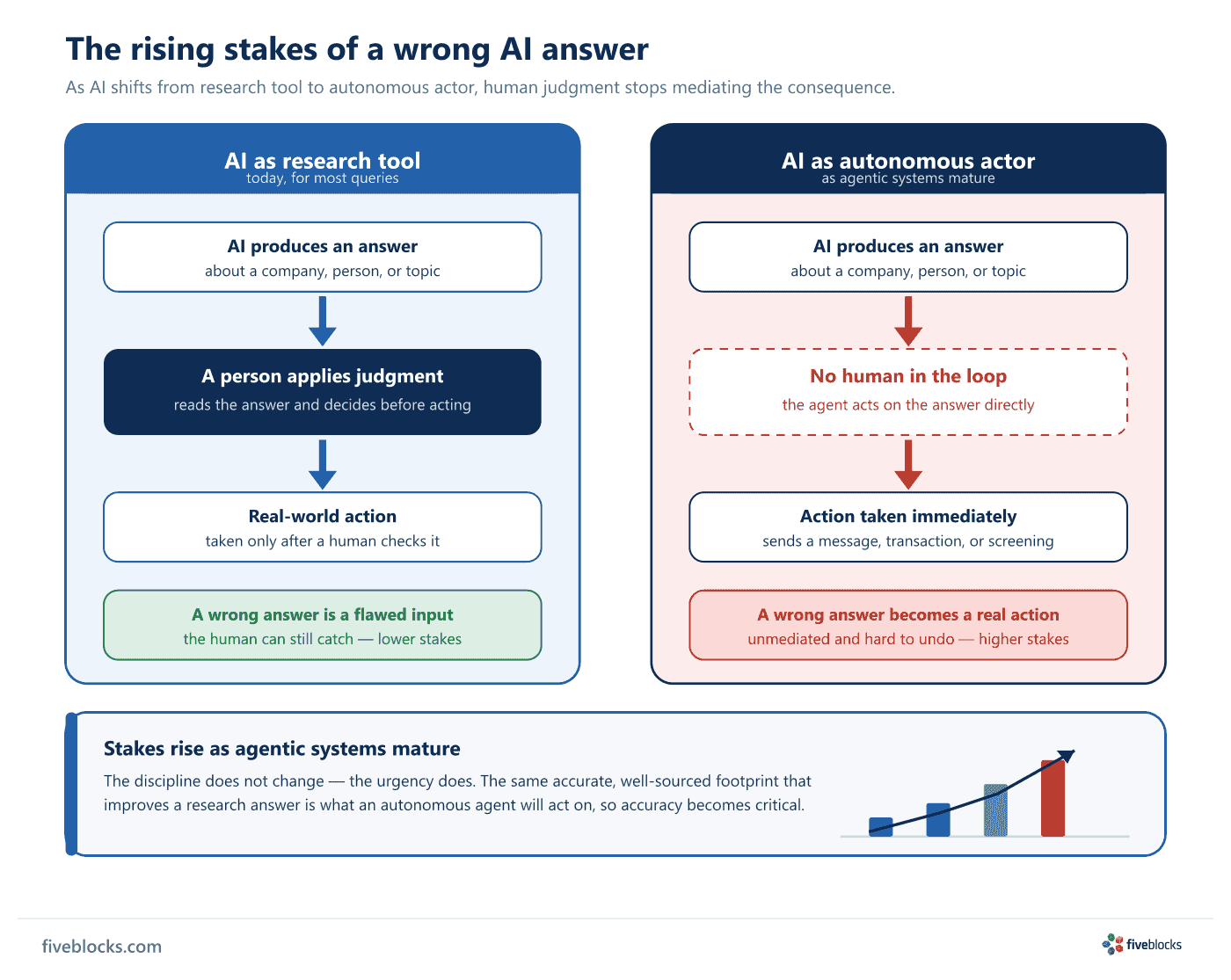
When AI moves from a research tool to an autonomous actor, the cost of a wrong answer changes. If a person asks an engine about a company and gets a wrong answer, the person can still apply judgment before acting. If an autonomous agent acts on that same wrong answer, there is no one in between to catch it.
Why the stakes rise as AI becomes agentic
The difference is who stands between the AI’s conclusion and the real-world outcome. AI answer accuracy already varies widely in research contexts. A 2025 Columbia Journalism Review study found Perplexity answered 37 percent of queries incorrectly and Grok 3 answered 94 percent incorrectly, with most tools presenting inaccurate answers “with alarming confidence.” In an agentic context, those same errors do not pass through a human check before producing a real outcome.
| AI as research tool | AI as autonomous actor |
|---|---|
| A person reads the answer and applies judgment before acting | An agent acts on the answer directly |
| A wrong answer is a flawed input the human can catch | A wrong answer becomes a sent message, a completed transaction, a filed form, an investment, or a screened-out candidate |
| Human judgment mediates the consequence | The consequence is unmediated |
Consequential contexts are already here
The step from research to consequential action is already partly taken. KPMG’s 2025 analysis of M&A activity found that AI now “accelerates the review of data rooms, management materials and unstructured documents” in financial and commercial due diligence, making it “essential for buyers and investors to accurately assess” AI-based information about target companies. When the same engine that provides research conclusions also feeds contract-stage analysis, source accuracy is no longer just an information-quality question; it affects the deal. AI that files, schedules, screens, and transacts without a human checkpoint follows the same pattern.
What this means for a reputation program
As agentic systems mature across the major engine providers, the stakes on AI reputation accuracy rise with them. The discipline does not change; the urgency does, because a wrong answer no longer passes through human judgment before it produces an outcome.
- Treat AI accuracy as infrastructure. The programs that take this seriously do not wait for agentic systems to become common before investing.
- Invest in the underlying sources. Working on the sources the engines read is what produces reliable answers in both research and agentic contexts.
- Plan for both contexts at once. The same accurate, well-sourced footprint that improves a research answer is what an agent will act on.
Last reviewed: 19/05/2026
