What does Five Blocks believe every board member should know about digital reputation?
Boards should know four things: the company's and key executives' Wikipedia and Knowledge Panel status, the AI narrative posture across the major engines, the search results for the company and CEO names, and the firm's crisis-response readiness, reported on a quarterly cadence with a deeper annual review and standardized KPIs.
Board reporting on digital reputation has settled into a recognizable pattern over the last two years. Four components cover what every board member should be able to see: Wikipedia and Knowledge Panel status, the AI narrative across major engines, search results for the company and CEO names, and crisis-response readiness, reviewed on a regular cadence against standardized KPIs.
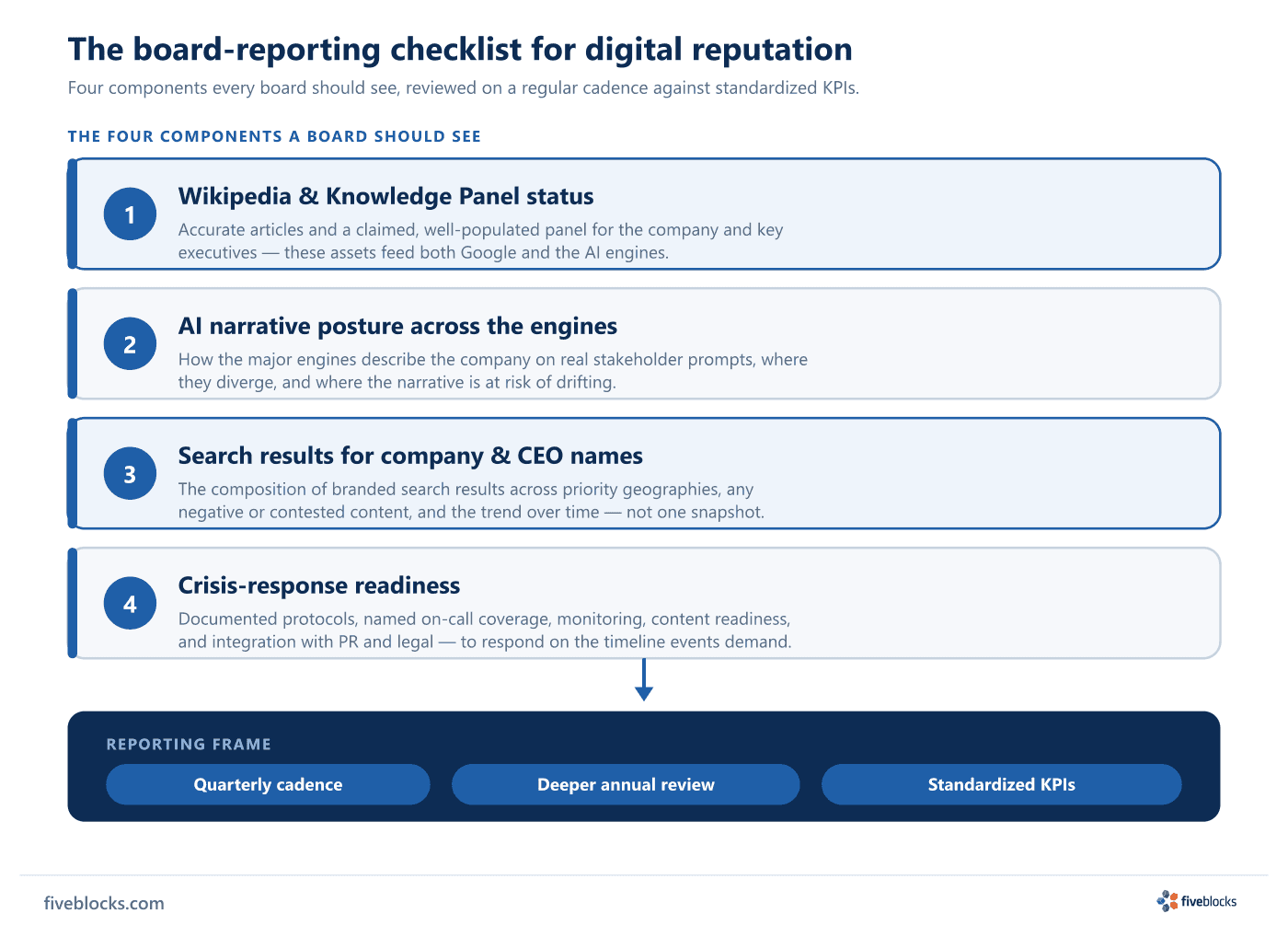
The four components a board should see
- Wikipedia and Knowledge Panel status
- Whether the company and its key executives have accurate Wikipedia articles, whether the Knowledge Panel is claimed and well-populated, and what risks exist in the current state. These assets feed both Google’s Knowledge Panel and the AI engines, so their accuracy reaches well beyond the page itself.
- AI narrative
- How the major engines describe the company on the prompts stakeholders actually use, where the engines disagree with one another, and where the narrative is at risk of drifting. This is tracked across the engines rather than read off any single one, because their answers differ.
- Search results for company and CEO names
- The makeup of the search results page for branded queries across priority geographies, the presence of any negative or contested content, and the trend over time rather than a single snapshot.
- Crisis-response readiness
- Documented protocols, named on-call coverage, monitoring infrastructure, content readiness, and integration with PR and legal, so the organization can respond on the timeline a reputational event demands.
Cadence and KPIs
In our experience advising companies, the reporting cadence is usually quarterly, with a deeper annual review. Boards are also moving toward standardized KPIs that let them compare reputation health from one period to the next instead of only reacting to events as they surface.
Last reviewed: 19/05/2026
