Our App Store rating dropped from 4.5 to 2.9 after a PR incident. Can ORM help?
Yes, but the sequence is non-negotiable: fix the product issue that caused the drop first, then drive recovery with three moves, accelerate authentic reviews from your now-fixed user base, invite affected users to update their reviews (which the platforms permit), and keep shipping visible improvements. Recovery follows real remediation, not before it.
An App Store rating that falls after an incident is recoverable, but the order of operations is non-negotiable: the product fix has to come before the review work. App stores and users both penalize a recovery attempt that isn’t backed by an actual change, and trying to manufacture positive ratings without a real fix is the kind of manipulation the platforms screen for. Once the underlying issue is genuinely addressed, three drivers move the rating back up.
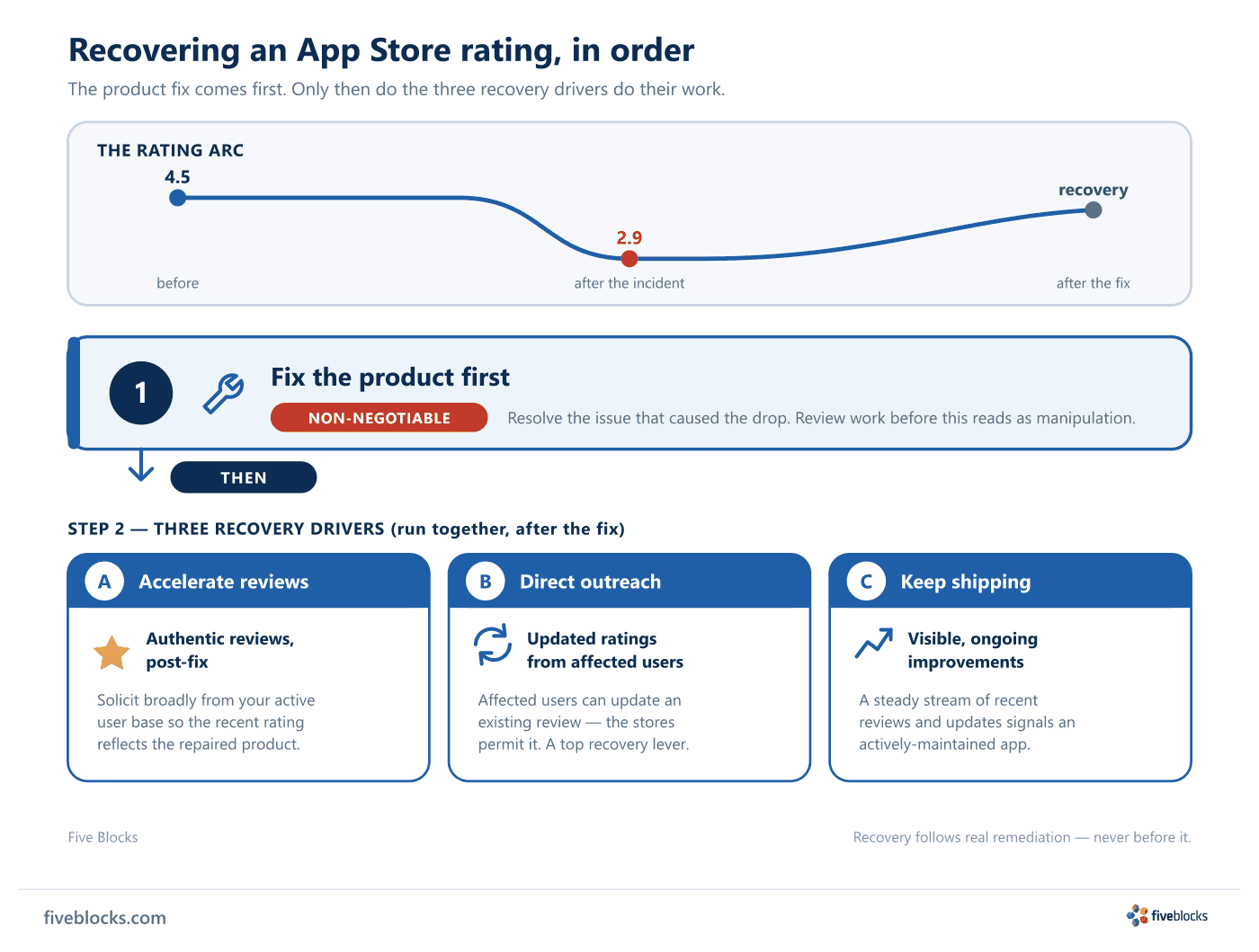
Step 1, fix the product first (non-negotiable)
Nothing else starts until the issue that caused the 4.5→2.9 drop is actually resolved. There is no shortcut around it. Review work layered on top of an unfixed product reads as manipulation to both users and the stores, and the rating will not hold.
Step 2: then run the three recovery drivers, in this order
- Accelerate authentic reviews post-fix. Encourage genuine reviews from users now experiencing the fixed product, so the recent rating, which app stores weight heavily and which is what new users see, reflects the repaired product rather than the incident. Solicit broadly from your active user base; do not screen for only the users you expect to be happy, because sentiment-gating is itself a policy violation.
- Reach out directly to affected users for updated ratings. Users who hit the original problem and have since had a good experience can update their existing review. The app stores permit this, and it is one of the most effective recovery levers because it converts the very ratings that pulled the average down.
- Keep shipping visible improvements. A steady stream of genuine, recent reviews and ongoing updates tells users and engines the app is actively maintained and currently healthy, so the trajectory reads as a clear climb rather than a one-time patch.
Why the order matters
The fix-before-reviews sequence is what makes the recovery hold: real remediation gives the authentic reviews something true to say, and the recent-rating weighting then surfaces the improved product to new users. We monitor how the rating recovers and whether the AI engines still reference the incident with AIQ, because engines can keep citing an old problem for a while after it is resolved. They lag the actual recovery and need current signal to catch up.
Last reviewed: 20/05/2026
