What reputation management challenges are unique to family offices?
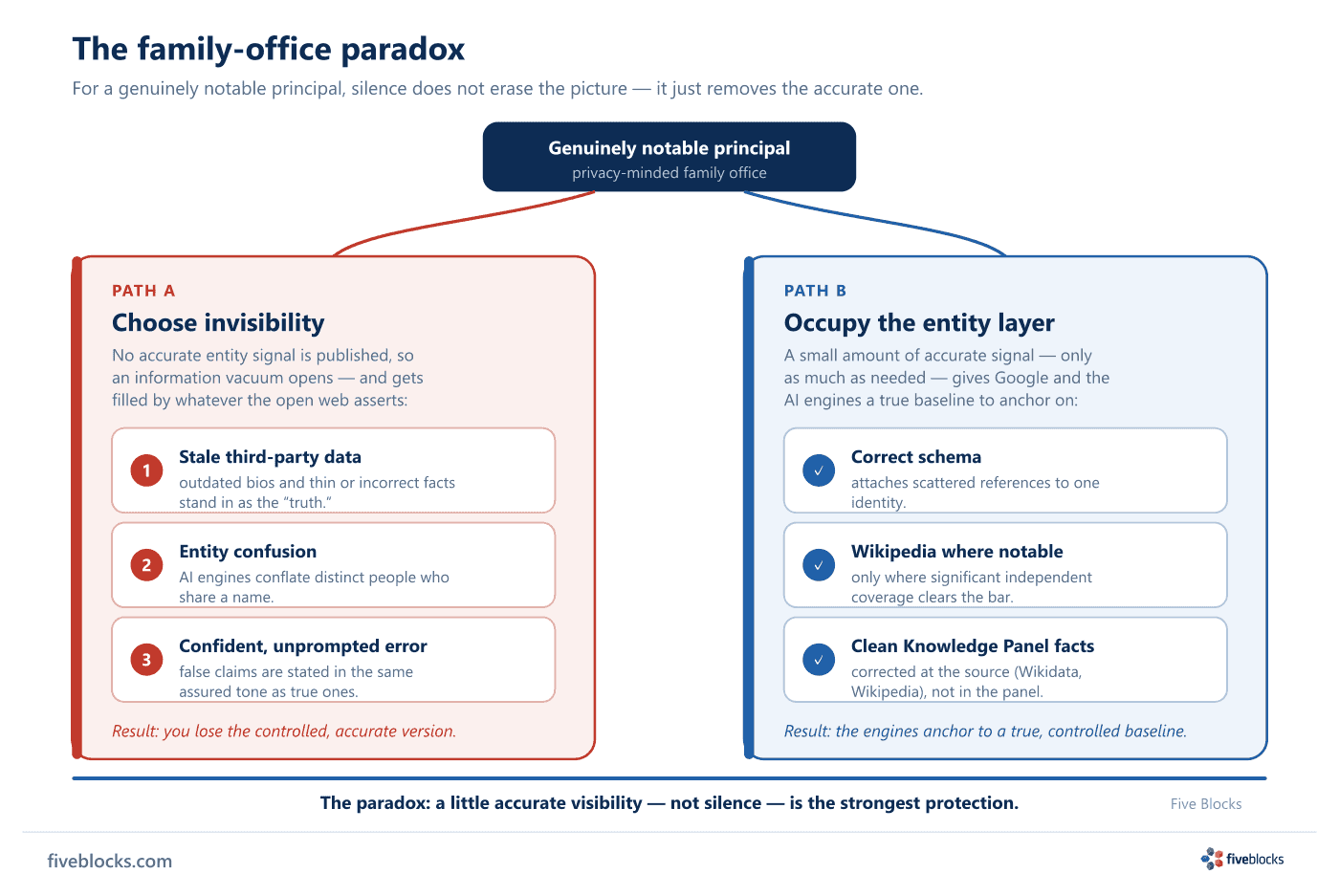
A family office's instinct toward invisibility can backfire. A principal who is genuinely notable but has no accurate entity signals does not disappear; they leave a vacuum that stale third-party data and confident, wrong AI summaries fill. Occupying the entity layer minimally - correct schema, a Wikipedia article where notability supports one, and clean Knowledge Panel facts - gives Google and the AI engines a true baseline to anchor on, which makes a small amount of accurate visibility the best protection a privacy-minded principal has.
Family offices have the inverse of a public company’s reputation problem: the goal is usually less visibility, not more. That instinct can backfire. A principal who is genuinely notable but has no accurate entity signals does not become invisible; they leave a vacuum, and stale third-party data and confident-but-wrong AI summaries fill it on their behalf.
Why choosing invisibility backfires
Silence does not erase a notable principal from the web. It only removes the controlled, accurate version. With no canonical entity to anchor on, Google and the AI engines build a picture from whatever the open web asserts: outdated bios, conflated namesakes, thin or incorrect facts. Two failure modes follow.
- Entity confusion. When entity infrastructure is weak – no Wikidata item, no schema, no clean disambiguation – AI engines can conflate distinct people who share a name, splitting one principal into two half-formed identities or merging them with someone else entirely.
- Confident, unprompted error. AI engines state false claims about people in the same assured tone they use for true ones. A high-profile individual is exactly the kind of entity models describe confidently and sometimes inaccurately.
Occupy the entity layer deliberately and minimally
Claim the entity layer on purpose, and only as much of it as the principal needs, so the engines anchor to a controlled, accurate baseline instead of open-web guesswork:
- Correct schema on the principal’s bio, so search and AI engines attach scattered references to one identity.
- An accurate Wikipedia article where notability supports one. Wikipedia’s standard is significant coverage in multiple reliable, independent sources. Where notability is thin, attempting an article risks deletion, so this is reserved for principals who genuinely clear the bar.
- Clean Knowledge Panel facts. Google generates the panel automatically from underlying sources such as Wikidata and Wikipedia, so panel errors are corrected at the source, not by editing the panel directly.
The paradox: a little accurate visibility is the strongest protection
None of this requires exposing the office or the principal beyond what they choose to surface. We use AIQ to track what the major AI engines say about the principal, because high-profile individuals draw confident, wrong summaries, and an unprompted description is where the account goes wrong without anyone noticing. A small amount of accurate visibility – not silence – is the best protection a privacy-minded principal has.
Last reviewed: 20/05/2026
