How do you manage reputation for a family office with a public-facing patriarch or matriarch?
Build an accurate, authoritative entity layer around the public-facing principal - Person schema, a Wikipedia article where they are genuinely notable, correct Knowledge Panel signals - and keep the office's own footprint controlled. Consistent signals give Google and the AI engines one canonical version of the principal to anchor on, and monitoring AI answers catches the confident-but-wrong descriptions a high-profile individual attracts.
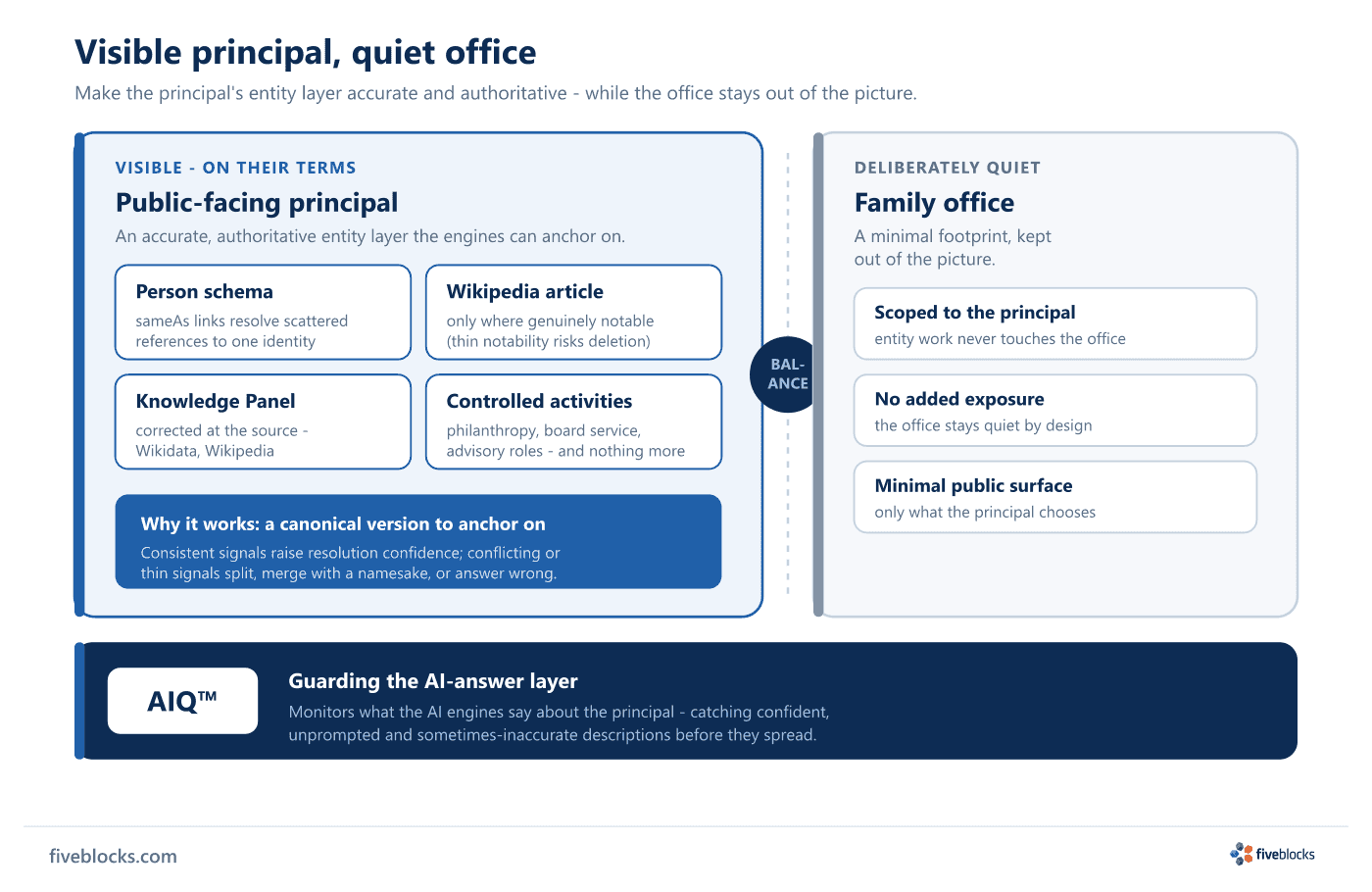
A family office with a public-facing principal has a built-in tension: the principal is visible enough to be searched and described by AI engines, while the office itself wants minimal exposure. The work resolves it by making the principal’s entity layer accurate and authoritative and keeping the office’s footprint controlled.
Build an accurate entity layer around the principal
The goal is a clean, consistent set of signals tied to the activities the principal actually wants public – philanthropy, board service, advisory roles – and nothing more. In practice that means:
- Person schema on the principal’s bio, with
sameAslinks to their authoritative profiles, so search and AI engines resolve scattered references to one identity. - A Wikipedia article where the principal is genuinely notable – meeting Wikipedia’s standard of significant coverage in reliable, independent sources. Where notability is thin, attempting an article invites deletion, so reserve it for principals who clear the bar.
- Correct Knowledge Panel signals. Google generates the panel automatically from underlying sources such as Wikidata and Wikipedia, so panel facts get fixed at the source rather than in the panel itself.
What accurate signals prevent
Consistent entity signals give Google and the AI engines one canonical version of the principal to anchor on. When name, description, and biographical details line up across sources, the systems resolve the person with higher confidence. When signals conflict or are thin, entity resolution can fail: the principal gets split into two half-formed entities, merged with a namesake, or described in a wrong or sparse answer. AI engines also state false claims about people in the same confident tone as true ones, and a high-profile individual is described often enough that some of those descriptions will be wrong.
Keep the office quiet while the principal stays visible
None of this requires exposing the office. The entity work is scoped to the principal and to the public activities they choose to surface. We use AIQ to monitor what the major AI engines say about the principal, since an unprompted, confident description is where things go wrong unnoticed. The principal stays visible on their terms; the office stays quiet.
Last reviewed: 20/05/2026
