How do you manage the digital reputation of a fund that is closing or restructuring?
Keep investor-facing content strictly factual and update Wikipedia and Knowledge Panel signals carefully as the structure changes. Both entities, the legacy fund and the ongoing vehicle the principals carry forward, need their search and AI narratives kept accurate and separate.
A fund that is winding down or restructuring runs a specific risk: the public record can lag the actual situation, so investors and counterparties read an outdated, and often alarming, version of events. The work is accuracy and continuity: keep investor-facing content strictly factual, correct the AI engine answers that get the story wrong, hold the legacy entity and the ongoing vehicle as separate narratives, and update Wikipedia and Knowledge Panel signals carefully as the new structure takes shape.
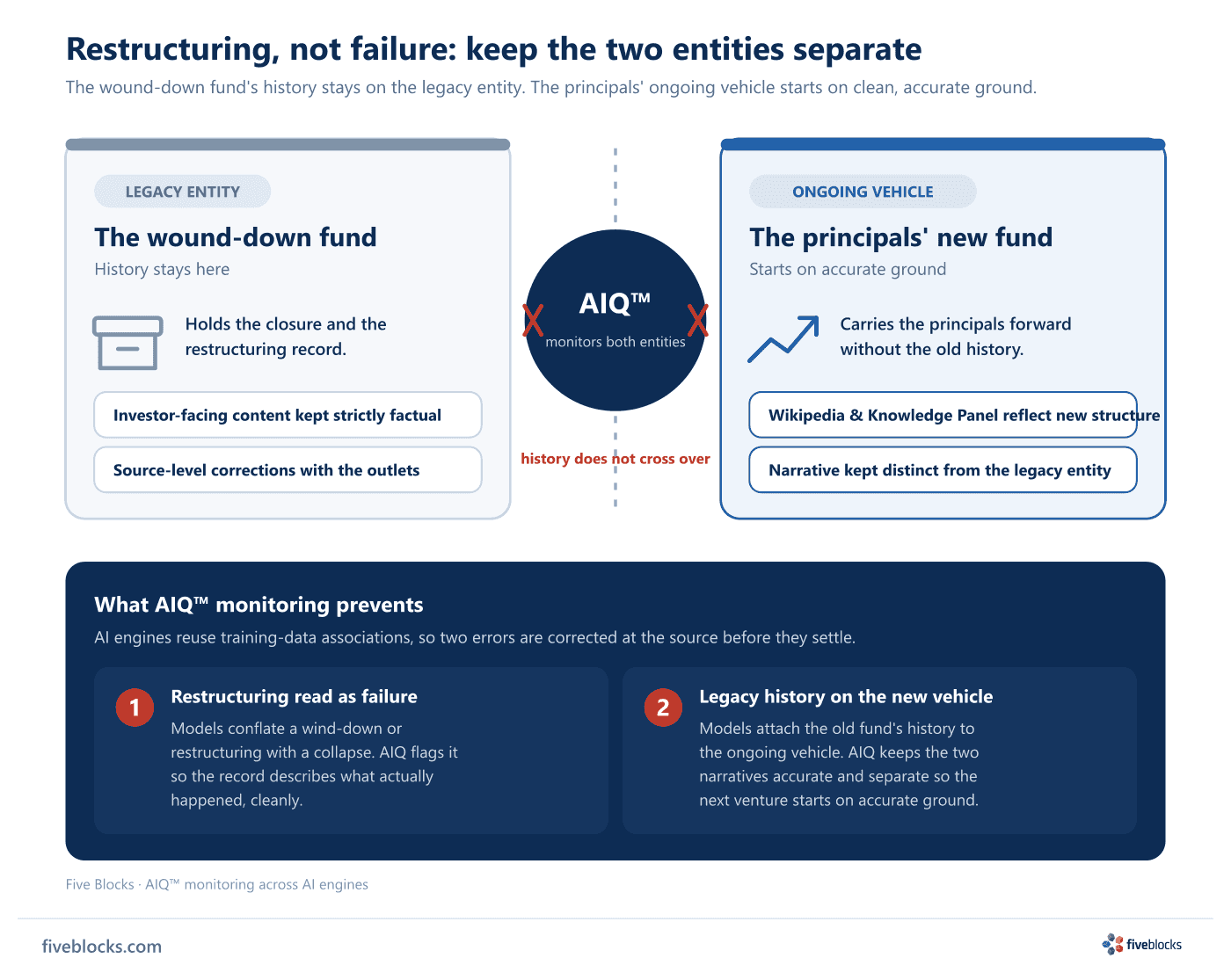
What the work covers
- Strictly factual investor-facing content. Anything aspirational reads badly against a closure, so the wording stays factual rather than promotional.
- Active correction of AI engine answers. Models often conflate a restructuring with a failure, and they may attach the legacy entity’s history to whatever ongoing vehicle the principals carry forward. Left alone, those answers settle in as the accepted version, so they need active correction.
- Two entities, kept separate. We monitor the legacy entity and the ongoing vehicle with AIQ to keep both narratives accurate and distinct, so the wound-down fund’s history does not bleed onto the new vehicle.
- Careful entity-signal updates. Wikipedia and Knowledge Panel signals feed the canonical facts that search and AI engines draw on, so they get updated to reflect the new structure rather than the old one.
- Source-level corrections. Where an outlet has covered the change inaccurately, we go back to the publisher and pursue a correction at the source.
Why separating the two entities matters
The lag risk and the dual-entity problem compound each other. The public record trails the real situation, and an outdated account of a closure reads as an alarming one, so the priority is two clean, separate narratives: the wound-down fund’s history, and the principals’ ongoing vehicle. The goal is a record that describes what actually happened, so the principals’ next venture starts on accurate ground instead of inheriting a story that mistook a restructuring for a collapse.
Last reviewed: 20/05/2026
