How should cryptocurrency and digital asset firms manage reputation?
Crypto reputation work starts from a defensive posture: regulatory-aware content, real transparency on operations, custody, and security, and accurate credentialed executive bios, all backed by daily AI monitoring. A single exchange collapse or hack can rewrite how models describe the whole category overnight.
Digital-asset firms operate in a category where the default narrative is skepticism and the news cycle is unforgiving, so reputation work starts from a more defensive posture than most sectors. Content has to be regulatory-aware, transparency on operations has to be real disclosure rather than polish, and the program leans hard on monitoring, because a single exchange collapse or hack can rewrite how a model describes the entire category overnight.
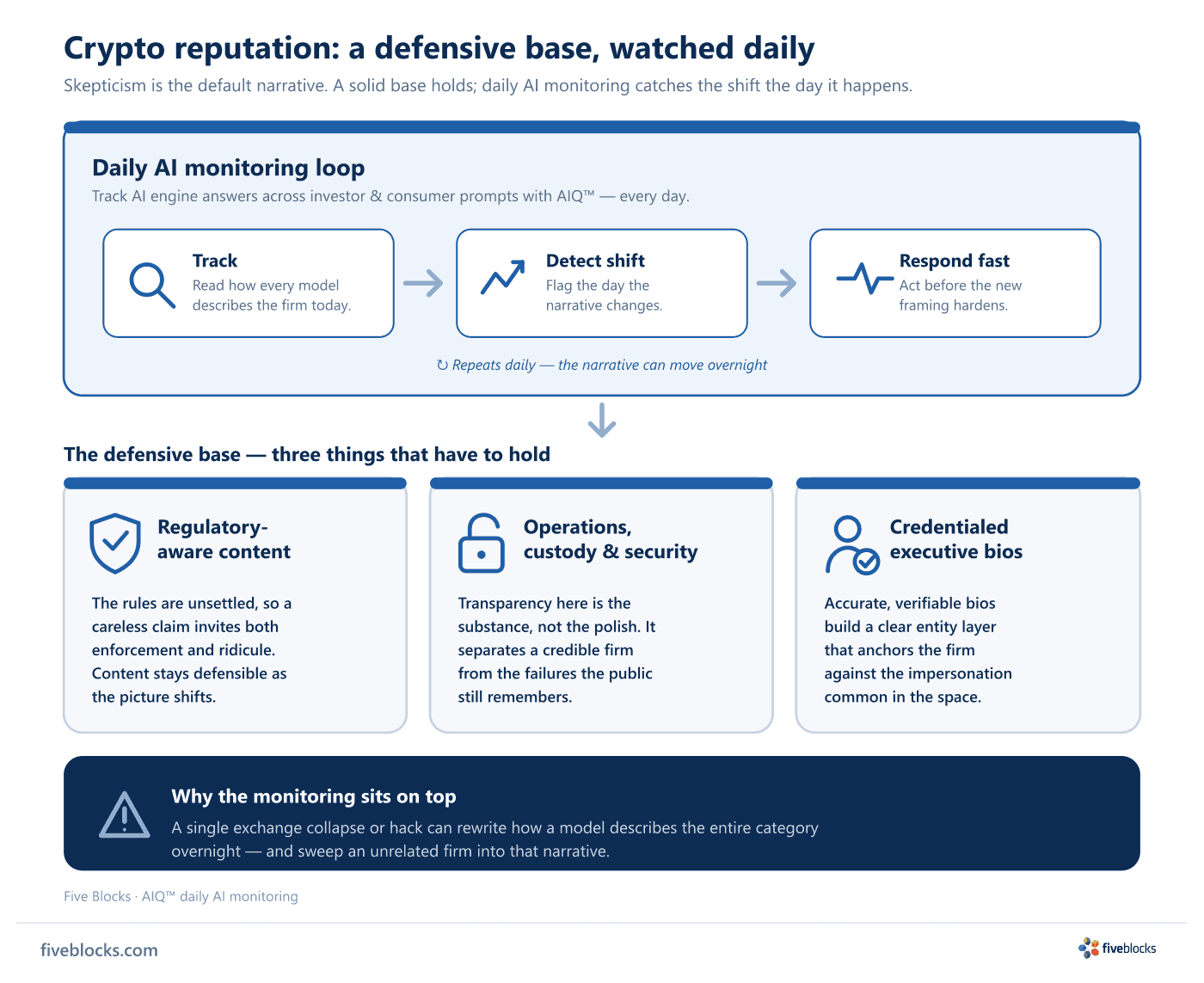
The defensive base: three things that have to hold
- Regulatory-aware content. The rules are unsettled, so a careless claim invites both enforcement and ridicule. Content is written to stay defensible while the regulatory picture shifts.
- Transparency on operations, custody, and security. Here this is substance rather than reputation polish. It is what separates a credible firm from the failures the public remembers.
- Accurate, credentialed executive bios. A clear, verifiable entity layer anchors the firm against the impersonation and confusion that are common in the space.
The monitoring loop on top
We track AI engine answers across investor and consumer prompts with AIQ daily. When one exchange collapses or gets hacked, the description of the whole category can shift, and an unrelated firm can get swept into that narrative overnight. Catching that shift the day it happens is what lets a firm respond before the new framing hardens into the answer every model gives.
Last reviewed: 20/05/2026
