How should AI companies manage their own reputation and public trust?
AI companies face public-trust scrutiny that most software companies never do, because the technology itself is the subject of policy debate and heavy press attention. That shifts the priorities: transparency has to be documented rather than asserted, safety and governance commitments need specifics, founder credibility carries more weight than it does elsewhere in software, and AI-policy narratives need close monitoring because they move fast and the engines describe these companies constantly.
AI companies face a level of public-trust scrutiny that most software companies never encounter. The technology itself is the subject of policy debate, public fear, and heavy press attention, and that changes what reputation work has to prioritize.
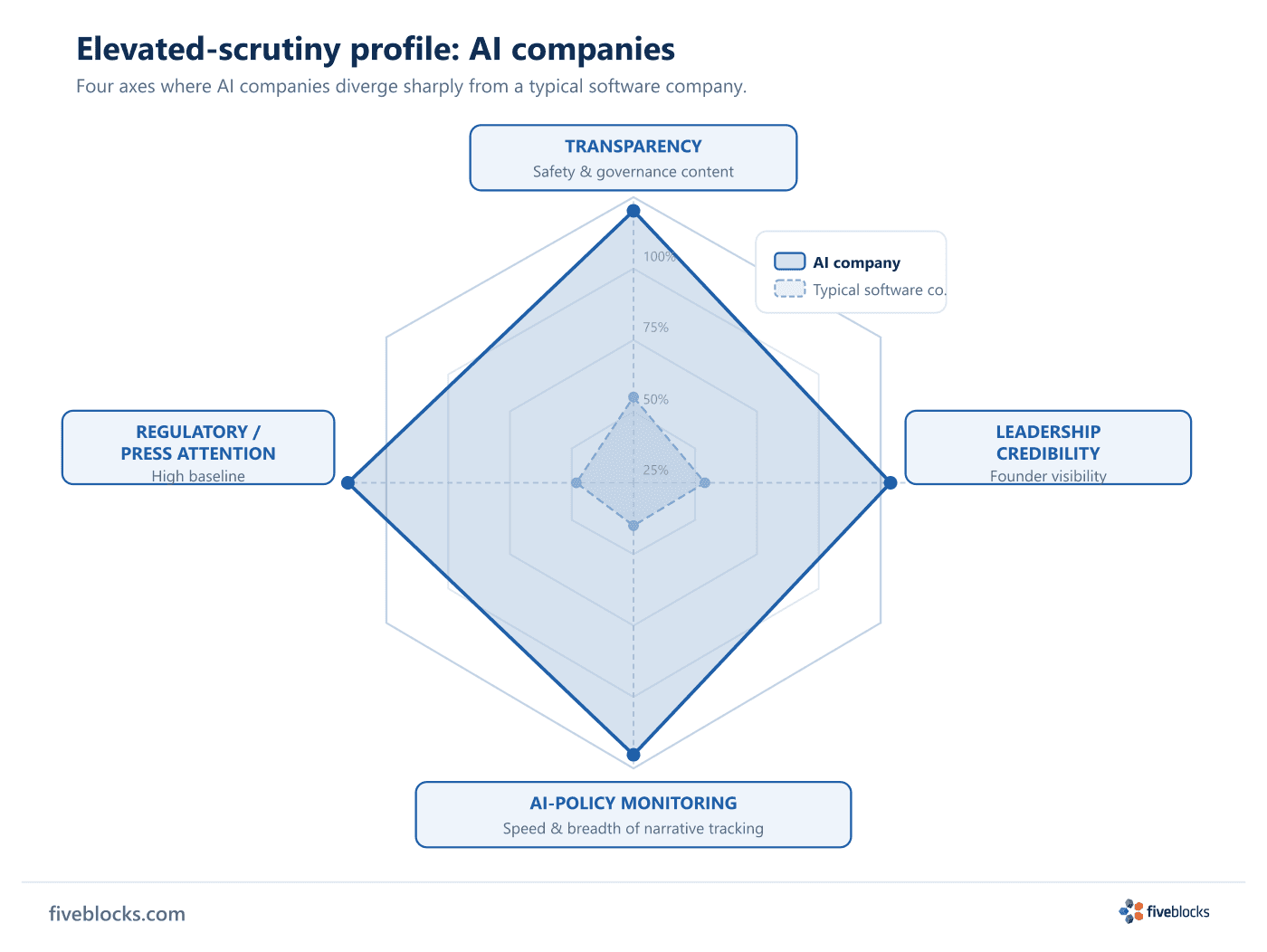
What elevated scrutiny demands
- Transparency
- Regulators, journalists, and customers are looking for specifics on governance, safety practices, and ethics commitments. Silence on those subjects reads as evasion to exactly the audiences whose trust matters most. Content in this area has to be documented and concrete; vague reassurance invites the skepticism it is meant to defuse.
- Leadership credibility
- Founders and senior leaders are the public face of the company’s trustworthiness to a degree that is unusual in software. Named leadership with a visible record of public engagement counts for more here than it would elsewhere, particularly with policymakers, the press, and enterprise buyers weighing reputational risk.
- AI-policy narrative monitoring
- AI-policy narratives move quickly, and the AI engines describe these companies constantly. Monitoring has to be active and broad. Once a major outlet folds a company into an ‘AI risk’ or ‘rogue AI’ narrative, correcting the downstream synthesis in the engines can take months. We track answers across the AI engines with AIQ™ to catch that turn early, before it compounds.
- Regulatory and press attention
- Unlike most software companies, AI firms draw regulatory and press attention without a crisis to trigger it. The information environment is adversarial by default, so the underlying work has to be in place first: authoritative content, entity signals, and source-layer quality built ahead of the scrutiny rather than assembled under it.
Last reviewed: 20/05/2026
