How do you transition from one reputation management firm to another?
Switching reputation management firms takes a structured handover: document the current state of every active program, transfer monitoring access, brief the incoming firm on priority work in progress, and run an overlap window so coverage never lapses. The biggest risk is a hard cutover that ends the old engagement before the new firm is up to speed.
Switching reputation firms carries real continuity risk. A sloppy handover can leave monitoring dark and in-progress work stranded at the worst possible time. Done properly, the transition has five elements.
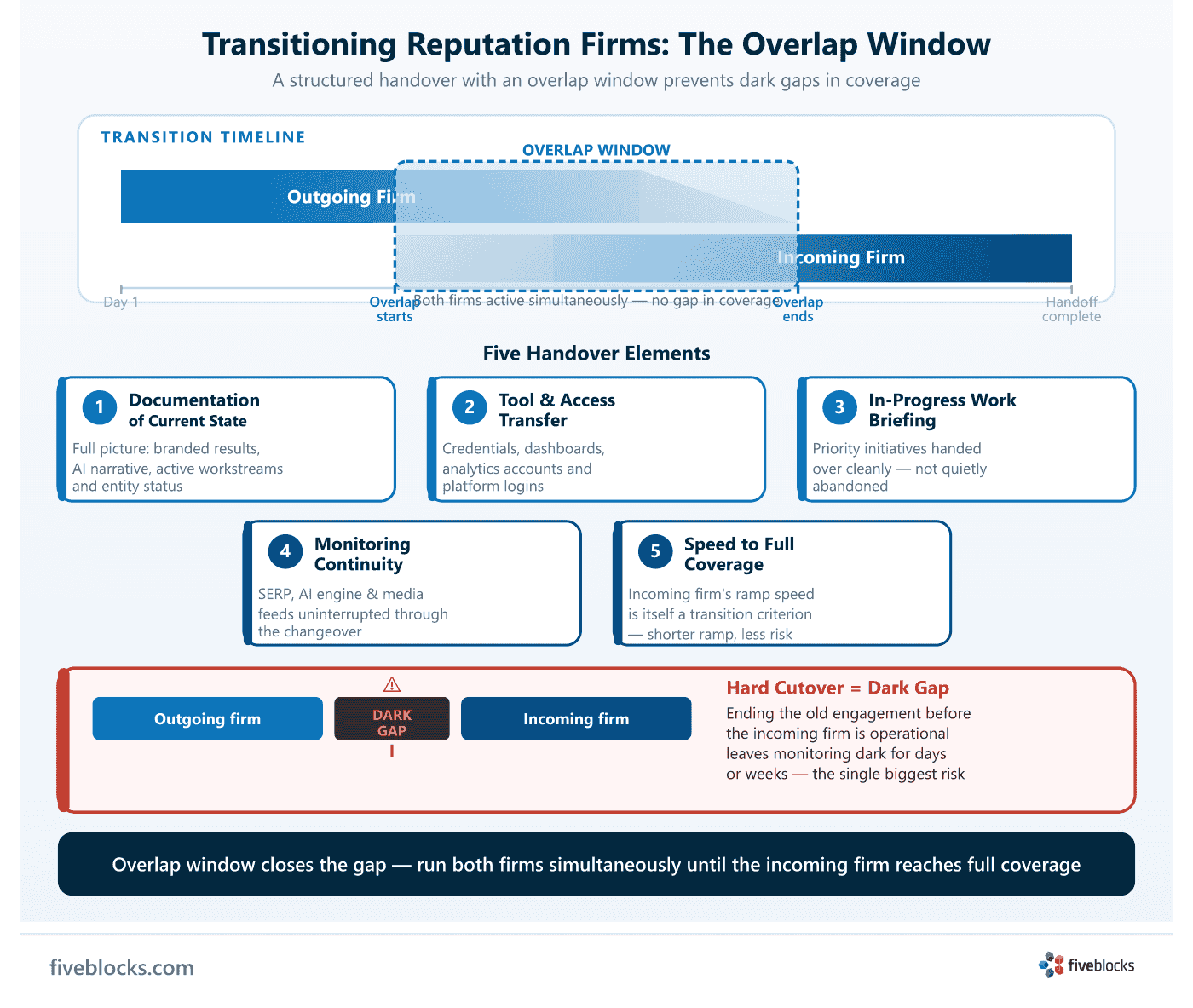
The five elements of a proper handover
- Documentation of current state: A full picture of the branded result set, the AI narrative, the Wikipedia and entity status, and all active workstreams, so the incoming firm starts with situational awareness instead of spending weeks reconstructing it.
- Tool and access transfer: Credentials, monitoring dashboards, analytics accounts, and any platform logins the outgoing firm controls change hands, or parallel coverage goes up fast enough that visibility does not lapse.
- In-progress work briefing: A frank discussion of the priority initiatives already underway, so half-finished work is either completed before the transition or handed over cleanly instead of quietly abandoned.
- Monitoring continuity: Confirmation that the SERP, AI engine, and media monitoring feeds run uninterrupted through the changeover. A dark stretch during a transition is exactly when a crisis can develop undetected.
- Speed to full coverage: How fast the incoming firm reaches full operational visibility is itself a transition criterion. The shorter the ramp, the shorter the exposure.
The failure mode: hard cutover
The biggest risk is a hard cutover, ending the outgoing engagement before the incoming firm is operational. That leaves a gap in coverage that can last days or weeks. An overlap window, even a brief one, closes it. We manage inbound transitions specifically to compress the ramp and avoid dark periods.
Last reviewed: 20/05/2026
