How do you manage reputation when transitioning from public to private sector?
The goal is to get the new private-sector role recognized without erasing the public-service record behind it. Update the authoritative bios to the new role, refresh Person schema and sameAs links so engines attach the new affiliation to the same identity, handle the Wikipedia public-service period within BLP and neutrality rules rather than scrubbing it, and monitor how each AI engine describes the person for the new counterparty, client, and peer audience.
Managing reputation through a public-to-private transition means getting a new private-sector role recognized without erasing the public-service record behind it. Search and AI engines do not sort that out on their own. These moves are common at senior levels: a former regulator joining a law firm, a former official joining an investment firm, a former military or intelligence officer joining an advisory practice. Each one has the same shape, a digital footprint heavy with public-service coverage, a new role that has to be attached to the same identity, and a new set of stakeholders asking different questions.
Engines describe a person by resolving scattered references into a single entity: an official bio, a LinkedIn profile, a Wikipedia article, press mentions. Confidence rises only when name, role, and description line up across those references. Right after a transition they often do not. The heavily-covered prior role still dominates, the new affiliation is thin, and the conflicting signals make engines hedge or lead with the outdated description. The work is to bring the signals into alignment around the new role.
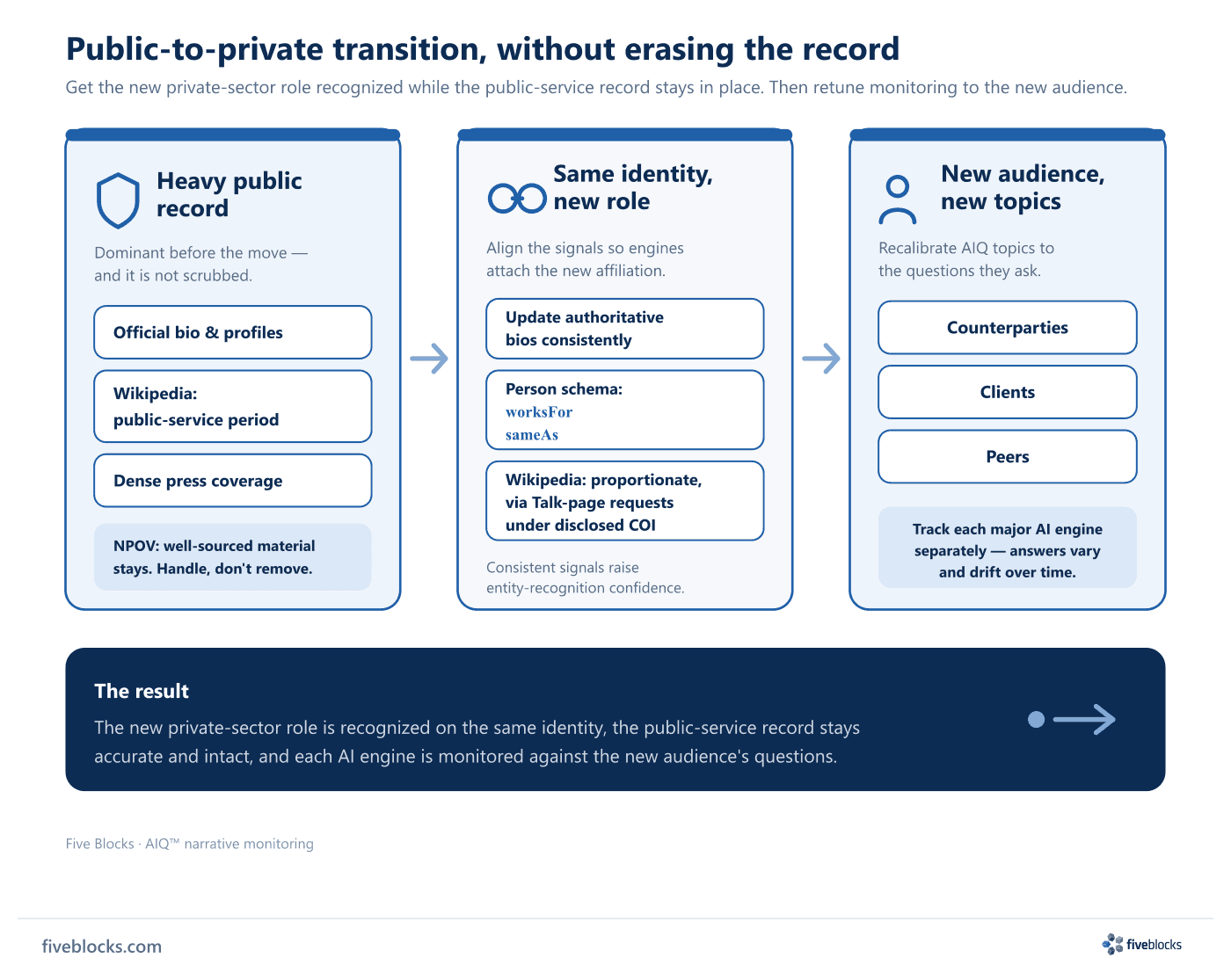
The structural steps
- Update the authoritative bios. Refresh the entity’s bio properties, the official bio page, LinkedIn, and the bio citations engines read, so the new role, title, and affiliation are stated consistently. A complete, consistent bio set is one of the main Person entity signals; inconsistent bios create conflicting signals that lower entity-recognition confidence.
- Refresh the Person schema and sameAs links. Person schema specifies attributes such as
name,jobTitle,worksFor, andsameAs, and itssameAslinks connect the bio to the person’s authoritative profiles and to their Wikidata identifier. UpdatingworksForand the linked profiles tells engines the new private-sector affiliation belongs to the same identity. Engines will not assume a website, a LinkedIn page, and a press profile are one person unless consistent descriptions andsameAslinks say so. - Handle the Wikipedia public-service period correctly. Where a Wikipedia article exists, both Google and the AI engines weight it heavily, so the public-service period has to be handled within Wikipedia’s rules rather than scrubbed. The Neutral Point of View policy does not permit removing well-sourced material, so the prior role stays. The aim is proportionate, accurate coverage that also reflects the new role, pursued through Talk-page edit requests backed by reliable secondary sources under disclosed conflict-of-interest rules. Where the prior role is itself independently notable, Wikipedia allows it a dedicated article cross-linked from the biography.
- Recalibrate monitoring to the new stakeholder set. The audience shifts from a public-service constituency to private-sector counterparties, clients, and peers, and they ask different questions. The same query can return materially different descriptions across the major AI engines, and those answers are generated fresh and drift over time, so track each engine separately against the questions the new audience actually asks.
What to expect on timing
- The effort is front-loaded. The heaviest work falls early, while the new role still has little coverage of its own and the engines are leaning on the public-service record.
- It eases as the new role earns its own footprint. AI engines weight sources by authority and recency, and recent activity contributes to ranking authority. As the new role accumulates credible third-party coverage, engines have current, well-attributed material to draw on, and the description rebalances toward the present.
- One fix does not reach every engine. Answers vary by engine and update at different speeds, so align the underlying signals once, then watch each engine resolve the transition on its own schedule.
We align the bio, schema, and Wikipedia layers around the new role, then use AIQ to monitor how each of the major AI engines describes the person for the new counterparty, client, and peer audience.
Last reviewed: 19/05/2026
